Aspects of Hahndorf's History
The emigration and voyage
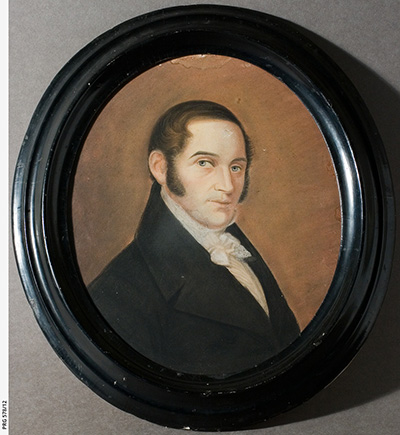
Portrait of Captain Hahn, by Hugo Carstensen, 1842, watercolour
State Library of South Australia, PRG 578/12
The first large groups of German immigrants came to Australia in 1838 under the guidance of their church leader Pastor Kavel, mainly seeking religious freedom of worship. They took on a huge challenge in leaving their homeland. They sailed to the other side of the world (almost like a journey to another planet in modern terms) and arrived in a British colony where the capital city, Adelaide, was only two years old with not much infrastructure. Before they left Europe they had to travel for three weeks on river barges from their villages in the Prussian provinces of Brandenburg and Silesia (in the east of the German-speaking lands) to the harbour of Altona (close to Hamburg).
➜ You can read more here about their voyage on river barges on canals and rivers to Altona.
A total of three ships sailed from Altona to Australia in 1838; of these, the Zebra is the most famous ship. The first two ships Bengalee and Prince George (with Pastor Kavel) arrived in Adelaide in November 1838 and the passengers established the village of Klemzig, about 6km from Adelaide. Six weeks later, the third group of German immigrants arrived in South Australia on the Zebra.
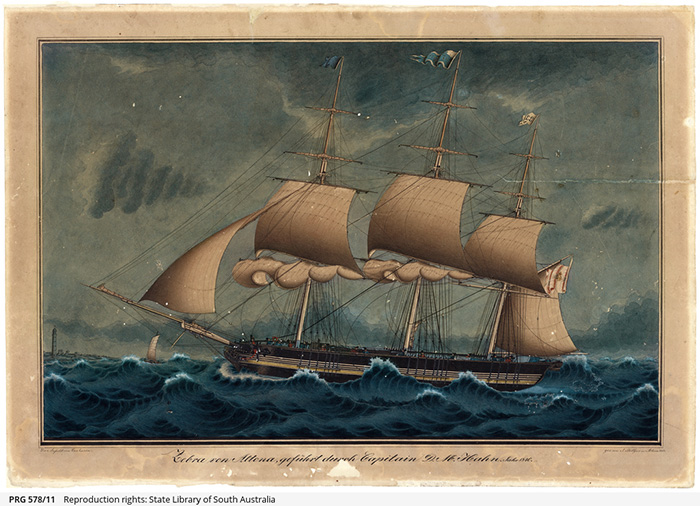
Painting of the Zebra. Text along the bottom of the frame: "Zebra von Altona, geführt durch Capitain D.M. Hahn. Jahr 1840"
Böttger, Jacob Ahrend Hinrich. 1842. (Water colour, pen and ink)
State Library of South Australia, PRG 578/11
When the owner of the ship Zebra first asked the ship's captain Dirk Hahn if he would like to sail to Adelaide, he had not even heard of the city before and had to find the necessary sea navigation charts himself in order to be sure that it'd be possible to get there. As he had previously had unpleasant experiences with emigrants on a voyage to the USA, he did not want to make the journey to Adelaide at first,[1] but he was eventually persuaded to do so. However, the emigrants had to prepare their own supplies for the long journey and organise other preparations themselves. On 12 August 1838 the Zebra finally left Altona, which is now a western borough of Hamburg, but at that time was a separate town and belonged to Denmark.
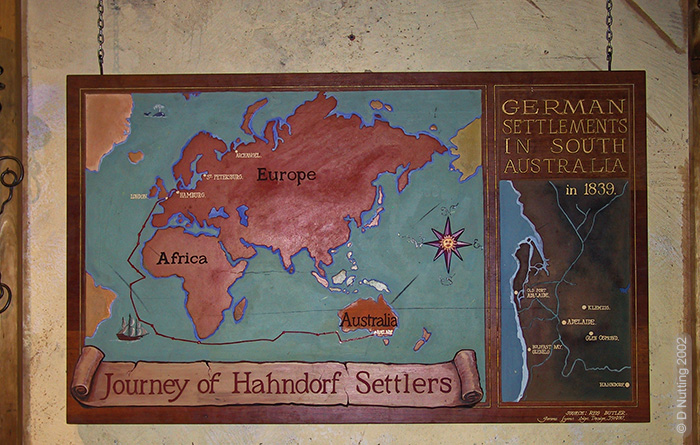
A wall display in the Hahndorf Inn, showing the route of the Zebra.
During the four-month voyage the passengers on the Zebra sometimes had petty arguments and quarrels amongst themselves and Captain Hahn occasionally had to step in and 'smooth the waters' between them. Conditions on the Zebra were difficult, as the ship was originally a cargo ship and carpenters had to modify parts of the ship in order to accommodate passengers. The food which the passengers had organised was also not very satisfactory for the voyage. Captain Hahn slaughtered his own personal pig for his passengers to eat.[2] Most of the emigrants became seasick, and the ship was struck by typhoid fever, smallpox and scurvy. Six adults and five children died en route, the other 186 passengers went ashore in Port Adelaide in good health on the 2nd January 1839.
Getting ashore near Port Adelaide was an uncomfortable experience. There were mangrove swamps and knee-deep mud. At that time it had the nickname ‘Port Misery’ - until the building of proper port facilities ships had to anchor some distance from the shore because the water was shallow. The Zebra passengers had to travel from the ship to shore in rowboats and had to wade the last part of the journey to the land. Crew members of the Zebra carried the women and children ashore by piggy-back.[3]
Port Misery, the original landing place for Adelaide, was chosen by Colonel William Light (Surveyor General for the Colony of South Australia). At the original landing place is a historical marker (at Settlers Drive, West Lakes) dedicated in 1986 "in the South Australian Jubilee 150 Year to the memory, courage, sacrifice, faith and zeal of the immigrants from Great Britain and northern Germany who landed at the old port 'Port Misery' 1837-1840 to establish and settle in the colony of South Australia" (wording on the plaque).
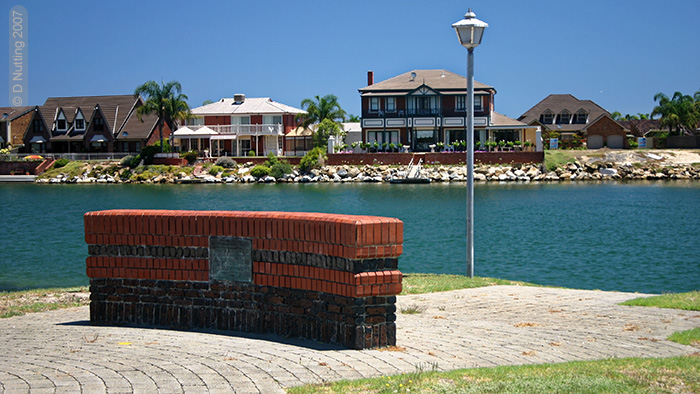
The memorial plaque at the original landing place in present-day West Lakes
During the long voyage, this group of emigrants had greatly impressed Captain Hahn. Despite their occasional quarrels, Hahn was impressed by their religious earnestness and fervent singing. He was worried about their future in a foreign land: they were poor, they did not know English, they did not know where to settle. When he heard about a newly discovered area of very fertile land in the Adelaide Hills, he visited the area himself, accompanied by English landowners. He then helped his Zebra passengers to lease about 50 hectares of land in the Onkaparinga Valley and to get some animals (cows, pigs, etc) on credit. This enabled the emigrants to establish their own settlement and live together as a community.
The emigrants were of course grateful for these offers and the assistance, and decided to name the settlement "Hahndorf" to honour Captain Hahn (Dorf = village). But that was not the end of their problems. Their land was about 30 kilometres from Adelaide, even further from the port where they were living at the time. There were no roads, hardly any paths through the mountains. They were also too poor to hire a horse and cart to transport their things. So they had to walk the long distance and carry everything themselves; only a few owned small handcarts which they built themselves. Nadia Wheatley described the challenge for the settlers as follows:
In the heat of February, the Zebra passengers set off on foot to make the fifty-kilometre trek from the landing place to their new home in the hills. As they had no horses or carts, they used a kind of relay system to transport their goods. After carrying as much as they could for a kilometre or so, they left the stuff with someone to guard it, and went back for the next lot. Little by little, walking to and fro, helping each other, they all arrived by the end of May. It would be a race against time to get some rough shelters built before the winter cold set in.[4]
Nadia Wheatley
The last Zebra passengers finally reached the new settlement of Hahndorf six months after arrival at Port Adelaide.
♦ Notes:
1. "This news hit me like a shower of cold rain." (see Hahn's description of the Zebra's voyage)
2. Kuchel (2014)
3. Schubert, David. (1997). Kavel's People. From Prussia to South Australia. Second edition. Highgate (South Australia): H. Schubert. p.77; Lodewyckx (1932), p.45; Leske (1996), p.28
4. Wheatley, Nadia. (2013). Australians All: A History of Growing Up from the Ice Age to the Apology. Allen & Unwin. p.88
♦ References:
Hahn, Dirk M. Emigrants to Hahndorf (English-language edition of Die Reise mit Auswanderern von Altona nach Port Adelaide Süd-Australien 1838). German transcription by Frank Rainer Huck, transcription revised by and translated by Lee Kersten. Adelaide: Lutheran Publishing House (now Openbook Publishers), 1989.
Kuchel, Rachel. (2014, April 10). Captain Compassion. Lutheran Church of Australia. (Online article). By the archivist of the LCA.
Leske, Everard. (1996). For Faith and Freedom: the Story of Lutherans and Lutheranism in Australia 1838-1996. Adelaide: Openbook Publishers. p.31
Lodewyckx, Prof. Dr. A. (1932). Die Deutschen in Australien. Stuttgart: Ausland und Heimat Verlagsaktiengesellschaft. pp.43-46
Tampke, Jürgen & Colin Doxford. (1990). Australia, Willkommen. Kensington NSW: New South Wales University Press. pp.30-32