Chronology
* You can search this page for a specific year or person by using the combination of the keys Ctrl F on your keyboard.

1960s
Despite the strength of the West German economy and high standard of living now enjoyed by most in central Europe, many Germans (and Austrians and Swiss) were still attracted to Australia. Some saw it as a place of wide open spaces (unlike their crowded homeland) and new opportunities, for example Wolf Blass, the mega-successful South Australian wine maker who arrived in 1960 after qualifying as a winemaker in Germany. In 1982 Blass told the German magazine DER SPIEGEL:
Nothing would attract me back to Europe and its limited possibilities. Germany cannot offer me the freedom which I enjoy in Australia, both personally and as an entrepreneur.
- Wolf Blass
It's estimated that about 135,000 Germans emigrated to Australia between 1950 and 1975.
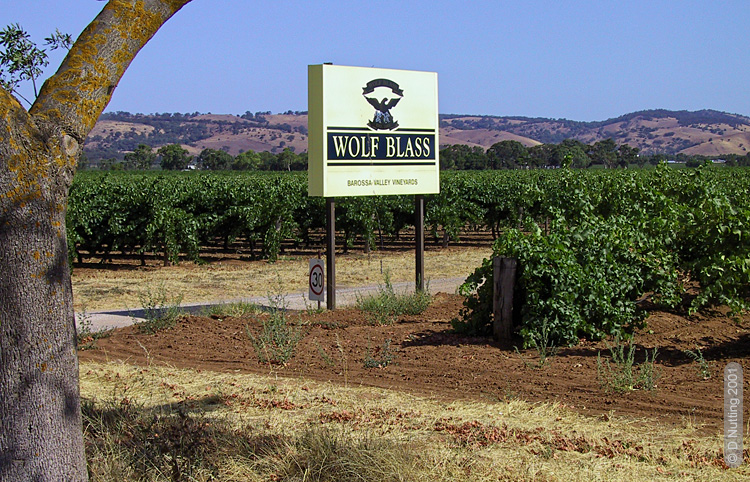
Wolf Blass vineyards in the Barossa Valley, South Australia
1960
On the 24th May the (new, post-WWII) Republic of Austria appointed its first Envoy Extraordinary to Australia (Dr. de Comtes). On the 17th March 1964 Austria decided to upgrade its legation in Australia to an embassy and on 17th July 1964 the first ambassador, Dr. Reitbauer, arrived in Canberra.
1970s
With the worldwide economic recession of the 1970s and higher unemployment in Australia, immigration numbers were reduced and authorities became more selective. Immigrants bringing capital and entrepreneurial skills were in demand.
1972
On the 22nd December the German Democratic Republic (East Germany) opened its embassy in Canberra. This followed the decision of Gough Whitlam's new government to establish diplomatic relations with China, East Germany and North Vietnam; the Whitlam government wanted a "more independent Australian stance in international affairs". In June 1974 the Minister for Foreign Affairs Senator Willesee said:
The first duty of Government is to recognise and comprehend the world as it actually is, not as we might conceive or wish it to be.
- Senator Don Willesee, in a speech to the Australian Institute of International Affairs
1978
In January 1978 the German immigrant Paul Robert Neumann established a micronation called ‘The Sovereign State of Aeterna Lucina’ in New South Wales, initially at Byron Bay and later at Cooma. He called himself Baron Neuman of Kara Bagh, designed a flag and created military-style medals - he wore large medals on his chest. In a pamphlet entitled A Promised Land he promoted his micronation and advertised for people to buy into his new country, a land of ‘unspoiled mountain character’. One West German, a computer technician named Günter Frick, paid a lot of money to buy land and become a member of Neuman’s new community. His motivation was a common one among Germans emigrating to Australia in that era: he was ‘sick of hearing about nuclear missiles, the daily poisoning of the environment and ruthless corporations’. The Australian government did not recognise Aeterna Lucina as an independent territory, and eventually Neuman was charged with fraud. Aeterna Lucina faded away when Neuman passed away in the 1990s.
1980s
In this decade there continued to be German-speakers who came to Australia
in the belief that they would be safer here than in Europe in the event of the
Cold War becoming a nuclear one. German immigrants in the 1980s were usually
well-off, and according to Australia's Immigration Office in Köln the main reasons
for German emigrants' interest in Australia were: danger of war, growing unemployment,
overcrowding in Germany's big cities, high housing costs and Australia's weather.
➜ More about social reasons for people from the German-speaking countries emigrating to Australia...
1980
In April the Australian government granted political asylum to Heidi Giersch, a ballet-dancer touring Australia with the East German ensemble Komische Oper. This is only the second occasion since World War II when the government has granted political asylum (the first was the Petrov Affair in 1954) and it caused quite a stir. It was probably a political protest act directed against the European communist countries at a time when Russia had recently invaded Afghanistan and when the Australian government had decided against joining the US-led boycott of the Moscow Olympic Games.
1997
A comprehensive reader survey conducted by Germany's premier travel magazine, GLOBO revealed that Australia was the favourite travel destination for German tourists in 1997.