Aspects of Hahndorf's History
The Hahndorf women walkers
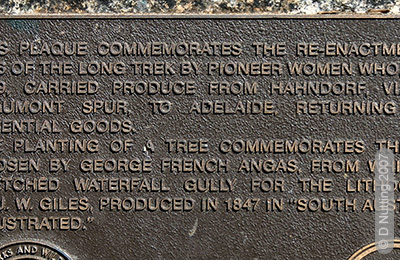
A plaque commemorating the women walkers of Hahndorf (detail)
In order to earn money to pay off their ship and land debts, many of the Hahndorf men (and sometimes whole families) left the village to work for wealthy British landowners clearing the bush and building fences. Many of the German women therefore had to work alone on their small farms, raising animals and vegetable gardens, and making butter and cheese.
Conditions in the colony of South Australia, which was only two years old, were difficult. Animal transport was scarce and food was generally poor in quality and expensive since almost everything had to be imported from other colonies in the east of Australia (New South Wales and Tasmania). Most of the English settlers in the Adelaide area did not have much experience in agriculture, unlike the German immigrants, who soon produced more food than they needed for themselves.[1] So the German women of Hahndorf found it easy to sell their fresh vegetables and dairy produce in Adelaide. However, they had to carry it themselves in baskets on their backs, or suspended from yokes across their shoulders, all the way to Adelaide. They soon became known as ‘the Hahndorf walkers’. A memorial to them in the Pioneer Gardens in Hahndorf describes their walk to Adelaide this way:
The women and older girls would leave Hahndorf at midnight and follow a 35km winding track through dense bush to arrive at Beaumont at 4 o'clock in the morning. Here they rested by a creek and often sang Lutheran hymns before walking on to Adelaide to sell their produce. On the homeward trek they carried their money along with household goods such as sugar, tea, coffee, needles and sewing thread and tobacco for their menfolk. They also carried stout sticks to ward off thieves! (…) This memorial honours the German women of Hahndorf whose courage and perserverance helped South Australia prosper in its early years.
Information board in the Pioneer Gardens
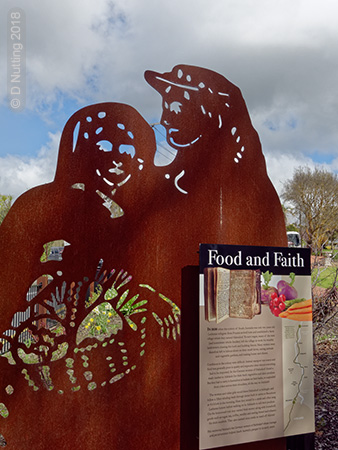
Information display about the women walkers, in the Pioneer Gardens of Hahndorf
The German women walked barefoot in order to save shoe leather, and as they walked back up the hill, they also carried two bricks each for building their church in Hahndorf. These night walks to Adelaide to sell produce at the city market continued into the late 1850s. The route taken by the Hahndorf walkers was rediscovered by the local branches of the National Trust of South Australia and Walking SA in 1980. They launched the Pioneer Women’s Trail in 2007, a walking track that closely follows most of the original route. It follows country roads, laneways and bush tracks through parts of the Adelaide Hills.[2]
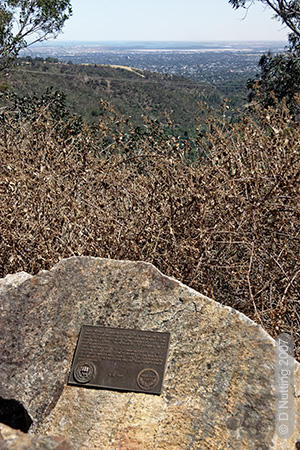
Memorial plaque along the route down to Adelaide taken by the Hahndorf women walkers
Part of the text on the plaque reads: "This plaque commemorates the re-enactment in 1986 of the long trek by pioneer women who, from 1839, carried produce from Hahndorf, via the Beaumont Spur, to Adelaide, returning with essential goods."
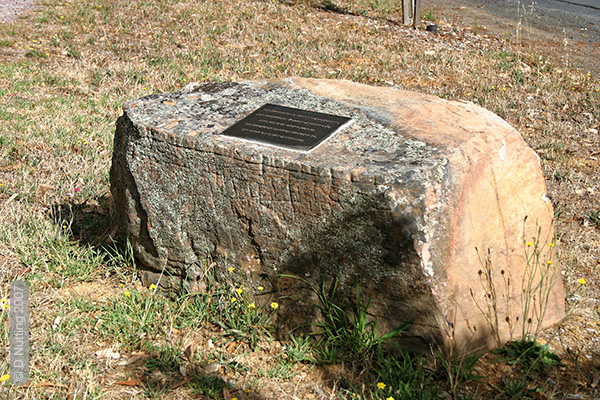
Memorial plaque about the Hahndorf women walkers, in Main Street
The text on the plaque in the photo reads: "This avenue of 54 trees commemorates the pioneering women of Hahndorf and the part they played in the provision of fresh produce to the early settlers of Adelaide."
The women of Hahndorf were active in a wide range of tasks that were important for their new settlement. Anni Luur Fox listed them in her book about Hahndorf:[3]
One can only have the greatest admiration for the strong-willed women of Hahndorf. They worked alongside their men in the fields, ploughing, sowing and harvesting; they were hired by other farmers in the district to shear sheep; they tended the vegetable gardens and carried the produce on foot to Adelaide; they milked the cows, helped build the houses, kept them clean, cooked, bore the children – the list is endless.
Anni Luur Fox
♦ Notes:
1. Harmstorf, Ian. (1994). German Settlement in South Australia to 1914. In: Insights into South Australian History, vol. 2, South Australia’s German History and Heritage. Historical Society of South Australia Inc. p.18; Young, G., Harmstorf, I., Brasse, L., Marsden, A. (1981). Hahndorf survey Vols 1 & 2. [Survey for the Australian Heritage Commission] Adelaide: Techsearch. p.118
2. National Trust of South Australia. (2017). Pioneer Women's Trail. Information brochure.
3. Fox (1982), p.23
♦ References:
Fox, Anni Luur. (1982). Hahndorf - a brief look at the town and its history. (Revised edition). Hahndorf: Fox Publishing Pty Ltd.
Fox, Anni Luur. (2005). Pioneer Women's Trail - History. Adelaide Hills localwiki. (Online article)
Lodewyckx, Prof. Dr. A. (1932). Die Deutschen in Australien. Stuttgart: Ausland und Heimat Verlagsaktiengesellschaft. p.46
"UNWRITTEN CHAPTERS." (1928, January 28). The Register (Adelaide, SA : 1901 - 1929), p. 9. Retrieved August 18, 2022, from <nla.gov.au/nla.news-article55069716>. The report consists largely of an article by Pastor Alfred Brauer - the article includes a paragraph about the women walkers.