Aspects of Hahndorf's History
Heritage vs Tourism
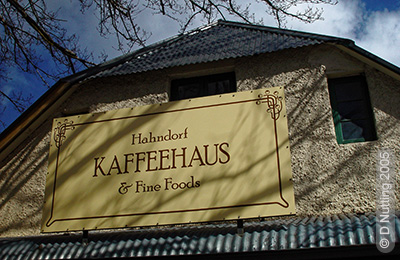
'Kaffeehaus', Hahndorf
In the 1960s and 1970s Hahndorf became a popular tourist destination, especially as it was an easy day-trip from Adelaide. The Princes Highway used to carry traffic through the middle of Hahndorf, long-distance traffic travelling from Adelaide to the south-east of the state and to Victoria. When the South East Freeway by-passed Hahndorf in 1972 and removed that long-distance traffic from the centre of Hahndorf, the Main Street became even more attractive to visitors.
,_The_German_Village_Shop_--_2019_--_0691.jpg)
Shop “The German Village Shop”, Hahndorf (2019)
Photo: Wikimedia Commons / Dietmar Rabich, Hahndorf (AU), The German Village Shop -- 2019 -- 0691, CC BY-SA 4.0
Many shops and restaurants focus on German products and German food, and emphasise German cultural traditions and artefacts that come from southern Germany (rather than the regions of north-eastern Germany where the original settlers came from), because they are the cultural characteristics which most Australians easily associate with Germany.
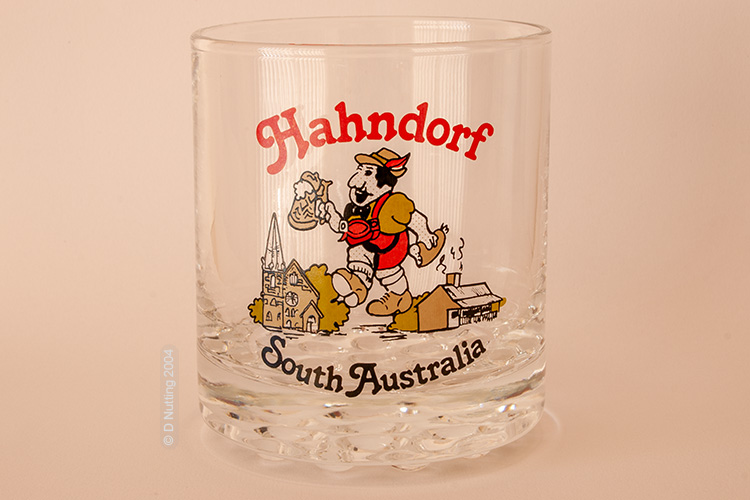
The German character depicted on this souvenir glass sold in Hahndorf is dressed in tradional clothing of southern Germany rather than north-eastern Germany.
At times in the 1970s and since then, there has been tension between efforts to exploit Hahndorf’s tourism needs and efforts to preserve the appearance of historic streetscapes and heritage buildings. Some locals have been concerned that too much development will spoil the historic look of the town. In her book Hahndorf : a journey through the village and its history Anni Luur Fox described the 1970s as a decade of particularly hard work for people in Hahndorf who wanted to protect the local heritage buildings from demolition.[1]
On 14th June 1978 the Mount Barker Courier published a cartoon with accompanying article that playfully suggested a solution to the conflict between, on the one hand, the needs of tourists and tourism-dependent businesses in Hahndorf, and on the other hand, the needs of local residents in Hahndorf who value peace and quiet in their historic village.
The cartoon and article suggested that a replica of Hahndorf be created close to the centre of Adelaide including as many German things as possible (even if they don’t reflect the Prussian/Silesian culture of the original founders of Hahndorf!).[2]
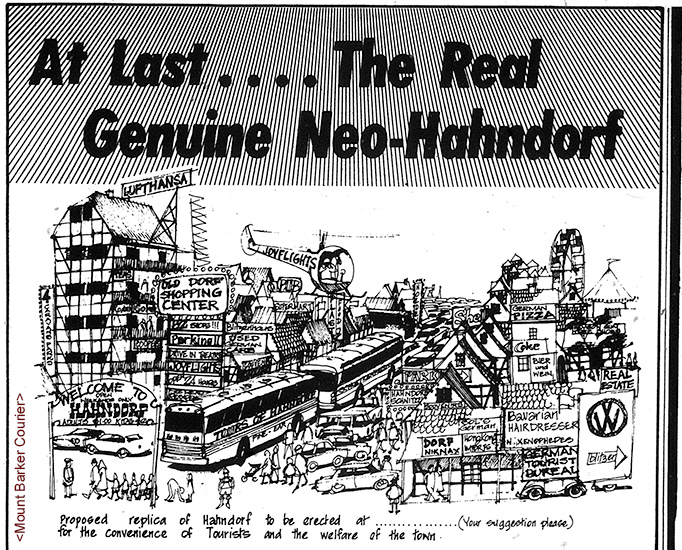
Cartoon showing the "Neo-Hahndorf".
The cartoon appears here with the permission of The Courier newspaper (editor I.J. Osterman) and of the State Library of South Australia.
The tongue-in-cheek article underneath the cartoon in The Courier included the following text:
At last – the real, genuine, Neo-Hahndorf! There has been an increasing conflict in recent years between the needs and requirements of Hahndorf’s residents and the demands of the hordes of tourists who descend on the town every weekend. In the midst of the conflict, the historic German character is in serious danger of being crushed and forgotten. (Allegedly a Hahndorf resident and Courier reader, Mr N.H. Noble suggested THE NEO-HAHNDORF!) Says Mr Noble – “Full use could be made of pseudo-Bavarian (Prussian-Silesian) architecture to create a piece of colourful Colonial history right there in the centre of Adelaide.”
Some shop-owners in Hahndorf give their shop a name which they feel matches the German character of Hahndorf, for example, “Das Kaffeehaus”. On at least one occasion, the attempt to use a German name didn’t work out. Stammtisch is a German word meaning ‘regulars table’, and refers to a group of people who meet regularly on an informal basis, and it can refer to the table at which they sit. Outside of Europe’s German-speaking countries there are many German-themed restaurants, bars and pubs with the name Stammtisch in various countries. This photo shows a bar and restaurant in Hahndorf whose owners made a mistake with the spelling of the name on the sign. The sign is no longer there.
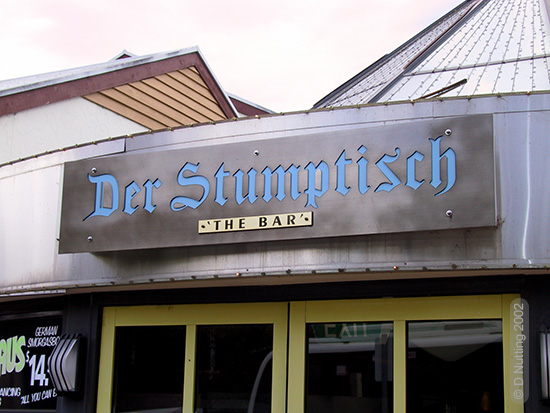
Sign above the entrance to the bar named Der Stumptisch
In a German-language travellers’ online forum a German backpacker with the username ‘Struzinelle’ responded to a post about the ‘Stumptisch’ sign – she wrote (here in English translation): “We were also in Hahndorf in 2002 and had a giggle about a "German" pub called "Stumptisch". :D”[3]
The Government of South Australia zoned Hahndorf as a state heritage area in 1988. Nevertheless, conflict between pro-development interests and heritage interests occasionally occurs in present-day Hahndorf. John W., a resident of Mylor in the Adelaide Hills, wrote a letter to the Adelaide Hills regional newspaper (The Courier) in September 2018 criticising Mount Barker Council's plan to alter an old stone building in Hahndorf's main street. He wrote: "Hahndorf sells itself as a heritage town. The people who are attracted here come to see a very early German/Australian settlement… a little of how Australia once was."[4]
'Our Heritage At Risk' was a national program of National Trusts in Australia intended to raise awareness of heritage issues in Australia, and in 2014 the program's website claimed that: “Hahndorf is at peril of losing its cultural integrity to tourism. The main street suffers from visual clutter with too many signs. Inappropriate buildings have been approved (…)”[5]
The Lonely Planet guidebook for Australia had some positive comments about Hahndorf in 2017:[6]
Like The Rocks in Sydney, and Richmond near Hobart, Hahndorf is a ‘ye olde worlde’ colonial enclave that trades ruthlessly on its history: it’s something of a kitsch parody of itself. That said, Hahndorf is undeniably pretty. (…) It’s also slowly becoming less kitsch, more cool: there are a few good cafes here now.
Lonely Planet Australia, 2017
A book about historic Australian towns concludes about Hahndorf: "Despite the pressures of tourism Hahndorf manages to retain a European character which distinguishes it among Australian towns."[7]
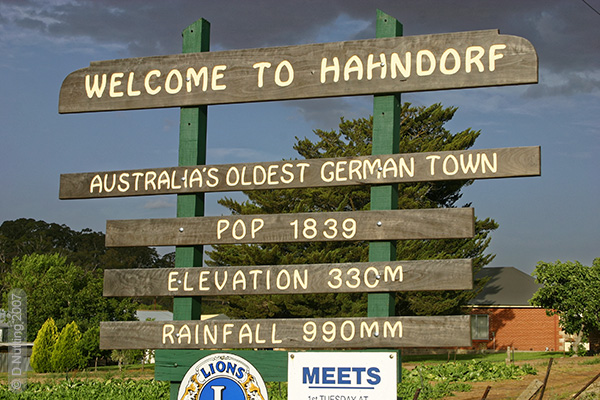
A roadside sign welcoming visitors to Hahndorf
♦ Notes:
1. Fox (2002), p.46
2. Mount Barker Courier - the cartoon appears here with permission of the editor, Ian Osterman. Personal communication (phone) 05/11/2019.
3. The blog is no longer publicly viewable.
4. The Courier, 05/09/2018, p.6 (newspaper of the Adelaide Hills)
5. The National Trust. Our Heritage At Risk (page archived on the 14th February 2014 at the Internet Archive)
6. Atkinson, Brett et al (Lonely Planet Publications Staff). (2017). Lonely Planet Australia. Lonely Planet Publications. pp.738-739.
7. Morrison, Robin. & Irving, Robert. (1998). Reader's Digest Book of historic Australian towns. (2nd ed.) Surry Hills (NSW). p.160
♦ References:
Fox, Anni Luur. (2002). Hahndorf : a journey through the village and its history. Hahndorf (S. Aust.) : Anni Luur Fox.