Aspects of Hahndorf's History
Some higher profile Hahndorf connections
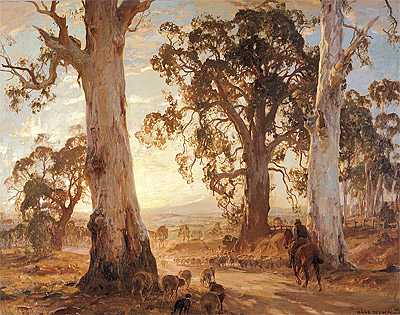
Hans Heysen, Droving into the light, 1914–21
State Art Collection, Art Gallery of Western Australia.
Image source: Wikipedia, public domain
Hans Heysen
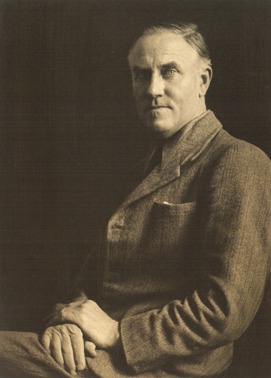
Photographic portrait of Hans Heysen by Harold Cazneaux taken in 1935
Photo source: Wikimedia Commons. Public Domain.
Wilhelm Ernst Hans Franz Heysen (1877-1968) was one of Australia's most popular landscape painters. He is particularly well-known for his landscape paintings with majestic gum trees. From 1908 onwards he and his wife lived close to Hahndorf and he also produced drawings of some of Hahndorf’s old farm buildings and its older settlers. 'The simple old-fashioned German village and the magnificent gum trees in the surrounding countryside that attracted Heysen was a landscape painter’s dream.'[1]
Hans Heysen won Australia's Wynne Prize for landscape painting nine times between 1904-32.
In 1897-98 (about 10 years before he moved permanently to Hahndorf) Heysen produced an oil painting of one of the historic half-timbered German houses at Friedrichstadt, close to Hahndorf. This painting is in the collection of the Art Gallery of South Australia, and is entitled At Friedrichstadt, near Hahndorf. (The name Friedrichstadt is a historical name and fell out of use many decades ago – the locality is generally known as Paechtown.) You can view Heysen’s painting At Friedrichstadt, near Hahndorf at the website of the gallery.
You can read more info about his painting Droving into the light at the website of the Art Gallery of Western Australia.
You can read more about Hans Heysen here...
Matthew Jaensch
Matthew Jaensch played Australian Rules Football for the club Adelaide Crows in the national league (AFL) from 2010-2016. Er played 74 games for the Crows. Jaensch was born in Hahndorf and played junior football for the Hahndorf Football Club (the 'Hahndorf Magpies') in the local Hills Football League.
Matthew Jaensch played at the Adelaide Crows with Simon Goodwin (a descendant of the famous German family of Friedrich Herbig). The 2010 season was Jaensch's first season and Goodwin's last season. When Jaensch retired from the AFL, he returned to his hometown to play on for the Hahndorf Magpies.
The surname Jaensch is among the names listed on the archway of the Pioneer Memorial Gardens in Hahndorf - the names of the 52 founding families from 1839.
'Hans of Hahndorf'
The 'Coodabeen Champions' (often referred to as "The Coodabeens") are an Australian comedy team with radio programs. These broadcasts began in 1981. A popular segment of each show is called Torch's Footy Talkback (“Torch” = Jeff "Torch" McGee, a member of the Coodabeens). This is a fictional talk radio segment, with callers phoning in with various football questions, rumours or thoughts, often in the form of humorous and subtle references to football personalities.[2]
The fictitious callers include among others: "Stan the statistician from Stradbroke Island", "Col from Cabramatta", "Helen from Healesville", "Pearl from the Peninsula" and "Hans from Hahndorf". “Hans from Hahndorf” is a big fan of the club Adelaide Crows. In the Coodabeens Footy Talkback of June 24, 2017, "Hans" began his phone call with the German greeting "Wie geht's?", and expressed his great admiration for the former South Australian footballer Malcolm Blight.
Coincidentally, a newspaper article about the painter Hans Heysen in The Mail in 1913 carried the heading ‘Hans from Hahndorf’.[3]
Ulrich Hübbe
Dr Ulrich Hübbe, born in Hamburg, became a lawyer after studying at three German universities. He arrived in South Australia in 1842. Although he wasn’t a member of parliament, his knowledge of the land property laws of north German cities helped him to make a valuable contribution to the drafting of an important law that the South Australian parliament passed in 1858. This law, sometimes known as the Torrens Title Act, was copied by several other countries. Hübbe died at Mount Barker in 1892 at the age of 86, and his grave is in the Hahndorf cemetery. You can read more here about Dr Ulrich Hübbe.[4]
Philip Nitschke
Philip Haig Nitschke (born 8 August 1947) is an Australian author, former physician, and founder and director of the pro-euthanasia group Exit International. He is known internationally for his advocacy for voluntary assisted dying laws.[5] His great-great grandfather Friedrich Wilhelm and great-great grandmother were among the founding families of Hahndorf.[6]
Friedrich Wilhelm Nitschke was from the village of Kay, in the Prussian province of Brandenburg. He was a mason and aged 35 when he came to South Australia in the ship Zebra, under the command of Captain Dirk Hahn. Nitschke and his family were among the founding settlers of Hahndorf. With Nitschke came his wife Maria Elisabeth (nee Süss), aged 35, and their three children: Johann Karl (aged 10), Johann Wilhelm (8), and Johanne Karoline (6).[7]
➜ You can view a page of photos of memorials and signs of the German legacy in Hahndorf here.
♦ Notes:
1. Andrews, Rebecca & Art Gallery of South Australia. (2008). Hans Heysen. Adelaide: Art Gallery of South Australia. p.6
2. Wikipedia contributors. (2022, June 16). Coodabeen Champions. In Wikipedia, The Free Encyclopedia. Retrieved July 30, 2022, from this page.
3. HANS OF HAHNDORF. (1913, May 3). The Mail (Adelaide, SA : 1912 - 1954), p. 8. Retrieved August 18, 2022, from <nla.gov.au/nla.news-article58514238>
4. Leske, Everard. (1996). For Faith and Freedom: the Story of Lutherans and Lutheranism in Australia 1838-1996. Adelaide: Openbook Publishers. pp.125-126
5. Wikipedia contributors. (2022, June 19). Philip Nitschke. In Wikipedia, The Free Encyclopedia. Retrieved August 28, 2022, from <https://en.wikipedia.org/w/index.php?title=Philip_Nitschke&oldid=1093852101>
6. Nitschke, Philip Haig. & Corris, Peter. (2013). Damned if I do. Carlton, Victoria : Melbourne University Press. (Chapter Two)
7. Iwan, W. & Schubert, David A. (1995). Because of their beliefs : emigration from Prussia to Australia. Highgate (South. Australia) : H. Schubert. p.77
♦ References:
Tampke, Jürgen. (2006). The Germans in Australia. Port Melbourne (Victoria): Cambridge University Press.