Aspects of Hahndorf's History
The early 1900s
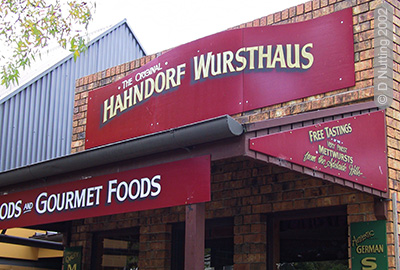
Hahndorf Wursthaus
The famous landscape artist Hans Heysen (born in Hamburg in 1877, named Wilhelm Ernst Hans Franz Heysen) and his wife Sally moved to Hahndorf in November 1908, and in 1912 they were able to buy 'The Cedars', an established colonial home in 15 hectares of land just outside Hahndorf. Heysen produced drawings of some of Hahndorf’s old farm buildings and its older settlers. He became most famous for his paintings of landscapes featuring majestic eucalyptus trees.
Up until the First World War, the Hahndorf area was still mainly populated by German families, both new immigrants and those of German descent.[1]
In Australia during World War I patriotism, and the desire to feel involved with the war effort, often led to anti-German feelings. Professor John Molony described it as follows in his history of Australia:
Patriotism in many guises gripped scoundrels and the decent alike. Anyone or anything to do with Germany, whether person, place or product, suffered discrimination or internment, name change or rejection.[2]
John Molony
Hans Heysen was under police surveillance at Hahndorf during the war, as the police in Adelaide thought he might be disloyal to Australia, simply because he was born in Germany. The police did not find any evidence of this. ‘Heysen had given generously to the South Australian wounded soldiers' fund, but police thought it was just a ruse.’ The Art Gallery of New South Wales conspicuously left Heysen out of a major 1918 exhibition of work by Australian artists. However, Heysen’s paintings continued to be very popular after World War I.[3]
Hahndorf was one of 69 South Australian place names “of enemy origin” which the state government changed during World War I. The name was changed to Ambleside, which was the name of a small railway stop two kilometres from Hahndorf.
On display at Hans Heysen’s studio visitors can see envelopes containing letters written to Heysen during those years – the address is ‘Ambleside’.
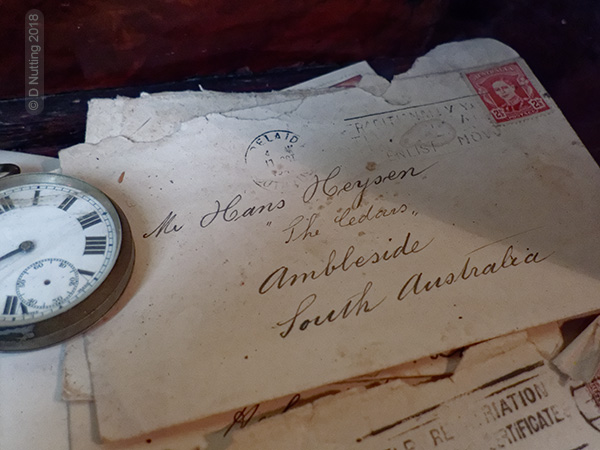
Letter addressed to Hans Heysen, at Ambleside (rather than Hahndorf)
In 1936 the South Australian government changed a few place names back to their original German names, as a gesture of reconciliation for the 100th anniversary of the founding of the state. Ambleside was changed back to Hahndorf.
♦ Notes:
1. Young et al. (1981), p.215
2. Molony, John N. (1987). The Penguin bicentennial history of Australia : the story of 200 years. Ringwood, Vic : Viking. p.221
3. Royal (2017)
♦ References:
HANS OF HAHNDORF. (1913, May 3). The Mail (Adelaide, SA : 1912 - 1954), p. 8. Retrieved July 26, 2022, from <nla.gov.au/nla.news-article58514238>
Royal, Simon. (2017, March 5). Artist Hans Heysen suspected of treachery during World War I. ABC News (online article).
Young, G., Harmstorf, I., Brasse, L., Marsden, A. (1981). Hahndorf survey Vols 1 & 2. [Survey for the Australian Heritage Commission] Adelaide: Techsearch.