Aspects of Hahndorf's History
Buildings and architecture
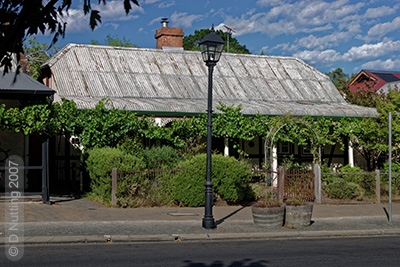
House #75, Main Street
As soon as the Germans arrived, they, like their fellow English colonists, had to improvise and manage with whatever materials were available. Timber from their packing cases, stones, mud, branches and grass were common building materials with which they constructed their first basic huts.[1]
The village had a distinct foreign appearance compared to the streets of Adelaide. A few years after the founding of Hahndorf the residents planted shade trees along both sides of the main street, which was a tradition well known in Silesia, and which gave the street an intimate character.[2]
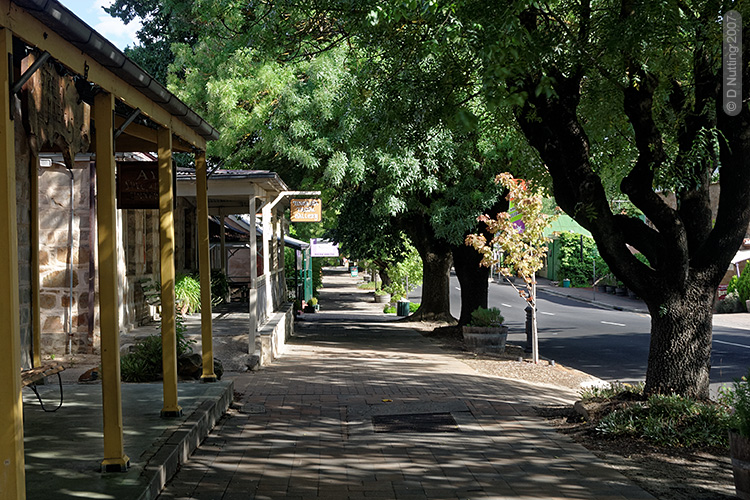
Tree-lined Main Street, Hahndorf
The appearance and construction-style of the houses built in Hahndorf in the first 10-15 years of the village reflected the style of homes in the north-eastern part of German-speaking Europe from which the settlers had come. The house design used in German villages and on German farms in South Australia was distinctive for at least 30 years after the arrival of the first German migrants.[3] English travellers who visited Hahndorf from Adelaide commented on the ‘exotic’ and distinctive style of the architecture in Hahndorf compared to the homes built by the English colonists. Houses such as these still exist in Hahndorf, most notably at Paechtown, close to Hahndorf. The historic homes in the Hahndorf area were often built in the Fachwerk-style (half-timbered) – there was a strong timber frame of beams that ran vertically, horizontally and diagonally (occasionally with curved diagonal beams) and the spaces between the beams were filled with brick. ‘The construction of these buildings required a high degree of skill and craftsmanship.’[4] ‘From humble beginnings in 1839 to its architectural peak in the eighteen fifties, a true Hahndorf style emerged which remained unequalled anywhere in Australia.’[5]
At Paechtown, a hamlet close to Hahndorf, examples of these historic German buildings include Paech Cottage, built around 1853 by Johann Gottlob Paech. It is a three-level house with a stone basement (cellars) and an upper structure of a half-timbered frame with hand-made red bricks filling out the spaces between the outer-walls' timber beams, and a half-hipped (or 'jerkinhead') timber-shingle roof. You can read more about the Paech family and this house here.
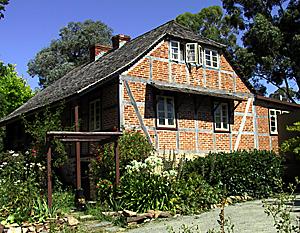
J.G. Paech's house at Paechtown
Johann Georg Häbich, born in Stuttgart-Botnang in 1813, arrived in Port Adelaide with his wife and three children on the ship Heerjeebhoy Rustomjee Patel. As a blacksmith he shoed horses, made nails, nuts and bolts and farm implements. Häbich's cottage is "one of the rare examples of fine German craftsmanship in Australia."[6] The decorative cast-iron lacework elements of the veranda add an Australian touch.
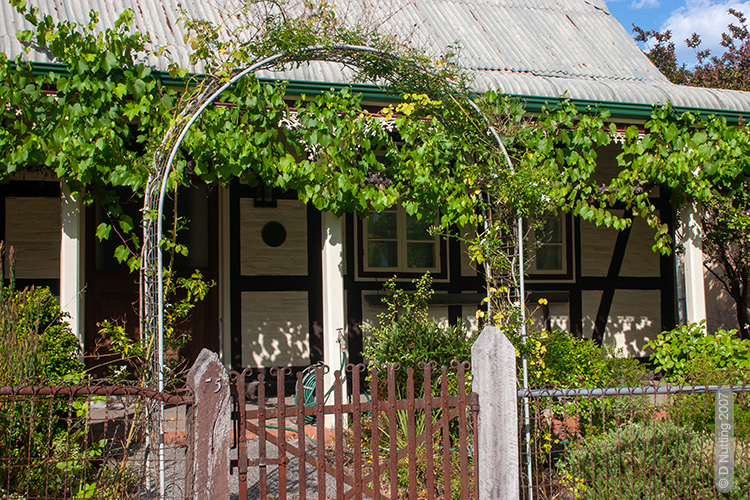
Haebich's cottage at #75 Main Street
The in-fill spaces between the structural beams of Fachwerk barns in Hahndorf were usually filled with wattle and daub rather than brick. In wattle and daub vertical wooden stakes (called in German Stakhölzer, or Staken) were usually placed in the spaces between the beams and a mixture of chopped straw and mud was packed into the spaces. Then a coat of whitewash was applied on the outside for protective and decorative reasons.[7]
Visitors' opinions
The writer Edward Hallack travelled through southern districts of South Australia in the early 1890s, and a series of 25 articles about his travels appeared in the South Australian Register and in the Adelaide Observer. He was impressed by the homes in Hahndorf, and wrote:
Nothing prettier and more foreign to our Adelaide and suburban 'square' style of architecture could possibly be imagined.
Edward Hallack
Hallack described the construction method: "Thatch for roofing, with brick walls intersected with gum-framing, V-shaped, horizontal and other shaped walled lacings" and wrote that "These 'German ideas' in building are well worthy of imitation and adaptation in many other localities".[8] In 1883 a reporter for the Adelaide Observer described Hahndorf as: "…that pleasantly-situated, young, but ancient looking, thoroughly German town of Hahndorf."[9]
Reimann/Mooney barnhouse
A farm building built and occupied by the Reimann family for several decades in the 1800s is unique in the Hahndorf area. It is on Schroeder Road about 3km east of Hahndorf and is usually known as Mooney’s barn-house (after the Mooney family that bought it in 1895). In 2004 Anna Pope & Claire Booth wrote a heritage report for the District Council of Mount Barker Heritage Survey, and they wrote that Mooney’s barn-house “is South Australia’s most significant surviving large-scale German barn-house and has vital associations with the early agricultural and cultural development of the State.”
Carl Friedrich Eduard Reimann built the house soon after he took up the land in 1854. It is a rare example in Australia of a German farmhouse that houses the farming family and some of their livestock under the one roof (known in German as a Wohnstallhaus or an Einhaus). Pope and Booth wrote: “There is no known comparable example of a barn-house on this scale anywhere in Australia.”[10] Mooney’s barnhouse is similar to the barnhouses usually found in many parts of northern and central Europe.
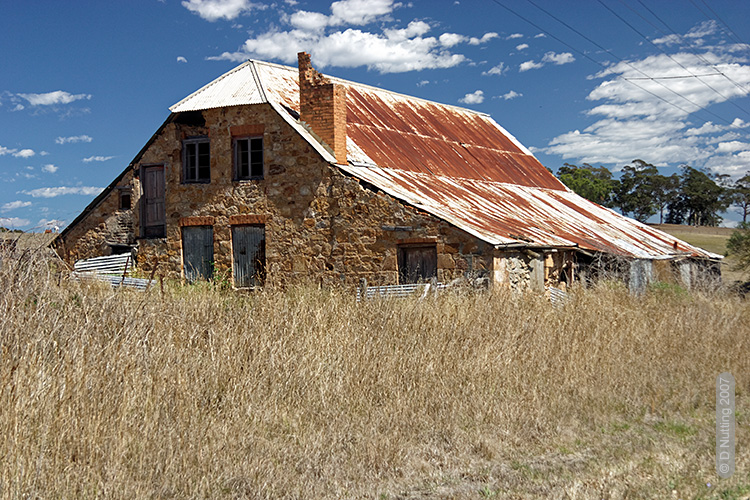
The Reimann barnhouse near Hahndorf, in the year 2007
The architects Gordon Young and Lothar Brasse (in the Hahndorf Survey of 1981) described the barn-house as follows:[11]
The large roof covers living quarters, a dairy, the stables, an implement and buggy shed, chaff room and hay loft. It has an unbelievably complicated structure with the original timber framing interlocking at the end of the building into a stone-built structure.
The roof of the Mooney barnhouse is made of corrugated iron, but initially the roof built by the Reimann family was of wooden shingles.Gordon Young and Lothar Brasse
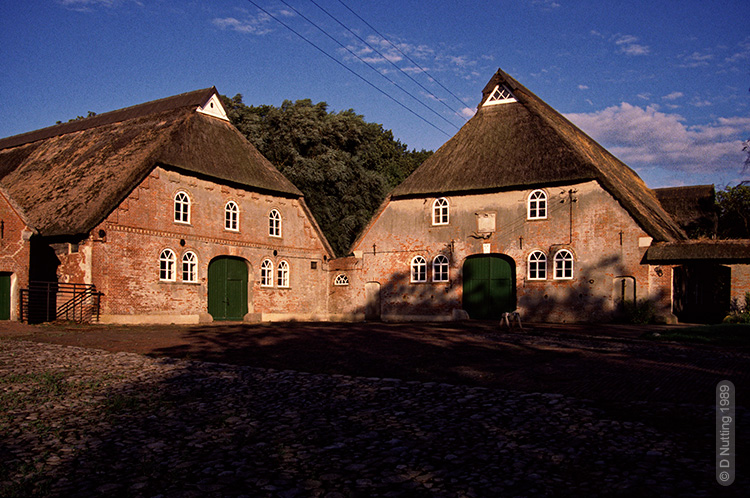
For comparison's sake here you see two old farm buildings of similar design in the countryside east of Bremerhaven, in the north of Germany. These have thatched roofs.
German immigrants built barnhouses (or housebarns) in the United States of America also, for example in Missouri, Wisconsin and Minnesota. You can read an article here about the Pelster 'housebarn' in Missouri.[12]
The travel writer Bruce Elder wrote of Hahndorf: "There are few places in the country where you can drive through typically Australian countryside and, quite suddenly, enter a world which seems to have been lifted out of Europe."[13]
♦ Notes:
1. Young et al. (1981), p.153
2. Young et al. (1981), p.255
3. Harmstorf, Ian. (1994). Folklore of the German People in South Australia. In: Insights into South Australian History, vol. 2, South Australia’s German History and Heritage. Historical Society of South Australia Inc. p.30; Tampke, Jürgen. (2006). The Germans in Australia. Port Melbourne (Victoria): Cambridge University Press. p.73
4. Young et al. (1981), p.159
5. Young et al. (1981), p.153
6. Fox (2002), p.46
7. Young et al. (1981), p.157
8. Hallack, E. H. (1892). Our Townships, Farms, and Homesteads: Southern Districts of South Australia: Comprising a series of 25 articles written for the S.A. Register and Adelaide Observer. Adelaide: W.K. Thomas & Co. pp.93-94
9. AT HAHNDORF. (1883, March 3). Adelaide Observer (SA : 1843 - 1904), p. 13. Retrieved August 7, 2021, from <nla.gov.au/nla.news-article159559423>
10. Pope & Booth (2004), p.127
11. Young et al. (1981), p.189
12. Blackwell, Claire F. (1992). The Pelster Housebarn: A Missouri-German Landmark. In: Ozarks Watch, Vol. V, No. 3, Winter. (Available online here.)
13. Elder, Bruce. (n.d.) Hahndorf, S.A. Aussie Towns (website).
♦ References:
Fox, Anni Luur. (2002). Hahndorf : a journey through the village and its history. [Hahndorf, S. Aust.] : Anni Luur Fox.
Pope A. & Booth, C. (2004). District Council of Mount Barker Heritage Survey. Part 2: State Heritage Recommendations. Heritage Online. (Available online here)
Young, G., Harmstorf, I., Brasse, L., Marsden, A. (1981). Hahndorf survey Vols 1 & 2. [Survey for the Australian Heritage Commission] Adelaide: Techsearch.