Aspects of Hahndorf's History
Captain Hahn back home
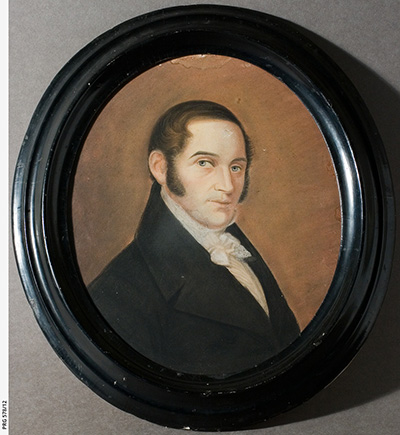
Portrait of Captain Hahn, by Hugo Carstensen, 1842, watercolour
State Library of South Australia, PRG 578/12
The Zebra and the Danish flag
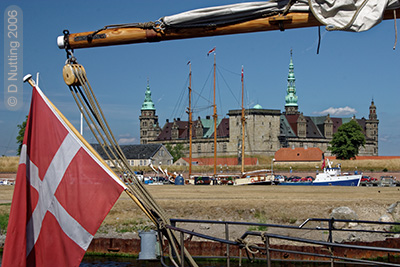
The Dannebrog, the Danish flag, in the harbour of Helsingør, Denmark
The Zebra was the first ship to arrive at Adelaide under a foreign flag rather than the British flag. The Zebra sailed under the Dannebrog, the Danish flag, because her final port of departure from Europe was Altona.[1] For a period of about 200 years from 1640-1864 Altona was under Danish administration (today it is the westernmost borough of the German city of Hamburg) – in 1838 the Zebra under Captain Hahn took its Prussian Old-Lutheran emigrants to South Australia.
Dirk Hahn - Danish or German?
Would the term “Danish sea captain” reflect everything about Captain Hahn’s cultural and language background? Was Dirk Hahn Danish or German? The answer might be: a bit of this and a bit of that. Technically he was a subject of the Danish king, because the island of Sylt (located on Germany’s North Sea coast, close to the present-day border with Denmark) was at that time part of the Duchy of Schleswig (in Danish: Slesvig). The duchy was a territory belonging to the king of Denmark. A royal bailiff represented the Danish king on Sylt. In Dirk Hahn’s lifetime, many people of Sylt spoke or understood Danish.
On the other hand, the German language played an important role for the islanders of Sylt. German was the language used for official communication: in church, in school, in written contracts, in writing of both an official nature and for private purposes.[2] Dirk Hahn wrote his memoirs of his journey (as captain of the Zebra) to Adelaide with the Old-Lutheran emigrants in German. Hahn died in 1860 (seven years before Schleswig became a province of the kingdom of Prussia), and the inscription on the tomb slab of his grave in the churchyard of the village church St. Niels in Westerland, the central town of Sylt, was written in German.
Captain Hahn’s surname, Hahn, is a German name/noun. During the First World War, due to the anti-German atmosphere of that time, the South Australian government changed German place names, including Hahndorf (changed to Ambleside). Perhaps the government would not have changed the name of the village if the captain’s name were a typical Danish name such as Jensen or Andersen rather than a German name (Andersendorf??)…
However, as with most people from Sylt, Dirk Hahn’s strongest cultural and language bonds were probably with the island of Sylt itself. The people of Sylt at that time considered themselves primarily to be just that, people of Sylt, rather than identifying with one nation or another. They had their own culture and language. The everyday spoken language used on Sylt was Sölring - the Sylt dialect of North Frisian (Frisia is the name of the region along the North Sea coasts of Germany and the Netherlands). Sölring was in the main not a written language.[2]
Dirk Hahn's retirement
Dirk Hahn never returned to South Australia and never saw the settlement that was named after him. Between voyages to Mediterranean countries and to ports in Russia Hahn had married Hedewig Nicolaisen of Westerland on 24th December 1831. He had become engaged to her in 1826.[3] In 1851 Captain Hahn wound up his career as a seafarer. The retired captain could not cope with the death of his wife Hedwig, who died in 1854. Christian Peter Hansen, a teacher and local historian of the island of Sylt at the time, reported that Dirk Hahn also became a victim of tourism. Beach guests bought Hahn alcoholic drinks in order to get him to tell them stories about the big wide world.[4] (In the 1850s bathing tourism came to Sylt and Westerland became a well-known seaside resort. At that time the holiday-makers were mainly from the middle-class and the upper-class of society.)[5]
The gravestones of Dirk Hahn and his wife Hedewig are next to the east wall of the old Protestant village church of St Niels in Westerland (built in 1875 on the street Kirchenweg). Dirk's gravestone records his age as 56 years, 6 months and 7 days. The text on the gravestone reads: Sein Gedächtnis lebt auf Erden / Denn die Guten sterben nie (His memory lives on earth, for the good never die).
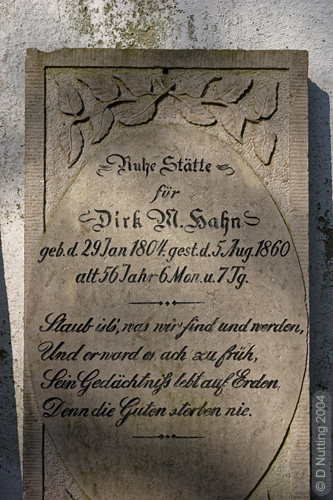
Tombstone of Dirk Hahn in Westerland
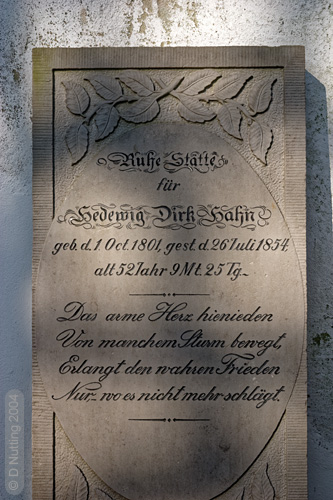
Tombstone of Hedewig Hahn in Westerland
♦ Notes:
1. Hahn/Buchhorn (1988), p.205
2. Westmore, Elisabeth. Sylter Archiv, Westerland. Personal communication, email 25/11/2019.
3. Hahn/Buchhorn (1988), p.179
4. Kunz, Harry and Thomas Steensen. (2002). Hahn, Dirk. In: Sylt-Lexikon. Published by the Nordfriisk Instituut. Neumünster : Wachholtz Verlag. p.126
5. Tourismus im Sylt-Lexikon. Online article, available here. (Accessed 17/08/2022).
♦ References:
Hahn, Dirk M. Die Reise mit Auswanderern von Altona nach Port Adelaide Süd-Australien 1838. Hrsg. Martin Buchhorn. Zürich: Pendo-Verlag, 1988. Originally written by Kapitän Hahn in his notebook with the title: Die merkwürdigsten Begebenheiten / meines Lebens. / Von meinem 35ten Lebensjahr bis zum 48ten Jahr / meines Alters.