Silesia
Homeland of many early emigrants to S.A.
In the story of German immigration in Australia, especially in the 19th century in South Australia, the geographic name Silesia comes up quite often. The majority of the early Old Lutherans who migrated to South Australia for religious reasons came from a region that included the Prussian provinces of Posen, Brandenburg and Silesia. The dissent and resistance to the king's religious decrees was strongest and most defiant in those provinces. In Breslau, the capital of Silesia, there were theologians who argued strongly against the king's plans.[1]
The German geologist Johannes Menge who explored the Barossa Valley in the late 1830s called the valley New Silesia in letters to colonial authorities[2], and in fact a map produced in Germany showing the areas of German settlement in South Australia marked the Barossa Valley as Neu Schlesien (New Silesia).
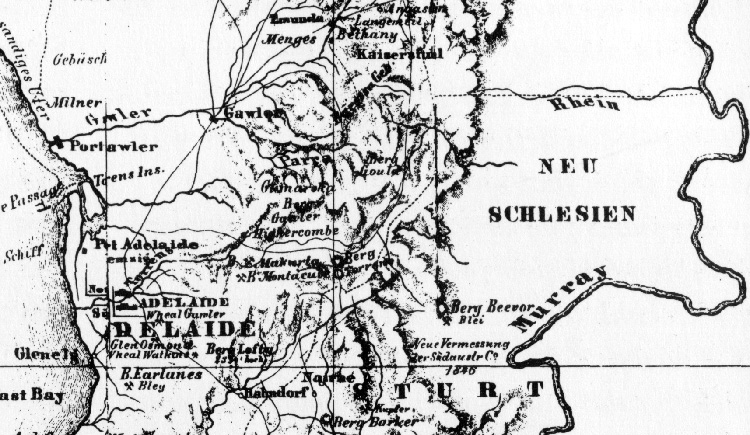
A map from 1849 of the German settled areas in South Australia.
Picture source: Laun, Eugen. (1849). Führer und Rathgeber für Auswanderer nach Australien und Port Adelaide. Bremen. (Reproduced in Voigt, Johannes H. (1987). Australia-Germany. Two Hundred Years of Contacts, Relations and Connections. Bonn (Germany): Inter Nationes. p.19
It seems that Menge named the area Neu Schlesien because he expected that the Lutherans who were arriving from Silesia would live there. The original Klemzig in Europe, from which some of the German migrants in the first group had come, was at the time of their emigration part of the Prussian province of Brandenburg, but had earlier been part of the province of Silesia.[3] With the many immigrants from Silesia, the Barossa Valley developed a Silesian flavour which it has retained into the present day.[4]
However, where in Europe was/is Silesia?
Silesia is a region in Central Europe that today belongs mostly to Poland (situated in the southwest of Poland), but small parts of historical Silesia are also in Germany and the Czech Republic. The region, which is about the same size as Switzerland, has a turbulent history because it often changed hands between different countries. Until around 1740, Silesia belonged to the Austrian Habsburg Monarchy. From 1740 onwards, the Kingdom of Prussia (under King Frederick the Great) conquered large parts of Silesia during the three “Silesian Wars”, which was a considerable loss for Austria (Silesia was an important centre for mining and industry).[5]
When many emigrants left Silesia in the mid-19th century and emigrated to South Australia, most of Silesia belonged to the Kingdom of Prussia. In Lower Silesia, most people spoke German, and in Upper Silesia, the population was bilingual (German and Silesian, which is a Polish dialect). The German name of the most important city was Breslau. In Polish, it is called Wrocław. In Berlin the name Silesia still has a high profile due to the name of a significant Berlin underground/metro station, ‘Schlesisches Tor’. The station was named after the former city gate that faced in the direction of Silesia.[6] The name of this former city gate was intended to remind Berliners of the new Prussian province of Silesia. Today, Schlesisches Tor is an important railway station in the Berlin-Kreuzberg district.
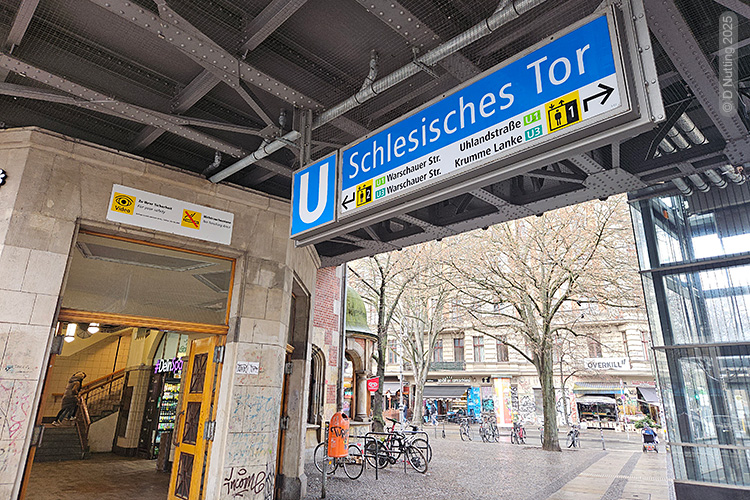
The information display at the entrance to Schlesisches Tor railway station, Berlin.
♦ Notes:
1. Ioannou (2000), pp.11, 64 / Lodewyckx, Prof. Dr. A. (1932). Die Deutschen in Australien. Stuttgart: Ausland und Heimat Verlagsaktiengesellschaft. p.35
2. Ioannou (2000), pp.16, 101
3. Ross, Don. (1992). Special surveys in a land of hills and valleys. In: Munchenberg, Reginald S et al. (1992). The Barossa, a Vision Realised. The Nineteenth Century Story. Barossa Valley Archives and Historical Trust Inc. p.15
4. Ioannou (2000), p.16
5. Clark, Christopher. (2007). Iron Kingdom: The Rise and Downfall of Prussia, 1600-1947. London: Penguin. pp.190-198
6. Kampfner, John. (2024). In search of Berlin: the story of a reinvented city. London: Atlantic. p.80
♦ References:
Ioannou, Noris. (2000). Barossa Journeys: into a valley of tradition. (Second edition) Sydney: New Holland Publishers.