Chronology
* You can search this page for a specific year or person by using the combination of the keys Ctrl F on your keyboard.

2000

On 23rd July, at its Regular Convention 2000, the Lutheran Church of Australia made an apology to Australia's native people. Dr Steicke made the following statement:
On behalf of the rest of the people of our church, I am sorry for the suffering and hurt that your people have had to endure. We ask God to forgive us for the evil we have done, and the help we have failed to give you. We resolve to work together with you, to share and learn together, to accept and respect each other. Help us to listen to you and learn from you. We promise to work with you and others for justice and harmony in relationships. We recognise the contribution which indigenous people are making. We are sorry for the bad things that have happened in the past. Please forgive us.
Dr Steicke
Pastor Jimmy Haines, representative of the Aboriginal people of Central Australia, responded in Arrarnta, which was translated by Mr Garry Stoll.
Many of us Aboriginal people living in Central Australia and also us pastors have been discussing this word reconciliation for a long time. More recently people asked me to speak on their behalf at this synod. That's why I'm speaking to you as their representative..... We do not hold a grudge against white people for what happened. There are people who always want to only talk about the bad things the white people did. We however would rather remember that many white people helped us and many are our friends to this day. More than anything however, we thank God that he sent his messengers to us with His Word. The missionaries taught us about God and stayed with us for a long time. Today there are many Aboriginal Christians and Pastors in Central Australia. We are really happy about that. We are also happy that the Lutheran Church continues to help us.
Pastor Jimmy Haines
On 5th July Australian champion discus-thrower Werner Reiterer stunned the Australian public with the publication of his book Positive. In it Reiterer admitted that he had taken banned performance-enhancing drugs from 1995 onwards, and he alleged that a handful of Australian Olympic officials were protecting some elite track-and-field athletes who were using them. The Australian Olympic Committee immediately announced a judicial enquiry; however, the enquiry was later called off when Reiterer refused to name specific people involved in his allegations. Reiterer was born in the north-west Austrian town of Hohenems (on the border with Switzerland) and emigrated to Australia with his family when he was 3 years old. He competed for Australia at two Olympic Games. He was a finalist (10th) at Barcelona in 1992, was Commonwealth Games Gold medallist in 1994, and was the male Australian track-and-field athlete of the year in 1995. He was Australian discus champion 9 times. During the Sydney Olympic Games he was interviewed by international journalists, and he found that they were more interested than Australian journalists in the issues he wanted to draw people's attention to. He believed that Australian journalists only wanted him to name names.
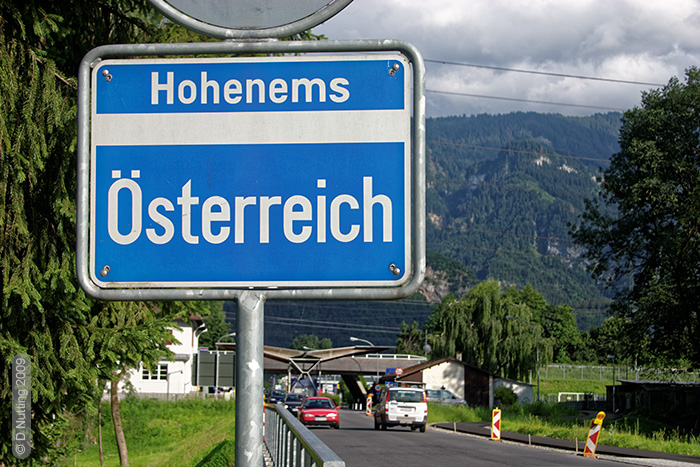
Town sign, Hohenems, Austria.
2005
On the 3rd of February 2005 the German-Australian Cornelia Rau was free again, after 10 months behind bars, firstly in a women’s prison, then in a detention centre for illegal immigrants on the edge of the desert in the state of South Australia. The case of this 39-year-old woman, whose family had emigrated from Hamburg to Australia in 1967, caused a scandal in Australia since it brought to public attention conditions in Australia’s refugee detention centres.
➜ More...
2007
In June 2007 Mathias Cormann, who had emigrated from the German-speaking part of Belgium, became a senator for the state of Western Australia in the Australian Parliament. Later he was Australia's Finance Minister for several years.
➜ More...
2008
On the 26th November 2008 the family of the German doctor Bernhard Möller received the news that the Australian Minister for Immigration Chris Evans had decided that they could stay in Australia on an ongoing basis. Möller worked as the only specialist for internal medicine in the rural town of Horsham north-west of Melbourne. Originally the immigration authorities had turned down the family’s application for permanent residency with the justification that the doctor’s Down-syndrome son would cause significant and ongoing costs to the Australian community.
➜ More...
2013
From 30 September 2013 to 2 March 2014, the German Emigration Centre in Bremerhaven (Germany's national museum on the history of emigration) hosted a special exhibition entitled Germans in Australia. 1788 – today. The topics covered in the exhibition ranged from Australia's history as a country of immigration to the 'Work and Travel visa' experiences of young Germans today. A timeline on the walls of the exhibition rooms and multi-layered collages provided an overview of Australia's development as an immigration destination – the early history of Aboriginal immigration to Australia was also briefly described. Even after the end of the special exhibition, personal objects related to Germans in Australia remain part of the museum's permanent exhibition.
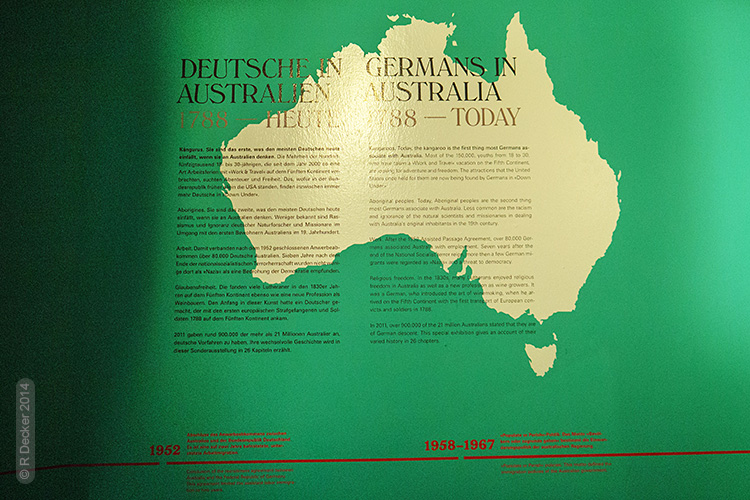
Part of the special exhibition at the German Emigration Centre in Bremerhaven in the northwest of Germany
2015
Memories in my Luggage was a travelling photographic exhibition that told the stories of German migrants who arrived in Australia between 1935 and 1956. The exhibition showed photographs and texts, digital presentations, information about organisations that assist migrants, and memorabilia which highlighted the experience of migration.
The idea for the exhibition came from Sabine Nielsen's book Ein bisschen Heimat im Gepäck. Nielsen, who herself emigrated to Melbourne in 1972, organised the exhibition with the German photographer Eva Maria Rugel and the Melbourne-based designer David Wong. The travelling exhibition was on display from December 2014 to October 2015 in several locations in Victoria, and was formally opened at the Bonegilla Migrant Reception Centre in the north of Victoria, where many German migrants in the years after World War Two spent their first weeks in Australia. The exhibition included photos and texts about the migrants' adventurous journeys and new lives, a digital presentation, and information about various organisations that supported the migrants, such as the Australian-German Welfare Society (founded in 1954).
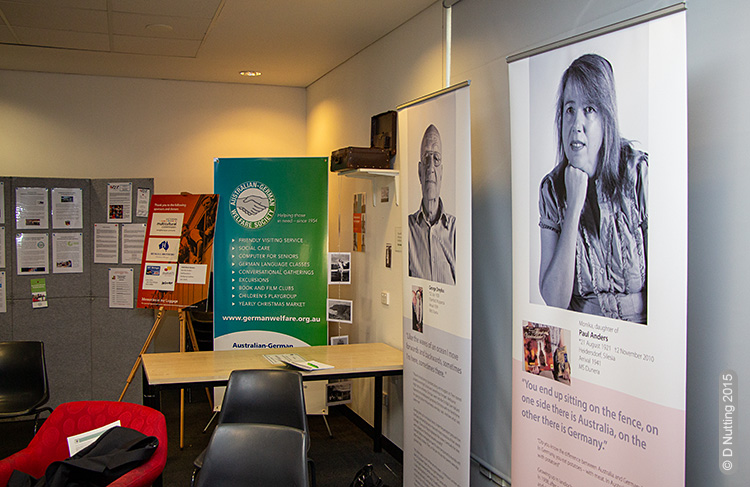
A part of the exhibition space for 'Memories in my luggage', Glen Waverley Library, February 2015.
2017
The former Australian rules footballer, Nick Riewoldt, published his autobiography, titled The things that make us. Riewoldt was one of the most successful forwards in the Australian Football League (the sports journalist Glenn McFarlane described him in 2023 as "a superstar key forward and great leader"). He played 336 games for the St Kilda Football Club between 2001-2017 and was the club’s captain in 2005 and from 2007 to 2016. The first chapter of his book is titled ‘Heritage’, and most of the chapter focuses on his German background.
➜ More...
2020
The German-born world champion Paralympic athlete Vanessa Low competed for the Australian Olympic Team for the first time at the 2020 Summer Paralympics in Tokyo.
➜ More info in the Introduction page...
2026
ABC TV News reported on 13/04/2026 that old handwritten sheets of sacred church songs in German had been discovered in 2025 in an old chest at the Immanuel Lutheran Church at Point Pass in the Mid-North of South Australia. A special performance of these songs by the Tanunda Liedertafel (male choir) was held at the church in April 2026 to celebrate the 150th anniversary of this Point Pass church.
The leader of the Liedertafel, Matthew Falland, said: “There’s sort of a joy to hearing music that’s seldom sung, lovely old arrangements in the traditional language. That connection between past and present that’s still in a place like Point Pass.”
101-year-old Gordon Schutz told how he was confirmed in a German-language service along with 13 other young people on the 18th September 1938 in the Point Pass Immanuel Lutheran Church. The wooden interior wall of the organ loft in the church is decorated (as is the case in some Lutheran churches in the Barossa Valley) with inscriptions of quotes from the Bible in German.
➜ You can read (with photos and video) the ABC News report.