Names
Australian Placenames of German Background
Introduction | NT & WA | NSW | QLD | SA | TAS | VIC
Official placenames in New South Wales today
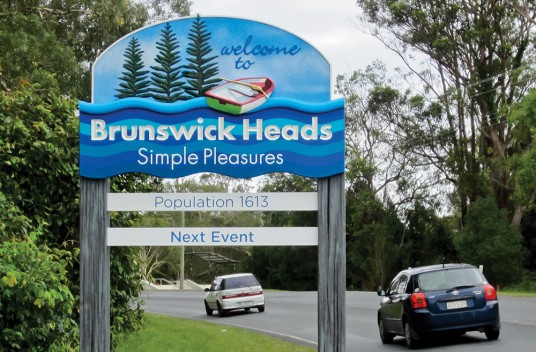
The town entrance sign of Brunswick Heads, NSW.
Picture source: photo kindly supplied by The Byron Shire Echo
➽ Brunswick Heads is a locality at the mouth of the Brunswick River about 13 km NNW of Byron Bay. It was proclaimed the village of 'Brunswick' on 20th March 1885, but is known as Brunswick Heads. Captain John Rous in the ship HMS Rainbow came upon the Brunswick River in 1828 and named it after Queen Caroline of Brunswick (German: Braunschweig). You can read more information here about Queen Caroline and the German origin of the name Brunswick in Australia.
➽ Emerton - outer northwestern suburb of Sydney, on Darug Country; named after German immigrant Wilhelm Emert, who was postmaster and storekeeper at Mt Druitt in 1861. You can read more about this place name and its origins in this article.
➽ Engadine - outer southern suburb of Sydney, on Dharawal Country; named after the Swiss part of the valley ('Engadin') of the River Inn. You can read more about this place name and its origins in this article.
➽ Heckenberg - a suburb of Sydney, near Liverpool, on Cabrogal Country. The name Heckenberg was given to the suburb because of the long association of the Heckenberg family with the Green Valley area. You can read more about this place name and its origins in this article.
➽ Leichhardt - a suburb 5km west of Sydney's CBD, on Gadigal and Wangal Country. In the early years of British settlement in the Sydney area the colonial authorities made a number of land grants in the area of present-day Leichhardt, on land that had been home to the Indigenous Australians of the Wangal clan. Two brothers named Hugh and John Piper received a number of large grants between them. Hugh Piper established an estate which he named "Piperston". Walter Beames bought this estate in 1846 and changed its name from 'Piperston' to 'Leichhardt' in honour of his friend Ludwig Leichhardt. Beames helped Leichhardt with provisions for his explorations.
Source: Leichhardt - Inner West Council, suburb history. Online at the council's website.
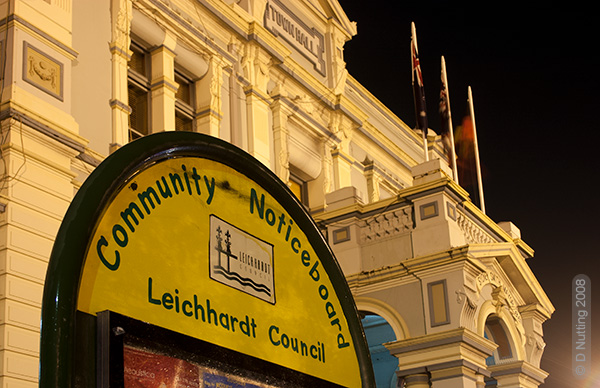
Sign in front of the town hall of Leichhardt, NSW.
➽ Linden - a village in the Blue Mountains west of Sydney, on Dharug and Gundungurra Country. In 1865 William Henderson received a grant from the government of 40 acres of land and built his home, which he named Linden Lodge, facing the single rail track snaking through the Blue Mountains. The area around Henderson's home became known as Linden, including the railway station that was opened there later on. 'Linde' (plural in German: Linden) is the German name of a type of tree. In Britain and Ireland they are called 'lime trees'. 'Unter den Linden' ("under the linden trees") is the name of a boulevard in the central Mitte district of Berlin, and is one of the most famous streets in that city.
➽ Pyrmont - a suburb two kilometres south-west of Sydney's CBD, on Gadigal Country. Named after a spa town 50 km southwest of Hannover, Germany. You can read more about this place name and its origins in this article.
➽ Sans Souci - a suburb in the south of Sydney, on Gadigal/Bidjigal Country. The name is indeed French, but the naming of this suburb has its origins in Germany. Sans Souci means "without a care". You can read more about this place name and its origins in this article.
Former German placenames in New South Wales
In earlier times Australia had many more German placenames, but local residents and governments have changed many names. The German names in the following list were changed during the First World War. Most German immigrants in the 19th century settled in rural areas.
➽ Germanton - now Holbrook, a town 64 km north-east of Albury, on Wiradjuri Country. You can read more about this place name and its origins in this article.
➽ Germans Hill - now Lidster, a locality 18 km south-west of Orange, on Wiradjuri Country. In 1887 the parents of children at Germans' Hill applied to the government for the establishment of a school and in 1888 Germans' Hill Public School opened. In 1915, during the anti-German atmosphere of World War I, the families of Germans' Hill asked the government to change the name of the place and of the school for patriotic reasons. At the end of 1915 the government agreed to the new place name of Lidster. This name honoured a popular local boy, Cecil Reginald John Lidster, who had been born at Germans' Hill and who had been one of the first people from the area to enlist in the army. Cecil Lidster was killed in action at Gallipoli and buried at Shrapnel Valley Cemetery. In February 1916 the Sydney Morning Herald reported on the place name change as follows:
In deference to the requests of the residents of the locality, Germans' Hill, so called from the small colony of Germans and German-born there, is henceforth to be called Lidster, in commemoration of Trooper Cecil Lidster, a member of a pioneer family, who was killed on April 25 at the landing at Anzac.
Sydney Morning Herald, 2nd February 1916
In 1927 Lidster Public School was renamed Nashdale Public School.
Sources: Mutton, Deardrie. [Compiler and editor]. (1988). Nashdale Public School, 1888-1988 (Centenary Booklet). Available online here (accessed 27/08/2023) / GERMANS' HILL. (1916, February 2). The Sydney Morning Herald (NSW : 1842 - 1954), p. 12. Retrieved February 5, 2023, from <http://nla.gov.au/nla.news-article15651998>
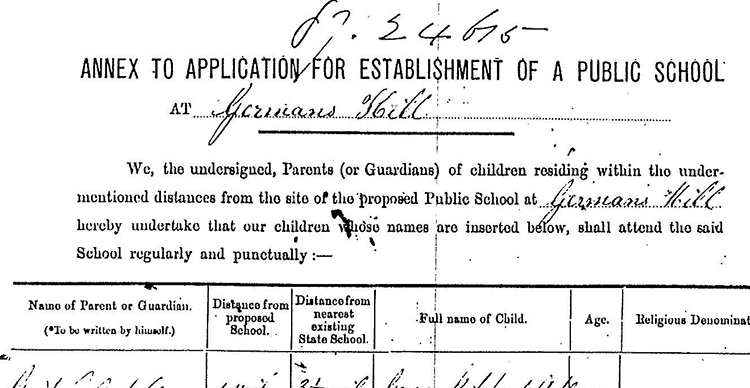
Extract from application for establishment of a school at Germans Hill, NSW, 1887
➽ German Creek - now Empire Vale, approx. 7.5 km south-west of Ballina on the north coast, on Bundjalung Country. You can read more about this place name and its origins in this article.