Names
Australian Placenames of German Background
Sans Souci, NSW
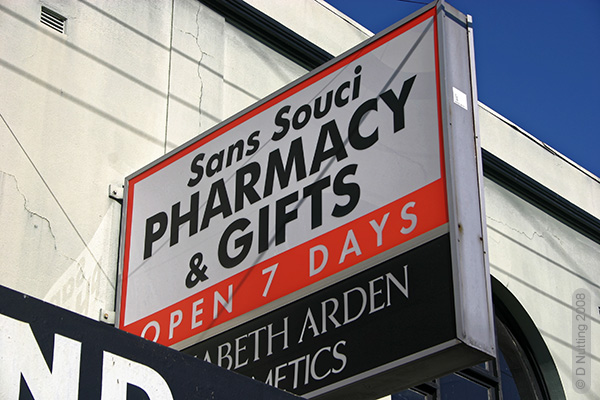
A shop sign in Sans Souci, a suburb of Sydney
The name of this southern Sydney suburb on the western shore of Botany Bay is a French phrase, but behind the name is a strong German connection. It is the name of a summer palace at Potsdam, near Berlin, built by Frederick the Great, King of Prussia. Friedrich der Große was a fan of French culture and of the French language, and he named his summer palace Sanssouci, meaning ‘without a care’, or ‘no worries’. But who brought the name of a German palace to New South Wales?
Thomas Holt was a wool trader, financier, land speculator and politician born in Yorkshire in 1811. As a young man he worked in his father’s company in the wool business, and he represented the company on the European continent for ten years, spending time in several countries. Thomas became fluent in Spanish, German and French. With his younger brother William he opened a branch in Berlin, dealing in wool.[1]
While working in Berlin Thomas Holt met his future wife, Sophie Johanna Charlotte Maria, daughter of Friedrich Eulert and they were married in Berlin in 1841 at a double ceremony in which Thomas Holt’s younger brother, William, married Sophie’s sister.[1] Thomas and Sophie Holt migrated to Australia and arrived in Sydney in November 1842. Thomas soon bought a large estate at Liverpool overlooking the Georges River and named it 'Sophienburg' after his German wife. They lived there for ten years.[2]
Holt got to know Ludwig Leichhardt, the German explorer who had become famous due to his journey to the north coast of Australia. Leichhardt was the godfather of one of Holt’s children, Frederick Samuel Ellis Holt, born on 22nd June 1846 at Sophienburg.[3]
Holt was very successful in land speculation and became very wealthy. He sold Sophienburg in 1853. Early in 1853 Holt bought Rocky Point House and 100 acres from the distiller Robert Cooper as an investment – he renovated it and re-named it ‘Sans Souci’, after the summer palace of the Prussian king Frederick the Great (1740-1786), close to Berlin. However, his wife Sophie refused to live there – the area was too quiet for her. Holt sold 'Sans Souci' in 1865 and it became a licensed hotel. The building was demolished in 1920.[4]
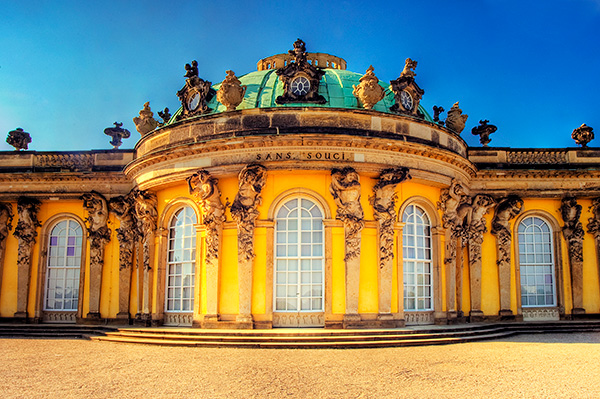
Sans Souci palace at Potsdam, Germany
Photo source: Wikimedia Commons / Wolfgang Staudt. Creative Commons licence.
Friedrich the Great's summer palace near Berlin was built between 1745-1747. He wanted his palace to be a kind of Versailles (the royal palace in France) for Berlin, a place for the enjoyment of the arts and the exploration of the latest trends in Enlightenment thinking.[5] In the first half of the 18th century the whole upper class of society in the German-speaking kingdoms and states admired and imitated French culture (including architecture, painting, literature, theatre, music and clothing) and the French language itself.[6] Sanssouci Palace is a great example of the ornate architectural style known as Rococo. Frederick the Great died there in 1786.
The entire complex with its palaces and park is inscribed as UNESCO World Heritage, recognised as “an outstanding example of architectural creations and landscaping” and “a cultural property of exceptional quality”.[7]
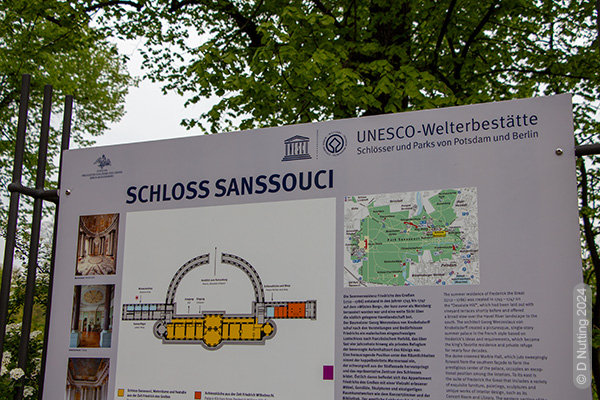
An information board in the gardens of the palace Schloss Sanssouci in Potsdam, Germany
◀ Placenames in New South Wales...
♦ Notes:
1. Salt (2008), p.5
2. Salt (2008), p.7
3. Salt (2008), p.8
4. Salt (2008), p.13
5. Domínguez, Martí. (2017). What’s So Great About Frederick? The Warrior King of Prussia. National Geographic History magazine. March/April 2017. (Available online.) / Hawes, James. (2018). The Shortest History of Germany. Exeter: Old Street Publishing (paperback edition). p.79
6. Genzmer, Herbert. (2017). Die deutsche Sprache: Ursprünge, Entwicklung und Wandel. Wiesbaden : Marix Verlag. pp.158-159 / Kampfner, John. (2024). In search of Berlin: the story of a reinvented city. London: Atlantic. pp.95-96 / Clark, Christopher. (2007). Iron Kingdom: The Rise and Downfall of Prussia, 1600-1947. London: Penguin. pp.184-185
7. VisitBerlin.de. (n.d.). Sanssouci Palace. Berlin's official travel website.
♦ References:
Appleton, Richard. & Appleton, Barbara. (1993). The Cambridge Dictionary of Australian Places. Cambridge: Cambridge University Press. p.267
Imgrund, Bernd. (2014). 101 deutsche Orte, die man gesehen haben muss. Darmstadt: Konrad Theiss Verlag. 4. Auflage. p.168
Rathbone, R. W. (2002). The Sans Souci Peninsula : a history of the suburbs of Dolls Point, Monterey, Ramsgate, Sans Souci and Sandringham. Glebe (NSW): Book House. pp.16-19
Salt, Daphne. (2008). Thomas Holt - A Dynamic Pioneer (A Reference Chronology of the Life and Enterprises of Australia’s First Colonial Treasurer). Sutherland Shire Historical Society. pp.5, 7-8, 13.