Names
Australian Placenames of German Background
NT & WA | NSW | QLD | SA | TAS | VIC
Brunswick
The historical background
A German duchy
The placename Brunswick is of German origin; the standard German spelling of the city in northern Germany is Braunschweig. The placename Brunswick is found in many places in several countries, mainly in former British colonies. The name is so widespread because of the important role played in the British monarchy by a northern German principality and duchy from 1714 to 1837. During those years the (north German royal) House of Hanover ruled Great Britain in personal union with the Electorate of Hanover. The House of Hanover was formally known as the House of Brunswick-Lüneburg, Hanover line. As a result the name Brunswick became widely known outside of the German-speaking states and kingdoms.
"The Black Duke"

Portrait of Frederick William, Duke of Brunswick-Wolfenbüttel
Pastel by Johann Christian August Schwartz, 1809
Photo: Wikimedia Commons, public domain
Friedrich Wilhelm von Braunschweig, also known as "The Black Duke", was one of the German folk heroes of the Napoleonic Wars, a Prussian general, Duke of Brunswick-Lüneburg and ruler of the principality of Brunswick-Wolfenbüttel.
During one part of the Napoleonic wars he and his unit served as part of the British army. At the time the duke got to know the British captain James Stirling of the Royal Navy. Stirling, who later became the first governor of the colony of Western Australia, was given the mission of carrying "The Black Duke" on his warship HMS Brazen to Holland.[1]
He was the brother of Princess Caroline of Brunswick.
The Duke is considered to be the namesake of Brunswick in Western Australia.
Caroline of Brunswick

Caroline of Brunswick (1768–1821)
Painted by Thomas Lawrence, 1798
Photo: Wikimedia Commons, public domain
Caroline Amalie Elisabeth von Braunschweig-Wolfenbüttel was a daughter of a German noble family (Brunswick is the English form of the German name Braunschweig). Later in her life she became Queen of the United Kingdom and Hanover as the wife of King George IV from 29 January 1820 until her death in 1821.
Background: Before George IV became king in 1820 he was Prince of Wales. He lived an extravagant lifestyle and had many affairs with a variety of women at the court, and he had lots of debts. He also had several illegimate children. His father, King George III, wanted his son George to produce a legitimate heir to the British throne and offered him a deal. If George would marry Caroline of Brunswick, his first cousin, the Parliament would cover George's debts. Parliament was in favour of Caroline because she was from a Protestant noble family (religion was an important factor in British politics in those days), and having allies in central Europe was useful during the years of struggle with Napoleon.
In 1795 Caroline went to London and married George, Prince of Wales. Right from the start the marriage was a disaster. Caroline found George unattractive and vice-versa. In their brief time together George and Caroline produced one child, Princess Charlotte of Wales. Charlotte married Prince Leopold of Sachsen-Coburg in 1816 at the age of 20. She died only a year later after giving birth to a stillborn son.
George, the Prince of Wales, and Princess Caroline started living separate lives in London not long after the birth of their daughter Charlotte. In the next few years rumours arose about Caroline living an unusual lifestyle and entertaining guests from various walks of life. The Prince of Wales got his father the king to set up a secret commission whose job it was to investigate Caroline's lifestyle and activities. The commission found no evidence but the British newspapers found out about the investigation and took sides with Caroline. 'Popular media of the time represented George as a libertine and Caroline as the wronged wife.'[2] She was also immensely popular with the public, who felt sorry for her. The Prince of Wales was dismayed that he was so unpopular and that his wife, whom he loathed, was so popular with the general population. Caroline was socially isolated in the royal family and in 1814 she left Britain for a few years, and lived and travelled in Europe.
The Prince of Wales wanted to end his marriage to Caroline but he needed to prove that she had committed adultery. The government sent a group of spies (the 'Milan commission') to try to find evidence that Caroline was in a sexual relationship with one of her Italian servants. King George III died in 1820 and George, the Prince of Wales, became King George IV. Caroline, who was now technically queen, returned to England in order to claim her rights as queen.
The government, however, ran a trial in the Houses of Parliament, in order to convict her of adultery, end the marriage and remove her rights as Queen. The trial became more and more unpopular and there was huge public support for Caroline and protests against the king. She became a popular focus of public dissatisfaction with George. There were slogans around London such as: 'The Queen for ever! The King in the river!'[3] The government had to withdraw the case and stop the trial. Caroline tried to enter Westminster Abbey for George's coronation ceremony, but he made sure she was not let in. Three weeks later she died at the age of 53, possibly from cancer. Before she died she expressed the wish that her body be taken back to Brunswick. Her final resting place is in the crypt of Brunswick Cathedral, near the coffin of her father.
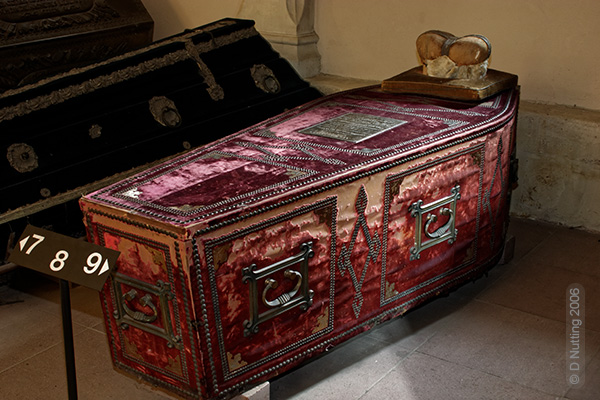
The coffin of Caroline of Brunswick, in the crypt of Brunswick Cathedral, Germany
There was huge sympathy for Caroline among the general public of Britain and through news reports British colonists in Australia were aware of this too.
In 2008 BBC Radio 4 broadcast a radio play dramatising the marriage of George and Caroline. It was written by Shelagh Stephenson and entitled "The People's Princess".
Caroline is the namesake of places in Victoria and in New South Wales.
♦ Notes:
1. Multhoff, Robert F. (1961). "Friedrich Wilhelm" in: Neue Deutsche Biographie 5, p.502 [Online-Version]; URL: <www.deutsche-biographie.de/pnd118703242.html#ndbcontent>
2. Knowles, Rachel. (2011, November 19). 'George IV and Queen Caroline: a disastrous royal marriage'. In: Regency History [blog here] (accessed 10/11/2013)
3. Fraser, Antonia (editor). (1999). The Lives of the Kings and Queens of England. Los Angeles: University of California Press. p.290 (author of the chapter on the House of Hanover: John Clarke)
♦ Reference:
History Hub. (2020, June 5). The Queen Caroline Affair 1820. (Presented by Dr Katie Carpenter in the Parliamentary Archives.) [YouTube] <www.youtube.com/watch?v=oQeJ-V-2fJE>