Names
Australian Placenames of German Background
Holbrook/Germanton, NSW
Johann Christian Pabst, from the village of Cursdorf, about 125 km south-west of Leipzig, was born in 1803. He and three other sheep overseers were brought from Saxony to New South Wales by the Australian Agricultural Company in 1825. The British government established this company in 1824 in order to develop agricultural land and to extend and improve the flocks of merino sheep in the colonies for fine wool production. The Company also imported Merino sheep from Saxony.[1] In 1835 he married Ellen Scott, a 21-year old Irish immigrant.
When he finished his contract with the Australian Agricultural Company, Johann Pabst moved to the Ten Mile Creek area of southern New South Wales and worked for two land-owners there. He became a successful businessman and took over the license of the Woolpack Inn in 1840 - the Inn was a stagecoach-stop on the southern bank of the Ten Mile Creek. Soon the people of the area and travellers started referring to the area around the Woolpack Inn as "John the German’s", or "The German’s" etc, and this evolved into the name Germanton - in August 1858 surveyor Sam Parkinson surveyed the township and called it Germanton. This name was officially gazetted in 1876.[2] The Pabst family opened the Germanton Hotel on 2nd November 1868. They owned a considerable amount of land in Germanton.[3]
Examination of advertising and other articles from editions of the Albury Border Post published between 1867 and the 1880s shows that the names ‘Ten Mile Creek’ and ‘Germanton’ were both in use at the same time until at least 1888.[4]
In early 1915, during the anti-German atmosphere of the First World War, some residents of the area requested that the local council lead a change of name for the town. Despite strong opposition from many people in the local community, the Germanton Shire Council called several public meetings in September 1914 to put forward suggestions for a change of name.[5] At one public meeting some people were apprehensive about the need to change the name. They said that 'it was not necessary to change the name to prove their loyalty' or to 'avoid the German taint'.[6] However, the Sydney newspaper The Farmer and Settler described the name Germanton as "distasteful":[7]
Germanton, a town of over one thousand inhabitants, and the centre of an important grazing district in Eastern Riverina, has decided, in order to express its indignation at the conduct of Germany in the war, to change its name. (...) During the discussion, it was said that Germanton, as a name of a loyal British district, was disgraceful and misleading.
'The Farmer and Settler', 2 February 1915
1915 was ironically the year after Johann Pabst’s grandson, Fred Pabst, had enlisted in the AIF (Australian Army).[8] Some people in Germanton made a point of emphasising that the origin of the name 'Germanton' referred to just one single German, John Pabst and his family, who had a store on the Great South Road (now known as the Hume Highway) and did not refer to a German settlement. They also emphasised that Germanton should not be confused with South Australian towns where Germans predominated.[9]
In the end the town council chose the name Holbrook - this was the name of a British submarine captain who had become famous because of a successful raid off the Turkish coast.
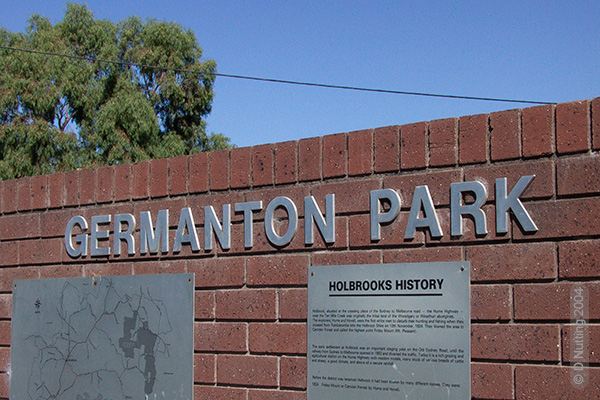
Germanton Park, Holbrook, NSW
Germanton Park was dedicated to the pioneers of Holbrook Shire in 1988. The name of this park ensures that the former name of Holbrook doesn't disappear from public memory.
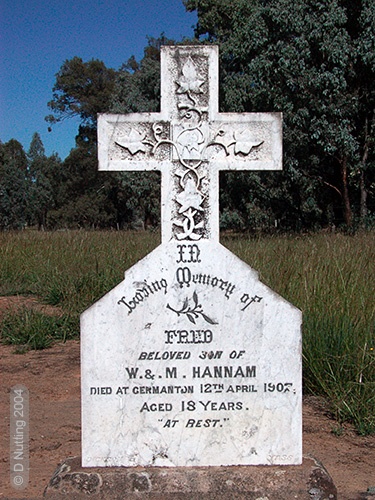
The inscription on this gravestone in Holbrook's cemetery bears witness to the earlier name of the town. The deceased person died in Germanton in 1907.
◀ Placenames in New South Wales...
♦ Notes:
1. Brown (2011), p.207
2. Greater Hume Shire Visitors Guide (2012), p.22
3. Greater Hume Shire Visitors Guide (2012), p.24
4. Brown (2011), p.219
5. FitzSimons & NSW (2018), p.89
6. Pennay, B. (2006). An Australian Berlin and hotbed of disloyalty: shaming Germans in a country district during two world wars. Journal of the Royal Australian Historical Society, Vol. 92, Part 1, p.18
7. GERMANTON DISTASTEFUL. (1915, February 2). The Farmer and Settler (Sydney, NSW : 1906 - 1955), p. 2. Retrieved November 1, 2022, from <http://nla.gov.au/nla.news-article116687882>
8. Jones, Howard. (1989). German settlers in this district. Albury & District Historical Society, Bulletin No 270. Available online here.
9. Pennay, B. (2006). An Australian Berlin and hotbed of disloyalty: shaming Germans in a country district during two world wars. Journal of the Royal Australian Historical Society, Vol. 92, Part 1, p.18
♦ References:
Appleton, Richard. & Appleton, Barbara. (1993). The Cambridge Dictionary of Australian Places. Cambridge: Cambridge University Press. p.138
Brown, A. (2011). Chattering voices: Activating stories in Riverina Museum collections. [PhD thesis, Charles Sturt University]. Charles Sturt University. pp.207-209, 219
Cloos, Patricia & Jürgen Tampke (editors). (1993). 'Greetings from the Land where Milk and Honey flows' - the German Emigration to NSW 1838-1858. Canberra: Southern Highlands Publishers. p.34
'Culcairn, Henty, Holbrook, Jindera, Walla Walla.' (2012). Greater Hume Shire Visitors Guide. Holbrook: Greater Hume Shire.
FitzSimons, Peter. & New South Wales. Roads and Maritime Services, issuing body. (2018). The old Hume Highway : history begins with a road : routes, towns and turnoffs on the Old Hume Highway. Second Edition. Parramatta : NSW Transport, Roads & Maritime Services
Lech, Michael. (n.d.) Germanton or Holbrook? Stories from our museums. Sydney Living Museums. <https://sydneylivingmuseums.com.au/ww1/germanton-or-holbrook>