Hans Heysen
Landscape painter
Hans Heysen was one of those rare artists who changed the way we view the landscape in this country. Through his atmospheric renderings of eucalypts in the Adelaide Hills, he created an image of the gum tree that has become firmly imprinted in our imaginations.[1]
Rebecca Andrews
Curator, Art Gallery of South Australia
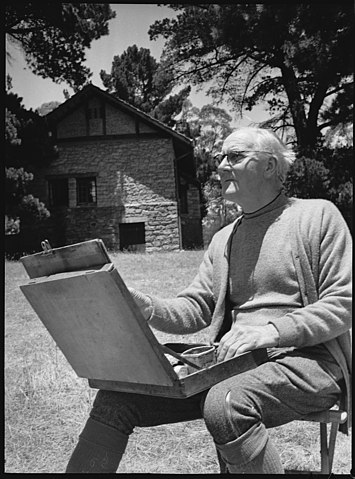
Hans Heysen painting, Hahndorf, Adelaide Hills, January 1950
Photographer: R. Donaldson, PIX Magazine, State Library of New South Wales, ON 388/Box 004/Item 006
Wilhelm Ernst Hans Franz Heysen arrived from Hamburg in 1883 at the age of six. During his childhood in Adelaide he went to stay with a family friend at Hahndorf, thus beginning his life-long attachment to the small German village, the Adelaide hills and, above all, the majestic gum trees.[2]
Heysen received art lessons in Adelaide in the late 1890s and his artistic talent became quite well-known in the city. Four Adelaide businessmen decided to give Heysen 400 pounds so that he could go to Europe for a few years and attend art school there. In return Heysen had to send them all the work he produced during his years overseas. He spent the first two and a half years studying in Paris. While in Europe he visited Hamburg in Germany, the city where he had lived as a small boy, and he visited relatives in the city of Braunschweig.[3]
Heysen’s national significance as a painter was clear as early as 1904 when the Art Gallery of New South Wales and the Art Gallery of South Australia bought major paintings from him, and over the next five decades Australian public art galleries bought his works.[4]
In 1904 he married Selma Bartels. Like Heysen, she was of German background. Her father, Adolph Bartels, born in Gilten, Hanover, had been Mayor of Adelaide from 1871-1873.
From 1908 onwards they lived in Hahndorf (South Australia) and Heysen became one of Australia's most popular landscape painters. He also produced drawings of some of Hahndorf’s old farm buildings and its older settlers. 'The simple old-fashioned German village and the magnificent gum trees in the surrounding countryside that attracted Heysen was a landscape painter’s dream.'[5]
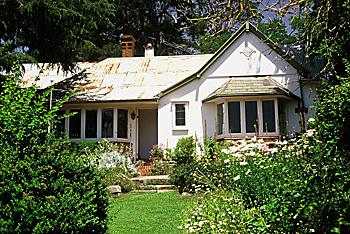
"The Cedars" - Hans Heysen's home in Hahndorf
You can visit the house and Heysen's studio alongside it.
Photo: D Nutting
He held his first important exhibition in Melbourne during 1908. As a result of this successful exhibition in Melbourne, in 1912 Heysen and his wife were able to buy 'The Cedars', an established colonial home in 15 hectares of land just outside Hahndorf. Sales of his paintings at a Sydney exhibition in 1927 made an Australian record.
In 1913, in an interview with a newspaper reporter who visited him in Hahndorf, Heysen explained his affection for gum trees: “It is a wonderful old tree, full of romance and mystery. It picks up the light in ways that no other trees seem to do, and it has a great hold on the affections of the people.” He explained why Hahndorf was for him a good place to live: “Not more than ten minutes or a quarter of an hour's walk of this house (...) I have the trees, the sunlight, the shadow, and the colours I want just here at home. If I can make other people feel the beauty of the gum tree, then I will surely have done something.”[6]
An example of Heysen's 'monumental gum trees' is his painting Droving into the light, at the Art Gallery of Western Australia. You can view the painting and read about it via this link.
Later in his career he made trips into the Outback, particularly to the Flinders Ranges, where he produced groundbreaking depictions of the arid landscapes there. He painted pictures with amazing precision, particularly in the Aroona and Arkaba areas.[7] A long-distance walking trail in South Australia was named after him. The Heysen Trail runs from the Flinders Ranges via the Adelaide Hills to Cape Jervis and is approximately 1,200 kilometres long.
Hans Heysen won Australia's Wynne Prize for landscape painting nine times between 1904-32. His daughter Nora won Australia's prestigious Archibald portraiture art prize in 1938.
In 2013 Australia Post issued a stamp featuring a painting by Heysen. This stamp was part of a series which celebrated "landscapes from the National Gallery of Australia collection by five of Australia’s best known painters".[8] The artists featured were: Eugene von Guérard (another artist born in a German-speaking country), Hans Heysen, Arthur Streeton, John Glover and Nicholas Chevalier. Australia Post wrote about the Heysen stamp: "The landscape of the Flinders Ranges in South Australia provided great inspiration for Hans Heysen. German-born Heysen is known for conveying the majesty of large gum trees, evident in his In the Flinders – Far North."[9]
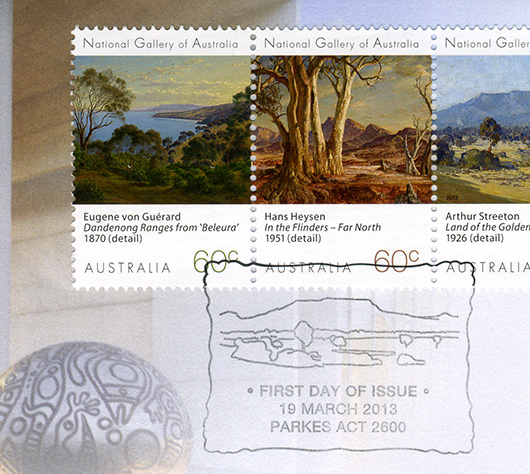
Australia Post's first day cover (detail) for the series "The Gallery Series (National Gallery of Australia) - Landscapes (2013)".
The streets of Milgate Park estate in Doncaster East (a suburb of Melbourne) honour landscape painters of Australia, and include the street Heysen Grove.[10] It is most likely that the street Heysen Drive in Sunbury (Victoria) is named after Hans Heysen (nearby streets are named after other well-known painters or art benefactors in Australia, such as Dobell Avenue, Drysdale St, Meldrum Court, Lindsay Avenue, Felton Avenue, and Nolan Court).
♦ Notes:
1. Andrews (2008), p.6
2. Heysen, Peter. (n.d). ‘Sir Hans Heysen, OBE’, SA History Hub, History Trust of South Australia, <sahistoryhub.history.sa.gov.au/people/sir-hans-heysen-obe>, accessed 21 August 2022.
3. Andrews (2008)
4. Andrews (2008)
5. Andrews (2008), p.46
6. HANS OF HAHNDORF. (1913, May 3). The Mail (Adelaide, SA : 1912 - 1954), p. 8. Retrieved August 18, 2022, from <nla.gov.au/nla.news-article58514238>
7. Tampke & Doxford (1990), p.210
8. Stamp Bulletin Australia, No.321, 2013. Ferntree Gully (Victoria): Australia Post. p.12
9. Stamp Bulletin Australia, No.321, 2013. Ferntree Gully (Victoria): Australia Post. p.12
10. Wajnryb, Ruth. (2006). Australian place name stories. South Melbourne (VIC) : Lothian Books. p.8
♦ References:
Andrews, Rebecca & Art Gallery of South Australia. (2008). Hans Heysen. Adelaide: Art Gallery of South Australia
Tampke, Jürgen & Colin Doxford. (1990). Australia, Willkommen. Kensington NSW: New South Wales University Press.