Names
Australian Placenames of German Background
NT & WA | NSW | QLD | SA | TAS | VIC
Count Otto von Bismarck and names in Australia
The influence of the name Bismarck in Australia
Who was Bismarck?
Otto von Bismarck was a key figure in German and European history. He served as the Prime Minister of Prussia and later became the first Chancellor of the German Empire. Through strategic wars and diplomacy, he played a major role in unifying Germany in 1871 under Prussian leadership.
Bismarck was known for his political skill and the system of alliances he created to maintain peace in Europe. His foreign policies, called "Realpolitik," focused on practical goals rather than ideals. Bismarck's leadership helped make Germany a powerful European nation and influenced European politics for decades. The Encyclopedia Britannica describes Bismarck as "a towering figure who put his stamp on his age".[1]
.jpg)
Count Otto von Bismarck, approximately 1875.
Photo source: AD.BRAUN & Cie Dornach, Public domain, via Wikimedia Commons
.JPG)
Many Germans felt very happy and patriotic after the unification of about 25 states (that were of various sizes and forms of government)[2] into the German Empire. Some Germans had felt a bit of shame that their country played an insignificant role in world affairs and had the feeling that some foreigners made tolerant but slightly condescending remarks about 'the land of writers and thinkers'.[3] During the 1870s, after unification, Bismarck became not only the political symbol of the Reich (empire), but a culture hero also. A kind of fascination with him developed among artists and writers.[4] Bismarck's policies were not always universally popular with parliamentarians in the Reichstag (the parliament of the new unified Germany), but across many sections of the German population he was a hero because of his key role in creating the new nation.[5]
Evidence that the German Empire, created in 1871, is sometimes more associated with Bismarck than with the Kaiser/emperor of the Empire, is a speech given by Walter Scheel, former President (head of state) of West Germany in 1986. While listing different phases of German history he referred to ‘Bismarck’s German Empire’ [“im Deutschen Reich Bismarcks“].[6]
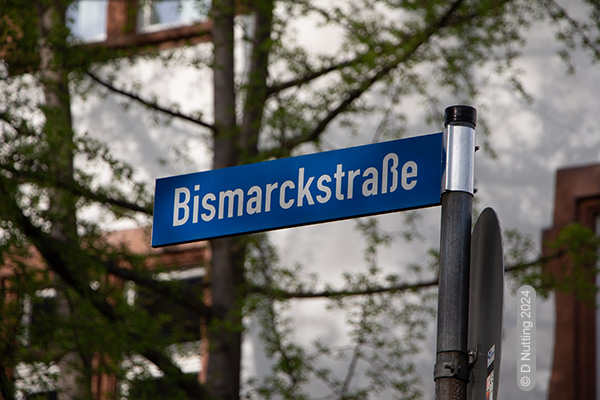
Bismarckstraße, a street in the city of Marburg, Germany.
Places, companies
At least four Australian villages were named after Bismarck in the 1870s (in Tasmania, Victoria, Queensland and in South Australia[8]), and the capital city of the state of North Dakota in the USA was named after Otto von Bismarck in the early 1870s.
The prosperity of Bendigo (Victoria) was due to its extensive gold mines, and many mining companies were formed there. Bendigo also had a significant population of Germans; there are many people in Bendigo today with a German surname. In 1867 the 'Bismarck' Company registered its claim for its quartz mine at Frühling's Reef in the Whipstick area of Bendigo.[9] In 1869 another company, also called 'Bismarck Co.' registered its claim for its deep-lead alluvial mine on Epsom Flat.[10] Both these 'Bismarck' companies were established by syndicates consisting of German miners or investors. Both companies were established before 1871, the year of the unification of many German-speaking states and duchies, however Otto von Bismarck was already a well-known statesman internationally in the 1860s.
The Bismarck United Quartz Mining Company, at Donnelly's Creek in Gippsland, eastern Victoria, was a mine employing 12 men in 1874.[11] The Count Bismarck Company operated a deep alluvial mine south-west of Bowenvale in Central Victoria. Work at the mine began around 1870, at a time when Otto von Bismarck was already a well-known statesman internationally.[12] In Queensland the Bismarck Mine was an open-cut copper and tin mine (now abandoned) west of Herberton in the Atherton Tablelands.[13]
For many years in the second half of the 19th century and on into the 20th century there was a Prince Bismarck Hotel in Barnard Street in Bendigo, Victoria.[14]
Bismarck Street in Heidelberg Heights (Victoria) became Thames Street in 1917 during the anti-German atmosphere of World War One. Before the outbreak of World War One in 1914, Carlton & United Breweries of Melbourne sold a lager beer with the brand name 'Bismarck'. In 1914 they stopped selling it.
A name for German Australians
Another example of the admiration which some Germans in Australia had for Bismarck in the years following the creation of a united Germany is the fact that German-Australian couples named their sons after Bismarck.
Harold Bismarck Schinkel - he was born in 1890 in the village of Goroke, in the far west of the Wimmera in Victoria (a region where there are many families of German descent). His father was born in South Australia and his mother was born in Germany. Harold served overseas in the Army Medical Corps of the Australian Imperial Force during the First World War. A tree in the World War 1 Avenue of Honour at Booroopki (22km from Goroke) honours Harold.[15]
Fritz (Fred) Bismark Vahland - the famous Bendigo (Victoria) architect Wilhelm Vahland, whose prolific work had a major influence on the appearance of Bendigo, and his wife Jane had ten children. They named one of their children Frederick Bismark Vahland, born in 1871, the momentous year of Germany's unification.[16]
Gifts from Australia
Otto von Bismarck was so admired that he received many presents from private citizens in Germany and in Australia.
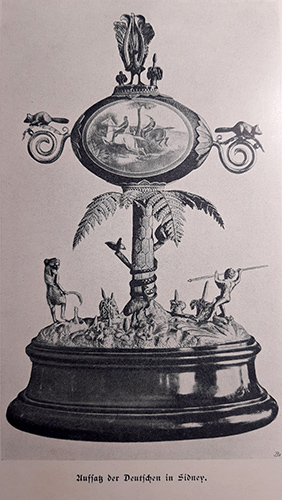
The table decoration (Tafelaufsatz) from Sydney - a present for Bismarck.
Picture from the 1899 catalogue

He received letters and presents from German Australians, including the wine merchant and mine owner F.C. Klemm from Bendigo (Victoria), who visited Bismarck personally as a representative of the ‘Deutscher Verein’ in Bendigo, who collectively had arranged a writing set made of Bendigo gold, St Arnaud silver and ebony (wood) from Mount Macedon.[17] Herr Klemm also handed over a tribute address (a formal text honouring him) by the Germans in Bendigo on 18 April 1873.
Bismarck also received a ‘congratulatory address from the German colony of Victoria in Melbourne. 1 April 1885.’ The congratulatory address, sent in an elegant leather binding, was produced by the renowned Melbourne lithographer (and German immigrant) Charles Troedel and signed on behalf of the ‘German Association of Victoria’ by its chairman Hermann Wilhelm Puttmann and secretary Ernest Hartung.[18]
From the Germans in Sydney Bismarck received a small sculpture in the form of a piece of decorative tableware, intended to be placed centrally on a festive dining table. The Bismarck Museum (opened in 1891 to display many of the objects important in Bismarck’s life, including gifts he received) produced a catalogue in 1899, and described the sculpture from the Germans of Sydney as particularly unique. It was described as made of silver with a black base and was, according to the German historian Johannes Voigt, “the most artistic and appreciated gift in the Bismarck household”.[19] The museum catalogue includes this description (here in translation): ‘On the ground, among plants native to Australia, we see an Aboriginal Australian hunting, an Aboriginal woman with her child on her back, and a New Holland ostrich [website editor: this refers no doubt to an emu and unusually uses the older term for Australia – New Holland]. In the centre rises a tree fern, around whose trunk a snake winds itself, while a dove sits on a branch. Finally, an ostrich egg decorated with a hunting scene rests on the tree, above which a lyrebird is presented.’[20] The “ostrich egg” was no doubt an emu egg.
The catalogue reported that when Otto von Bismarck saw this table centrepiece from Sydney, he showed particular interest in the exotic fauna depicted on it in various forms. He asked for the names of the different species of animals. This sculpture stayed with the Bismarck family at their manor house in Friedrichsruh (about 20 km east of Hamburg) and was not exhibited at the museum. A photo of the sculpture appeared in the museum’s book about the collection in 1899, about a year after Bismarck’s death. That photo is displayed here. Since the end of World War Two the whereabouts of the sculpture have been unknown.[21]
Bismarck Herrings
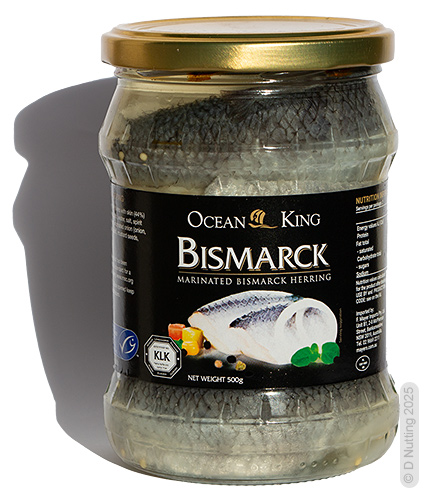
Bismarckherring, as sold in Australia.
Apart from the Bismarck apple in Tasmania (see information about the town Bismarck in Tasmania), a food product in Germany was named after him. In 1871 the owner of a canned fish company in Stralsund, Herr Johann Wiechmann, sent two small wooden barrels of his Baltic Sea pickled herrings to Bismarck as a gift (what's that? ➜ pickled, fresh, filleted herring in a vinegar-based brine, often with added spices and sometimes onions). He received permission to market them in future as 'Bismarck herrings' and they became a standard food item in low-income households, and the name 'Bismarck herrings' (in German: Bismarckhering) entered everyday language in Germany. This fish product is sometimes sold in other countries under that name, including in Australia. Bismarck was a food connoisseur with an enormous appetite: 16 eggs for breakfast, 150 oysters for dinner.[22]
♦ Notes:
1. Barkin, K. (2024, November 21). Otto von Bismarck. Encyclopedia Britannica. Accessed in November 2024 from <https://www.britannica.com/biography/Otto-von-Bismarck>.
2. Craig (1980), p.39
3. Craig (1980), pp.56-57
4. Craig (1980), p.59
5. MacGregor (2017), pp.383, 391 / Hoyer, Katja. (2022). Blood and Iron. The rise and fall of the German Empire 1871-1918. Paperback edition. Cheltenham (UK): The History Press. pp.72, 76, 80, 106
6. Scheel, Walter. (1986). Rede zum 25. Jahrestag des “Tages der deutschen Einheit” im Plenarsaal des deutschen Bundestages am 17. Juni 1978. In: Wen schmerzt noch Deutschlands Teilung? Zwei Reden zum 17. Juni. Reinbek bei Hamburg: Rowohlt Taschenbuch Verlag. p.33
7. Bismarckierung. Ein Projekt der Otto-von-Bismarck-Stiftung. Otto-von-Bismarck-Stiftung d.ö.R., Friedrichsruh. Online at <http://www.bismarckierung.de/>.
8. Voigt (1987), p.65
9. Cusack (1998), pp.36, 241
10. Cusack (1998), pp.36, 237
11. The Bismarck United Quartz Mining Company, Gippsland. Reports of the Mining Surveyors and Registrars. Quarter ended 30th June 1874. Presented to both Houses of Parliament by His Excellency's Command. Available at <www.parliament.vic.gov.au/papers/govpub/VPARL1874No64.pdf>
12. GOLD-MINING IN VICTORIA. (1876, February 9). The Argus (Melbourne, Vic. : 1848 - 1957), p. 7. Retrieved February 4, 2025, from <http://nla.gov.au/nla.news-article7431634> / Bannear, David. (n.d.). North West Victoria Historic Mining Plots (Maryborough), 1850-1980. Historic Notes (PDF). Available at Heritage Victoria. Accessed on 04/02/2025.
13. Map of Bismarck Mine, QLD. Information at bonzle.com. Accessed on 04/02/2025.
14. LICENSES REDUCTION BOARD. (1914, May 2). Bendigo Advertiser (Vic. : 1855 - 1918), p. 7. Retrieved February 4, 2025, from <http://nla.gov.au/nla.news-article89987042> / Cusack (1998), pp.81, 85
15. World War 1 Avenue of Honour. Booroopki, West Wimmera, Victoria, Australia. Casterton & District Historical Society. Available at: <www.swvic.au/goroke/schinckel.htm> / First World War Embarkation Roll. Harold Bismarck Schinckel. Australian War Memorial. Available at: <www.awm.gov.au/collection/R1929898>
16. Ballinger, Robyn. (2015). A short biography of William Vahland. Prepared for the City of Greater Bendigo. Longlea (VIC) : History in the Making. PDF online here. p.5
17. Voigt (1987), p.65 / Lodewyckx, Prof. Dr. A. (1932). Die Deutschen in Australien. Stuttgart: Ausland und Heimat Verlagsaktiengesellschaft. pp.227-228
18. Morgenstern, Ulf. (2025). Personal communication (email). 28/07/2025. (Otto-von-Bismarck Foundation, Friedrichsruh, Germany)
19. Voigt (1987), p.65
20. de Grousilliers, A. (editor). (1899). Das Bismarck-Museum in Bild und Wort. Ein Denkmal deutscher Dankbarkeit. Berlin: Im Selbstverlag. p.11
21. Gosdek, Katja. (2025). Personal communication (email). 30/07/2025. (Otto-von-Bismarck Foundation, Schönhausen, Germany)
22. MacGregor (2017), p.391 / Faigle, Iris. (2010). Rundum. Einblicke in die deutschsprachige Kultur. Stuttgart: Ernst Klett Sprachen. p.54
♦ References:
Otto von Bismarck. (2023, August 2). Wikipedia. Retrieved 19:47, February 3, 2025 from <https://simple.wikipedia.org/w/index.php?title=Otto_von_Bismarck&oldid=8976370>.
Craig, Gordon. (1980). Germany 1866-1945. New York: Oxford University Press
Cusack, Frank (editor). (1998). Bendigo - the German Chapter. Bendigo (Victoria): The German Heritage Society
MacGregor, Neil. (2017). Germany. Memories of a Nation. New York: Vintage Books.
Voigt, Johannes H. (1987). Australia-Germany. Two Hundred Years of Contacts, Relations and Connections. Bonn (Germany): Inter Nationes