Names
Australian Placenames of German Background
Bismark, Victoria
Bismarck/Bismark was an officially surveyed, but never proclaimed, township, which probably came into existence around 1874. It was located about 35 km north of Stawell in the Wimmera. The purchaser of allotments 1 and 2 in the township had a Germanic name, which may be the reason why the township was named 'Bismarck'.[1] Otto von Bismarck was a Prussian statesman who masterminded the unification of many independent German-speaking duchies, states and kingdoms as the German Empire in 1871 and he served as the first Chancellor of that empire. Bismarck had a major influence on European politics with his diplomatic strategies.
➜ Here you can read more about Otto von Bismarck's influence on names in Australia.
Bismarck in Victoria was one of at least four Australian villages named after Bismarck in the 1870s (others were in Tasmania, Queensland and in South Australia, and the capital city of the state of North Dakota in the USA was named after Otto von Bismarck in the early 1870s).[2]
Bismarck was located in a flood-prone area and its site has been under several feet of water on more than one occasion since it went into obscurity. There was never a state school at Bismarck. There was a state school only 3.2 km away from Bismarck, but that school was not called Bismarck – it was Carr’s Plains (State School No.1860) and operated from 1877 to 1913.[3]
In the 1881 census there were six dwellings recorded at Bismarck and a total of 31 inhabitants.[4]
The Bismarck post office operated from 1/8/1890 and closed on the 1/7/1895, perhaps because the declining population made a post office no longer worthwhile. In approximately 1902 an R.O. (receiving office) opened, which was a sort of part-time postal business that did not offer all the services of a post office.
During the First World War the residents of Bismarck asked the Stawell Shire Council in 1915 to change the name of their receiving office from Bismarck to Kitchener R.O. (Kitchener was the surname of a British general) and the Council agreed to this request. However, it appears that the change did not have an ongoing effect, perhaps because the population of Bismarck was very small in 1915.
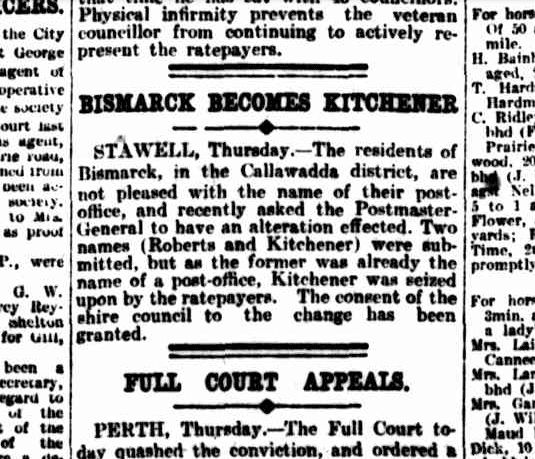
"Bismarck becomes Kitchener" - newspaper article in The Argus in July 1915[5]
The only local visible remnant of Bismarck’s existence is the name of the east-west road named Bismark-Lubeck Road, which appears on maps (e.g. in the VicRoads country street directory).[6] The ‘c’ dropped out of the name ‘Bismarck’.
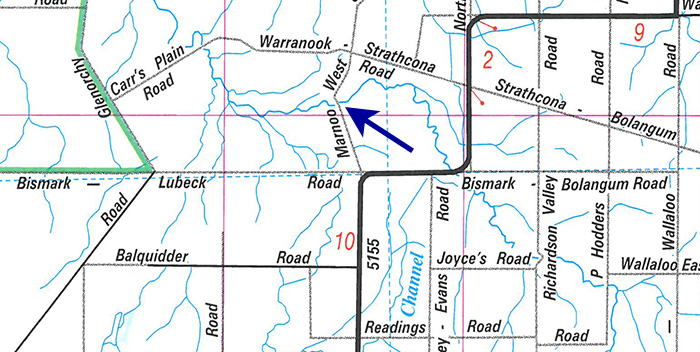
Detail from a map in the VicRoads country directory. The blue arrow shows the location of the village of Bismark.
Bismark is listed as a neighbourhood by VICNAMES – the Register of Geographic Names. The VICNAMES website shows Bismark in the area north of Callawadda. VicEmergency, the government website that gives Victorians emergency information and warnings, refers to Bismark when warnings are in place for the region north of Stawell. The name 'Kitchener' did not survive here.
♦ Notes:
1. Angus Watson, personal communication, 24/10/2004
2. Voigt, Johannes H. (1987). Australia-Germany. Two Hundred Years of Contacts, Relations and Connections. Bonn (Germany): Inter Nationes. p.65
3. Watson (2003), p.44
4. Watson (2003), p.44
5. BISMARCK BECOMES KITCHENER (1915, July 23). The Argus (Melbourne, Vic. : 1848 - 1957), p. 11. Retrieved November 20, 2022, from <http://nla.gov.au/nla.news-article1540336>
6. VicRoads: country street directory of Victoria. 5th ed. [n.d.]. Noble Park (VIC.): RACV Publications Department. ISSN: 1329-5284. map 41. Reproduced with permission of the RACV (28/05/2014)
♦ References:
Watson, Angus B. (2003). Lost & almost forgotten towns of colonial Victoria : a comprehensive analysis of census results for Victoria, 1841-1901. Angus B. Watson and Andrew MacMillan Art & Design. ISBN: 0958053707