Names
Australian Placenames of German Background
Collinsvale/Bismarck, Tasmania
In the early 1870s Tasmania’s immigration agent Friedrich Buck was travelling in Germany to recruit immigrants for Tasmania. In August 1870 the ship Victoria arrived in Hobart with German immigrants who soon moved up to Sorell Creek. Sorell Creek is in the mountains 18 kilometres north-west of Hobart. The first settler up there was English, but many Germans soon followed, and Danes also (Friedrich Buck had also promoted Tasmania in Denmark and published pamphlets in Danish about life in Tasmania[1]). Sorell Creek was proclaimed a town in 1881 and renamed 'Bismarck', in recognition of the many German settlers there. Otto von Bismarck was a Prussian statesman who masterminded the unification of many independent German-speaking duchies, states and kingdoms as the German Empire in 1871 and he served as the first Chancellor of that empire. Bismarck had a major influence on European politics with his diplomatic strategies.
➜ Here you can read more about Otto von Bismarck's influence on names in Australia.
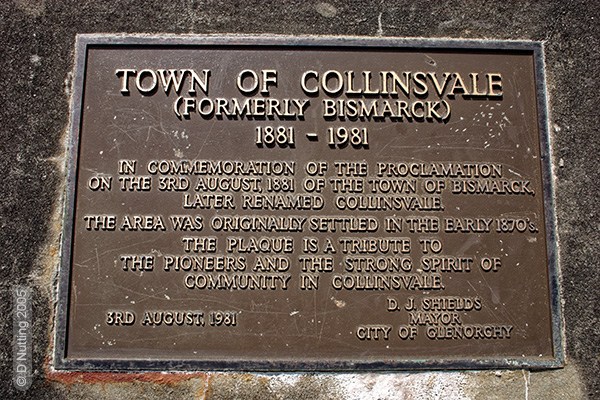
Commemorative plaque in a park in the centre of Collinsvale. It commemorates the centenary of the village and acknowledges the former name Bismarck.
The historian Henry Reynolds described the village of Bismarck as: "a highly successful German farming community in the hills near Hobart".[2]
The Bismarck apple
Bismarck was well-known for its fruit production, and the name of an Australian variety of apple has a German background, possibly in the Tasmanian village of Bismarck. The Bismarck apple is not very common today, but a British website for plant nurseries lists the Bismarck apple and describes it like this:[3]
An old Australian variety dating from c1870 which is believed to have either originated at the German settlement of Bismarck in Tasmania or raised by F Fricke, a German settler at Carisbrooke, Victoria. Awarded RHS [Royal Horticultural Society] First Class Certificate 1887. Grown in Victoria and also in Europe until 1930's.
Keepers Nursery
The name change
Not long after the start of World War One some people in Australia started to protest about anything in Australia that appeared to be German in some way. Some people in Tasmania demanded that the name of the village Bismarck be changed. Letters for and against went to the local council. Some people in Bismarck were worried that a name change would be a disadvantage for selling their farm produce, which was known under the name Bismarck and had a good reputation. Other people said the opposite, that the German name would now be detrimental to their business, e.g. guest house owners concerned about tourism.[4]
The Glenorchy Council received a petition requesting a name change, and another petition from Bismarck residents of German descent who were against the name change. The number of petitioners against the name change was higher than the number of petitions in favour of a name change. However, the Council confirmed the name change in 1915. An article in the Hobart newspaper reported:
The name of Bismarck has been formally changed to Collins Vale, but doubtless the old name will persist for a good while longer. A publication just issued by the Tasmanian Government Tourist Department, entitled "While the Steamer Waits," not only keeps to the old name of Bismarck, but describes it in these terms: - "Bismarck is a most charming semi-Danish village on the mountain side." In the "Tasmanian Tourist" of January 28 a further step is taken towards the de-Germanising of the village, for it is described outright as "the Danish village of Bismarck."[5]
The Mercury (1915, January 30)
The Glenorchy City Council assigned the name 'Bismarck Court' to this street in Collinsvale around the year 1988 – an acknowledgment of the name by which the village was known for 34 years.[6]
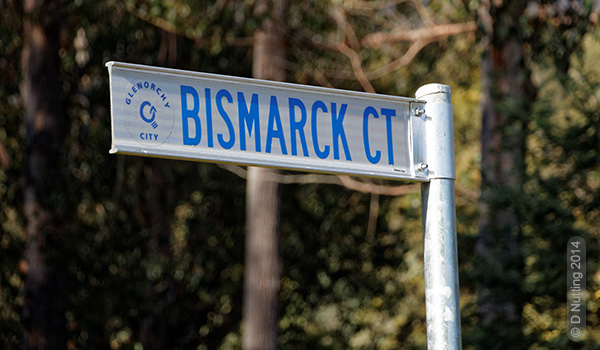
Street sign of Bismarck Court in Collinsvale
♦ Notes:
1. Watt (2020), p.5
2. Reynolds, H. (2011). A History of Tasmania. Cambridge; Melbourne: Cambridge University Press.
3. Keepers Nursery. Bismarck Apple (n.d.). <www.keepers-nursery.co.uk/bismarck-apple-fruit-trees.aspx> (accessed 23/05/2014)
4. Appeldorff (1986), p.19
5. COLLINS VALE, LATE BISMARCK (NEWS OF THE DAY). (1915, January 30). The Mercury (Hobart, Tas. : 1860 - 1954), p. 4. Retrieved May 27, 2022, from <http://nla.gov.au/nla.news-article10402055>
6. Parham, David. (2014). Personal communication (email). Heritage Officer, Glenorchy City Council.
♦ References:
Appeldorff, Gwendolyne. (1986). Memories of Collinsvale. Collinsvale, Tasmania: self-published.
Watt, Michael. (2020). German Settlers on Tasmania’s East Coast. In former TIMES, issue 15, December 2020. The Glamorgan Spring Bay Historical Society Inc.