Names
Australian Placenames of German Background
Introduction | NT & WA | NSW | QLD | SA | TAS | VIC
South Australian Placenames of German Background
▶ See the list of place names in South Australia changed in 1918 during World War I (with locations and explanatory notes).
▶ Article about South Australian German place names:
Part 1 - The effect of World War 1 :: A complete report? :: Cape Bauer - the British Empire's gratitude
Part 2 - German place names that ‘escaped’ detection :: Place names as a recruiting tool
Part 3 - "German" names by accident? :: The 1930s - some German names reinstated :: A German place name that didn’t happen :: New German place names after 1918
"German" names by accident?
In 1918 the government of South Australia aimed to remove place names from the map which were of ‘enemy origin’, i.e. of German origin. At least two Indigenous place names which the government of South Australia implemented during the First World War have in fact the same spelling as a German word. Among the relatively few Indigenous words that the government accepted as suitable in 1918 was 'Kunden' (to replace the German name Carlsruhe). According to the Nomenclature Committee’s report, ‘Kunden’ is “native for ‘resting’”.[1] (The report did not say which Indigenous language the word ‘kunden’ comes from.) 'Kunden' in German is the word meaning ‘customers’ (the plural form of ‘Kunde’).
In 1916 the government proclaimed a new town to be known as ‘Karte’ (located 31 km northwest of Pinnaroo in the east of the state), which according to the newspaper The Register is “Native, meaning 'a low thick scrub'”.[2] Karte has the same spelling as the German noun meaning a card, or a map.
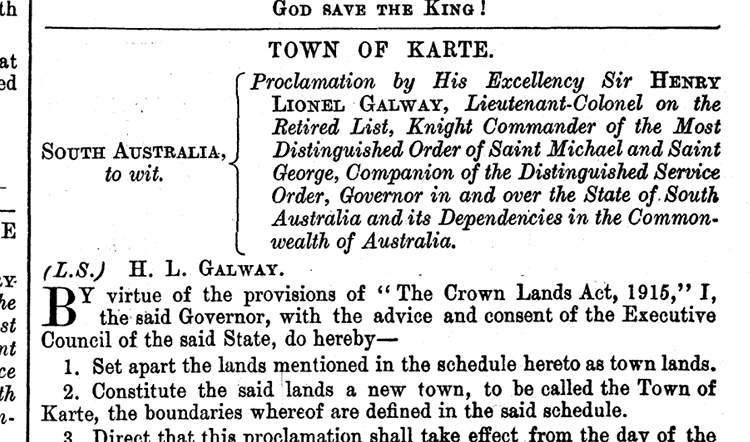
Announcement in the government gazette (close-up detail)
The spellings of the Indigenous place names Kunden and Karte are not intrinsically Aboriginal, as spelling did not exist in the oral culture from which the place names were taken.[3] Australian Aboriginal languages have some complex consonant combinations which don’t exist in English, and the spelling of Indigenous place names in Australia was usually created by an English native speaker who did not have much language training and who adapted what they heard to fit English spelling conventions.[4] It is ironic in the cases of ‘Kunden’ and of ‘Karte’ that the South Australian government implemented place names during the First World War whose spelling looked identical to German words, at a time when they were trying to remove place names that “indicate a foreign enemy origin”.
1930s: some German names reinstated
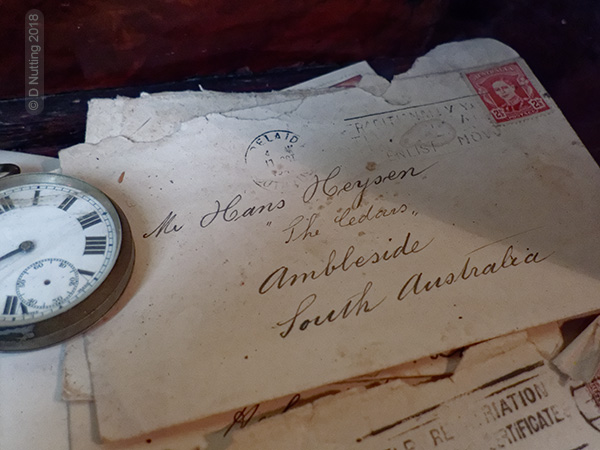
Letter addressed to Hans Heysen, at Ambleside (rather than Hahndorf)
In 1918 the South Australian government changed the place name Hahndorf to Ambleside. The photo above shows a letter addressed to the famous German-Australian painter Hans Heysen at the time when Hahndorf was called Ambleside.
In the 1920s and particularly in the 1930s as the 100-year anniversary of the founding of the British colony of South Australia approached, some South Australians began to feel that the place name changes of 1918 had not been fair to the reputation of the early German immigrants who had been so admired and valued as hard-working and reliable citizens in the 19th century. They suggested that some of the German place names should be restored in 1936 as an act of reconciliation and as a sign of respect to the German-descended citizens of the state. These suggestions triggered many letters to the newspapers of Adelaide, both for and against the restoration of German place names.[5]
For example, Mr W Robert Gray wrote in the Advertiser and Register newspaper in 1931 that the new place names were like memorials to the sacrifices made by South Australia’s men and women in the armed forces during the First World War – memorials to the soldiers who fought in order to save “the world from Teutonic hegemony”.[6] On the other hand, the News reported in 1932 that South Australia’s Attorney-General, Mr William Denny, who was a returned soldier, supported the idea of restoring many of the historical German place names.[7] Mr Denny said:
The decision to alter the names was an hysterical act which did not help the war in any way and did not represent the real views of the people of South Australia (...) When the first favourable opportunity occurs the old beautiful and historical names should be preserved.
Attorney-General, Mr William Denny
At the end of 1935 the South Australian government restored the names of Hahndorf, Lobethal and Klemzig.
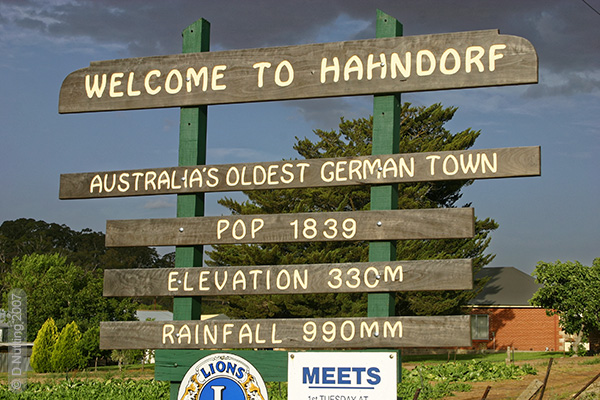
A roadside sign welcoming visitors to Hahndorf
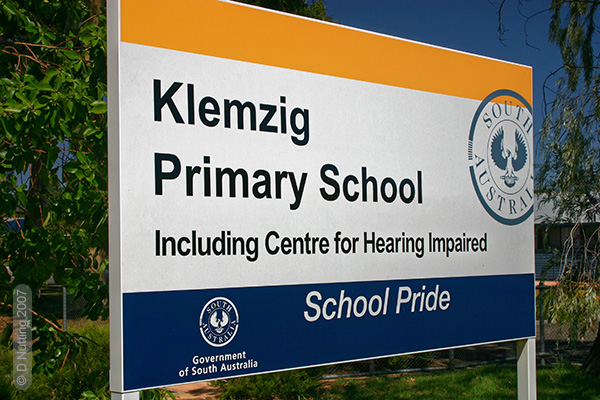
Klemzig Primary School
In the 1970s and 1980s a few more German place names were restored. Of the 69 names that were changed in 1918, 21 have been changed back to their original German names.[8]
Around the year 2015 some towns and hamlets that had a German name before 1918 received signs with dual names - they show the original German name underneath the present-day name. This was an initiative of the German Descendants’ Group within the S.A. German Association (a part of the German Club).[9]
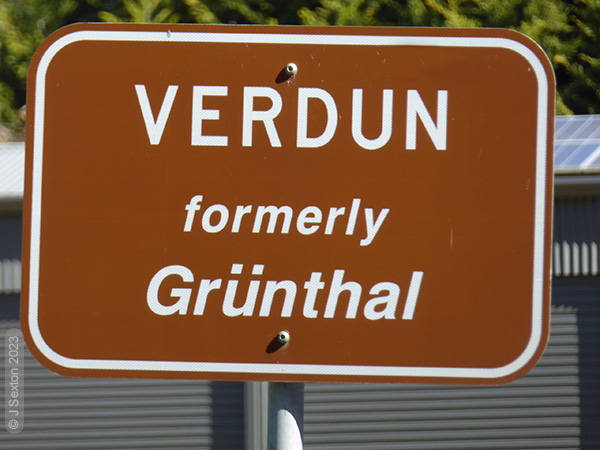
A dual name sign at Verdun in the Adelaide Hills, showing the original name, Grünthal.
A German place name that didn’t happen
The Advertiser newspaper in Adelaide reported in January 1910 that the Marine Board of South Australia had been asked to come up with names for a number of localities, particularly on the west coast of the state, that did not have names. The authorities wanted these places to appear on maps and charts, and the president of the Marine Board had produced a list of names for these places, and the Commissioner of Public Works had approved these names. The two points (headlands) at Venus Harbor (about 65 km south-east of Streaky Bay) were to be named after South Australia's Attorney-General (Mr. Hermann Homburg) and Mr. Thomas Pascoe (Minister for Agriculture).[10] Hermann's father Robert was born in Germany and had also been South Australia's Attorney-General.
The name Point Homburg did not appear in the Nomenclature Committee’s list of German place names in 1916, and it seems the names Point Homburg and Point Pascoe never materialised. For some reason the Marine Board’s plans never went ahead. A search of old government maps and charts and CFS maps revealed no sign of Point Homburg in 2023, and a family who has lived in the Venus Bay / Port Kenny area for generations has not heard of the name Point Homburg.[11]
New German place names after 1918
➽ Monash – this is a town in the Riverland area, about 18 km south-west of Renmark. It was proclaimed in 1921 and was established as part of South Australia’s Soldier Settlement Scheme. This scheme was a project in all Australian States to provide land to returned soldiers so that they could start a career in farming. Monash was named after Australia’s most famous army general in World War I, Sir John Monash, who grew up speaking German as well as English, and whose immigrant parents had removed the ‘c’ from the original spelling of their name (Monasch).
.jpg)
Monash Memorial Hall, in Monash, South Australia
Photo source: Sheba_Also 43,000 photos, CC BY-SA 2.0, via Wikimedia Commons
.jpg)
➽ Klein Point – this is a harbour, 7 km south-southwest of Stansbury on the southern east coast of Yorke Peninsula. It was built for the shipment of limestone by Adelaide Brighton Cement Ltd from the Yorke Peninsula to Port Adelaide. Before 1965 it was known as Farquhar Jetty. August Klein, an early settler from Germany, ran away to sea to escape military service in Germany, jumped ship at Port Adelaide and eventually went to the Yorke Peninsula.[12]
➽ Streitberg Ridge - this is in the northern part of the Flinders Ranges and was named, in 1968, after an engineer in charge of uranium exploration for the mining company Exoil NL.[13]
♦ Notes:
1. Nomenclature Committee's Report, p.2
2. NAMES OF RAILWAY STATIONS. (1915, March 24). The Register (Adelaide, SA : 1901 - 1929), p. 4. Retrieved October 4, 2023, from <http://nla.gov.au/nla.news-article60740013> / 'Karte' is also listed in: Reed, A. W. (1973). Place names of Australia. Frenchs Forest (NSW): Reed Books. p.127
3. Koch (2009), p.137
4. Koch (2009), p.127
5. Kupke (2017), p.52
6. TEUTONIC PLACE NAMES (1931, July 6). Advertiser and Register (Adelaide, SA : 1931), p. 12. Retrieved August 30, 2023, from <http://nla.gov.au/nla.news-article35670798>
7. Restoring German Names (1932, March 5). News (Adelaide, SA : 1923 - 1954), p. 2. Retrieved August 29, 2023, from <http://nla.gov.au/nla.news-article129322580>
8. Kupke (2017), p.62
9. Jiang, Wei. (Traffic Engineer, Traffic Investigations - Road and Marine Services, Department for Infrastructure and Transport, South Australia). Personal communication (email), 01/12/2023.
10. GENERAL NEWS. (1910, January 21). The Advertiser (Adelaide, SA : 1889 - 1931), p. 6. Retrieved September 16, 2023, from <http://nla.gov.au/nla.news-article5224259>
11. May, Debbie. (Elliston and Districts History Group Member), personal communication, email, 21/09/2023
12. Manning (2012), p.460 / SA Memory, via State Library of South Australia. Developing trade and port histories: Outports - Klein Point. Klein Point at the Internet Archive.
13. Manning (2012), p.828
♦ References:
Koch, H. (2009). The methodology of reconstructing Indigenous placenames: Australian Capital Territory and south-eastern New South Wales. In H. Koch & L. Hercus (Eds.), Aboriginal Placenames: Naming and re-naming the Australian landscape (Vol. 19, pp. 115–172). ANU Press. <www.jstor.org/stable/j.ctt24h9tz.12>
Kupke, Lyall. (2017). The restoration of German place-names in South Australia. Journal of Friends of Lutheran Archives, 27, 51–62
Manning, Geoffrey H. (2012). A Compendium of the Place Names of South Australia. From Aaron Creek to Zion Hill. With 54 Complementary Appendices. Available online here.
Nomenclature Committee's Report on Enemy Place Names. Parliamentary paper (South Australia. Parliament); no. 66 of 1916, pp. 1-4. Available at SA Memory, via State Library of South Australia, online here.
Styles, A. W. (8 June 1916). "TOWN OF KARTE" (PDF). The South Australian Government Gazette. Government of South Australia: 1215–1216. Retrieved 12 November 2023.