New South Wales
Germans in the Riverina and "The Trek"
19th century migration from the Barossa
In South Australia the inadequacy of small farms, and a series of crop failures due to drought, the rust disease or the declining quality of the soil from over-farming (this was before the invention of fertilisers) meant that many German farmers looked to better land prospects in the colonies in the east of Australia. The Robertson Land Act was passed by the New South Wales government in 1861 and this broke the stranglehold that pastoral squatters had had over large areas of 'Crown' land - the Act made available large areas of good wheat farming land in the Riverina in the south of NSW.
J.G. Scholz (1805-1891), known as Gottfried Scholz, brought his family from Silesia to South Australia on the ship HR Patel in 1845. They settled at Light Pass in the Barossa Valley. In 1866 J.G. Scholz and four of his younger children made the long journey overland to the Riverina in NSW and settled at Jindera.[1] They and other families from the Bethanien and Blumberg areas (now called Bethany and Birdwood) were among the first German Lutheran farmers to move to the Riverina from South Australia.
Moving from South Australia to the Riverina involved an arduous trek inland with the immigrants having to carry all the possessions they could in their covered German wagons, travelling through rough country without tracks or roads. One particular caravan of wagons travelling to the Riverina has become famous in the history of the town of Walla Walla - their migration from South Australia is known locally as 'The Trek'. On October 13, 1868 over fifty Lutheran settlers (eight families and two bachelors[2]) from the Light Pass and Ebenezer communities[3] started their journey in convoy to New South Wales, travelling with 14 wagons and two carts. These Lutherans were a mix of Germans and Sorbs (see more information about the Sorbian minority in Germany) and were the following families: Johann Gottlieb Klemke, Michael Wenke, Andreas Mickan, Andreas Lieschke, J. G. Klemke junior, Wilhelm Fischer (he had arrived in South Australia with Pastor Kavel's first immigrant group in 1838, on the ship Prince George[4]), Christian Terlich und Peter Hennersdorff, as well as the two young men Ferdinand Schmidt and Wilhelm Lührs.[5]
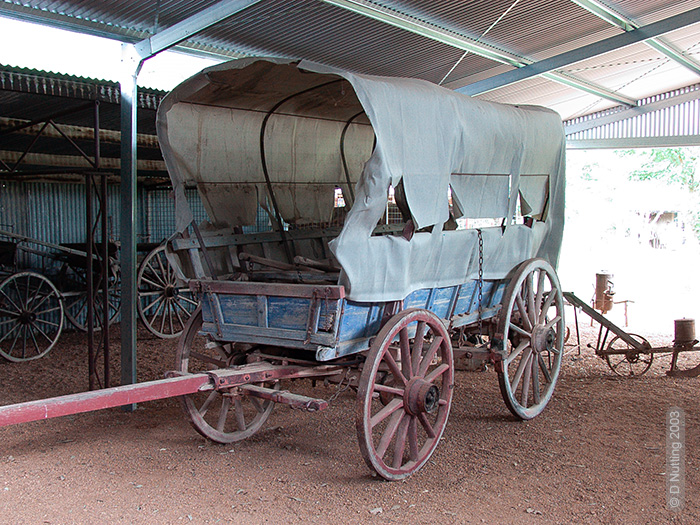
An original German wagon that took part in the Trek-migration from the Barossa Valley to the Riverina in NSW in 1868 (pictured at the Jindera Pioneer Museum).
This group of 56 people included 28 people who were under 10 years old, and Michael Wenke's wife Agneta was six months pregnant when the group left the Barossa Valley. It is therefore likely that these migrants did not try to travel as quickly as possible, out of concern for the welfare of the children and of Agneta Wenke.[6] Each of the 14 wagons was pulled by two horses, and the two carts were each pulled by one horse.[7]
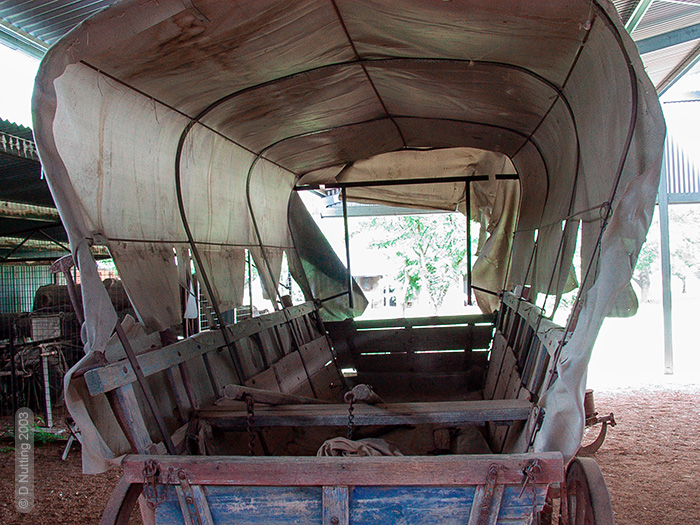
Interior view of an original German wagon that took part in the Trek-migration to the Riverina in 1868 (pictured at the Jindera Pioneer Museum).
They mainly followed the north bank of the Murray River, in order to be not too far from water for their horses and cows, and crossed the Darling River and the Murrumbidgee River by river ferry. Some members of the families slept at night in their wagons and others slept in the open air. They travelled six days a week, stopping every Sunday in order to hold a church service, run by the lay leaders.[8] The trek probably took about six weeks. The Germans were very happy to see the town of Albury, knowing that they weren't far from their destination in the Jindera district, about 17 km north of Albury.[9] The first night that they spent in the Jindera area was celebrated as a new start (J. G. Scholz was already living there and welcomed and helped them), and a stone cairn in Jindera's Pioneer Park is a monument to these Germans.
Ebenezer / Walla Walla
They eventually settled on land north of Jindera at Walla Walla, which they first called Ebenezer, a biblical name and also the name of a place in the Barossa Valley that some of them had come from. There was already a post office in New South Wales (near Sydney) named Ebenezer, so the Germans' town was renamed 'Walla Walla' in 1878. This group did not take a Lutheran pastor with them on the journey to NSW, but one person in the group, Johann Gottlieb Klemke, was a great lay leader, and the church in South Australia authorised him to conduct church services ('lay leader': a member of a church community who is not an ordained pastor or priest, but who holds a leadership position in that church community). Later on in 1868 the Germans in the Riverina were able to have a trained pastor in their parish.[10] A stone cairn on private farm land at Walla Walla was unveiled in 1954 and acknowledges the arrival of the first Lutherans in that area in January of 1869 - some of the men from the Barossa Valley who were looking for suitable land camped under a tree where the cairn now stands.

Memorial cairn at the spot in Walla Walla where the Trek group spent their first night
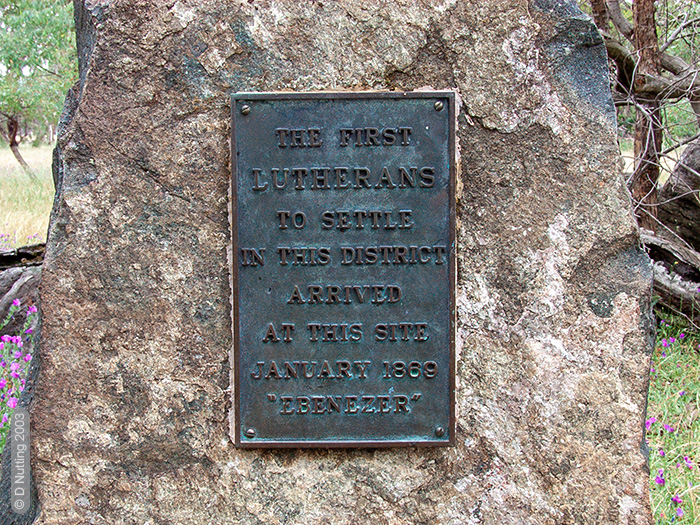
The plaque on the memorial cairn at the spot in Walla Walla where the Trek group spent their first night
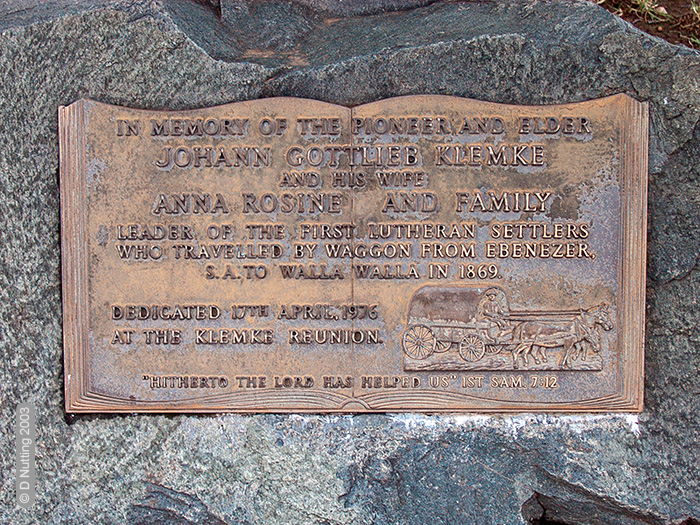
Memorial plaque outside the Zion Lutheran Church at Walla Walla, honouring Klemke and his wife Anna Rosine from the Trek group.
This wagon trek led by Johann Gottlieb Klemke was by no means the last wagon convoy from the Barossa Valley to the Riverina. Newspapers in towns along the route often mentioned that a group of wagons enroute to New South Wales had passed through (for example in The Deniliquin PASTORAL TIMES of Saturday, May 4, 1867).[11] Some of the Germans and Sorbs arriving in the Riverina were from German-speaking communities in the Hamilton and Hochkirch area of southwestern Victoria. The long trek in wagons to the Riverina is a proud part of the heritage of the German-descended people of the area, and the town entrance signs at Walla Walla include an illustration of a covered wagon from the 19th century trek.
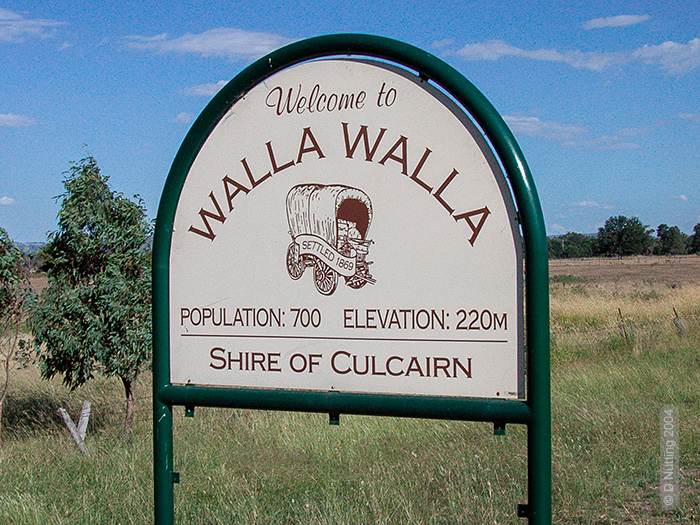
Town entrance sign at Walla Walla, including an illustration of a covered German wagon
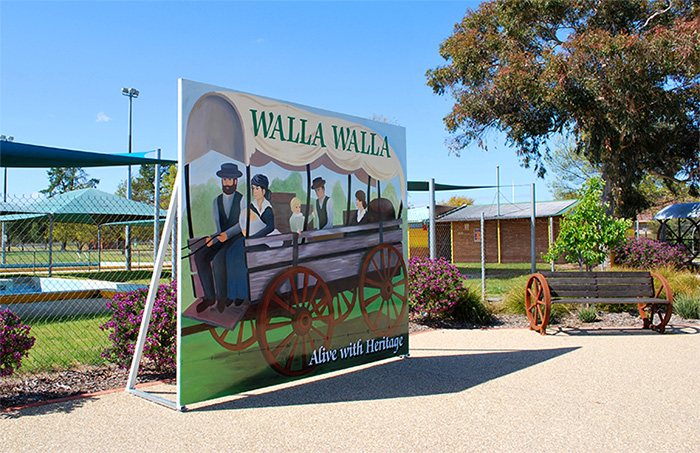
This mural outside the public swimming pool at Walla Walla highlights the importance of 'The Trek' in the town's history. Other features visible in the photo show how wagon wheels are design features in public infrastructure there.
Photo source: Mattinbgn, 2011, CC BY 3.0, via Wikimedia Commons

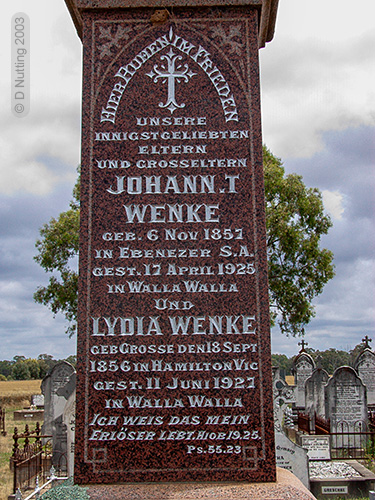
The grave of Johann Traugott Wenke in the Walla Walla Cemetery. He was 11 years old when he travelled with his parents on the Trek. His father Michael was a lay-reader and sometimes led Bible-readings during the Trek. Johann named his farm Fernsicht (meaning: 'clear views') but later changed the name to Fernsight.[12] His wife Lydia was one of the Germans who moved from southwestern Victoria.
Still more Germans moved across from South Australia to NSW and played a significant part in the development of Henty (1870s), Walbundrie, Moorwartha, Brocklesby and Burrumbuttock (1874). At the start of the 1880s a move further north became necessary and Germans made a contribution to the development of Wallendool, now Alma Park (1882), Dudal-Cooma, now Pleasant Hills (1884), Milbrulong (1891), Temora (1900), and Gilgandra (1905).[13]

Salem Lutheran Church, Alma Park.
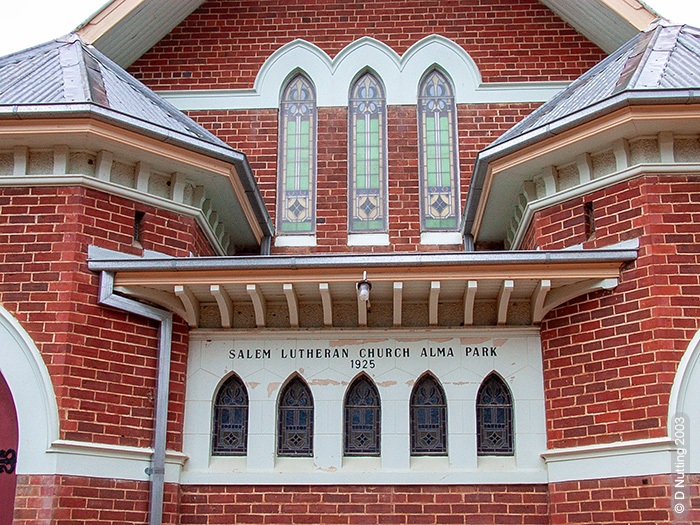
Salem Lutheran Church, Alma Park - close-up view.

The foundation stone of the Salem Lutheran Church, Alma Park, with its German inscription.
Most of these German settlers in the Riverina area created strong communities. The 2020 edition of the Greater Hume Visitor Guide said of Walla Walla: "At the turn of the twentieth century, Walla Walla was characterised by its close-knit community, together with its preservation of the German language and the old ways."[14] These groups were held together by their Lutheran Christianity. Because of this, they kept close ties to their German culture and language until the start of World War I.
Nevertheless, despite the wartime experience, the German language continued to be an important part of Lutheran church life, and it is noteworthy that as late as 1933 the memorial plaque that was installed in Walla Walla's Zion Lutheran Church upon the death of Pastor Simpfendorfer was written in German.
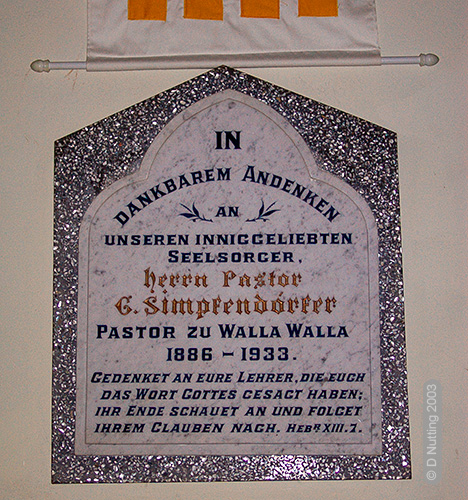
The text on the memorial plaque for Pastor Simpfendorfer in the Zion Lutheran Church is written in German. He graduated from the Basel Mission Seminary in 1885, came to Australia in the same year, and was pastor in Walla Walla for many years.[17]
The many German street names and names of family businesses in the area bear witness to the German heritage of the region.

A business name in Walla Walla that reflects one of the participants in the Trek of 1868.
A promotional brochure published by the Holbrook and Culcairn Shires in 2003 stated: "Our region's rich German rural heritage stands out, not only in our phone books, but also in the form of Walla Walla's impressive Zion Lutheran Church."[18] The first Lutheran church in Walla Walla was built in 1872. The present-day Zion Lutheran Church was built in 1924 and is the largest Lutheran Church in New South Wales. It was designed by Richard Rahnenfuehrer of Culcairn, who was no doubt of German background.
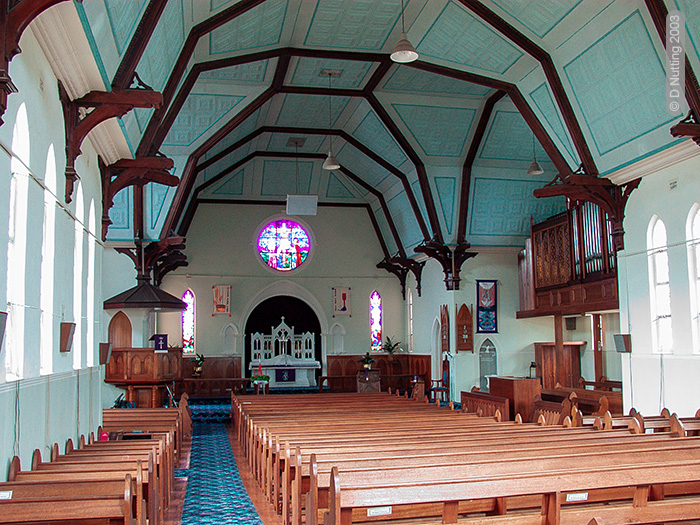
The interior of the Zion Lutheran Church in Walla Walla
In 2018 a large group of Walla Walla residents retraced the steps of their ancestors on the original 'trek' from the Barossa Valley, as part of the community's 150th anniversary celebrations. "Many of the families who were on that original journey, including the Lieschkes, Wenkes, Schmidts and Fischers, remain well-known names to this day."[19]
Hotel Culcairn's German connection
The historic heritage-listed Hotel Culcairn contains physical evidence of the German history of the area. Friedrich Wilhelm Scholz (1867-1934) took over the license for the Hotel Culcairn in December 1896. He was a grandson of J.G. Scholz, who was one of the first German South Australians to move to the Riverina (see above). Friedrich Wilhelm Scholz was the 10th son of Wilhelm Heinrich Scholz (1828-1912), who had arrived in South Australia in 1845 with his father J.G. Scholz and married a daughter of the Lutheran church elder Johann Klemke. She was W.H. Scholz's second wife. W.H. Scholz stayed at Light Pass when his father J.G. Scholz moved to Jindera in the Riverina in 1866.[20] His son Friedrich Wilhelm Scholz was born in the Nuriootpa area of the Barossa Valley in 1867, but moved to the Riverina with his family and spent the greater part of his life in NSW. He was 28 years of age when he and his wife, Louisa, took over the Walla Walla Hotel in 1896. They had a short stay as hosts there, and by the end of the year were running the nearby Hotel Culcairn.
Scholz bought the freehold of the hotel in 1901, and in 1911 added the second storey, making it the largest hotel between Sydney and Melbourne.
In that era the hotel was a very busy place and was the major overnight stop for coach travellers between Sydney and Melbourne.[21] In the list of publicans licenses in the New South Wales Government Gazette in 1898 Scholz' first name Wilhelm is given in the German spelling, as it would have appeared on his birth certificate in South Australia.[22]
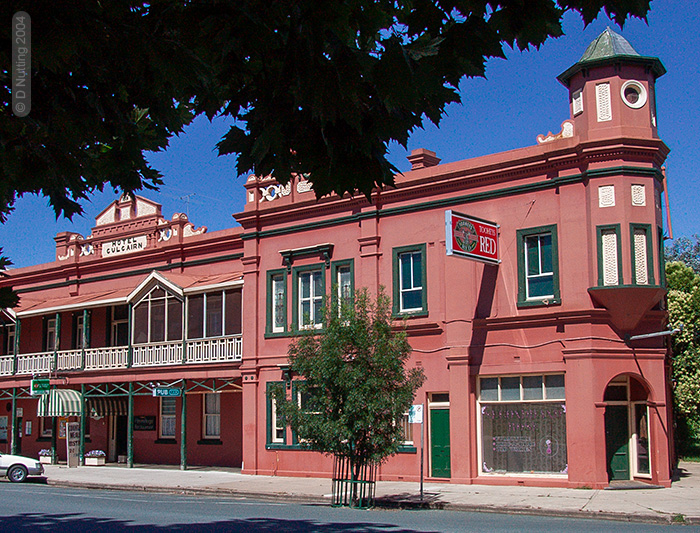
The Hotel Culcairn
Above the doorway leading into one of the hotel's dining rooms is a glass sign with the German words "Morgans Schlupfwinkel" (= Morgan's hideout). This sign was probably installed during Scholz's ownership of the hotel, which he sold in 1917.[23] We can assume that many people coming into the hotel in that era spoke German or were used to seeing and hearing the German language in the community. The 'Morgan' on this sign was the infamous bushranger and outlaw Daniel "Mad Dog" Morgan, who was shot dead in 1865. He had many hiding places throughout this region, and the most prominent is a large white granite formation known as Morgan’s Lookout situated near the road between Culcairn and Walbundrie, about 20 km southwest of Culcairn. Rising above the mostly flat, rolling terrain, this site was reportedly used by the bushranger Dan Morgan as a vantage point (with its 360-degree views of the surrounding countryside) to look out for approaching police.[24] You can read an article in Wikipedia about Daniel "Mad Dog" Morgan.

'Morgans Schlupfwinkel' - a sign inside the Hotel Culcairn
♦ Notes:
1. Kupke, Lyall. (2026, July 22). Personal communication (email), 22/07/2026. (Archivist, Lutheran Church of Australia.)
2. Blaess (1969), p.3
3. Lodewyckx (1932), p.57
4. Wegener (1994), p.56
5. Lodewyckx (1932), p.57
6. Wegener (1994), p.21
7. Wegener (1994), p.18
8. Lodewyckx (1932), p.58
9. Blaess (1969), p.1-2
10. Leske, Everard. (1996). For Faith and Freedom: the Story of Lutherans and Lutheranism in Australia 1838-1996. Adelaide: Openbook Publishers. pp.79-80
11. Reports from towns along the way: OUR LAND SYSTEM. (1867, May 27). South Australian Register (Adelaide, SA : 1839 - 1900), p. 2. Retrieved February 20, 2026, from <http://nla.gov.au/nla.news-article39177070> / RIVERINE INTELLIGENCE. (1867, May 4). The Pastoral Times (South Deniliquin, NSW : 1866 - 1963), p. 2. Retrieved February 20, 2026, from <http://nla.gov.au/nla.news-article267851071>
12. Wegener (1994), p.61
13. Lodewyckx (1932), p.58-59
14. Greater Hume Council. (2020). Greater Hume Visitor Guide. Holbrook (NSW): Greater Hume Council. p.39
15. Pennay (2006), p.20
16. Pennay (2006) / Wegener (1994), p.130 / Fischer, Gerhard. (1989). Enemy aliens: internment and the homefront experience in Australia. 1914-1920. St Lucia (Qld): University of Queensland Press. pp.132-134 / German internee at Liverpool Camp during the First World War – Johan Wenke. National Archives of Australia - Student Research Portal. Online here. / THE CULCAIRN TROUBLE. (1920, January 31). The Morning Bulletin (Rockhampton, Qld. : 1878 - 1965), p. 9. Retrieved March 9, 2026, from <http://nla.gov.au/nla.news-article53881329>
17. Blaess (1969), p.6
18. Tourism brochure produced by Holbrook Shire Council and Culcairn Shire Council in 2003
19. Ebsary, E. (2018, October 6). Historic trek being relived. Border Mail, The (Albury-Wodonga, Australia). Available from NewsBank: Access Australia and International News, online here.
20. Kupke, Lyall. (2026, July 22). Personal communication (email), 22/07/2026. (Archivist, Lutheran Church of Australia.)
21. Wegener, Leon. (2003, December 30). Personal communication (phone call). (Local historian). / Greater Hume Council. (2020). Greater Hume Visitor Guide. Holbrook (NSW): Greater Hume Council. p.24
22. Government Gazette Notices (1898, August 26). New South Wales Government Gazette (Sydney, NSW : 1832 - 1900), p. 6851. Retrieved February 22, 2026, from <http://nla.gov.au/nla.news-article220994309>
23. Wegener, Leon. (2003, December 30). Personal communication (phone call). (Local historian).
24. Greater Hume Council. (2020). Greater Hume Visitor Guide. Holbrook (NSW): Greater Hume Council. p.19
♦ References:
Blaess, F.J.H. (1969). One hundred years: Jindera New South Wales 1868-1968. Briese Family Genealogy Pages. (Article reprinted from the 1969 Lutheran Almanac, pp.20-42). Online at <https://gang-gang.net/briesegenealogy/histories/pdf_files/jindera-1868-1968.pdf>
Lodewyckx, Prof. Dr. A. (1932). Die Deutschen in Australien. Stuttgart: Ausland und Heimat Verlagsaktiengesellschaft. pp.57-59
Pennay, Bruce. (2006). An Australian Berlin and hotbed of disloyalty: shaming Germans in a country district during two world wars. Journal of the Royal Australian Historical Society. Volume 92, Part 1, pp.15-28
Wegener, Leon (editor). (1994). The Trek from South Australia to New South Wales. Walla Walla (N.S.W.): Walla Walla & District Historical Society.