Names
Former Australian Placenames of German Background
Tarrington/Hochkirch, Victoria
The village of Tarrington – approximately 9km south-east of Hamilton in Victoria's Western District, was for many years called 'Hochkirch'.
In 1852 ten families (most of them Wends/Sorbs) left Rosenthal and Hoffnungsthal in the Barossa Valley in South Australia to move to south-western Victoria, where new land was going to be made available by the colonial government. One family travelled by ship from South Australia to Portland in the southwestern corner of Victoria, and the other nine families travelled overland in covered wagons with their livestock and possessions to southwestern Victoria. Land which they had wanted to buy north of Portland was not available because it had been set aside as a townsite for Heywood, and so they moved north-east, further inland, to an area 9km south-east of Hamilton, and settled there.[1]
In 1853 members of the congregation signed an official document on which they wrote that they lived in 'Hochkirch', which was the first time that the name of their new settlement was officially used. As most of the settlers were originally from the parish of Hochkirch, near the city of Bautzen in Saxony, they used this name for their new home in south-western Victoria. Most of the settlers were bilingual, speaking German and Wendish, and some settlers occasionally used the name ‘Bukecy’, which is the Wendish-language form of the name Hochkirch.[2]
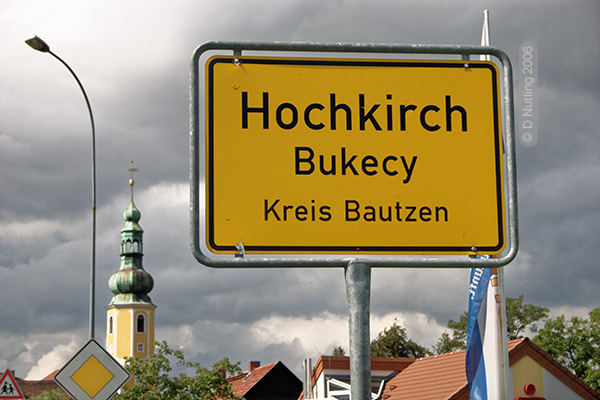
Sign at the entrance to Hochkirch in eastern Germany. The sign also gives the Wendish-language name of the place.
Hochkirch in Saxony is known also as the site of a bloody battle during the Seven Years' War (this war was a kind of World War in the 1700s). On the 14th October 1758 five Austrian units made a surprise dawn attack on the Prussian forces of Friedrich the Great who were camped at Hochkirch. The Prussians lost 9000 men and the Austrians lost 7000 soldiers. There was gruesome intense fighting in the churchyard and the outside walls of the Hochkirch church (its tower is visible in the photo above) still have marks from musket balls.[3]
The writer James Bonwick travelled through western Victoria in 1857 and noted that the people of Hamilton referred to the nearby settlement as 'Germantown'. The name Hochkirch had not yet become widely known.[4]
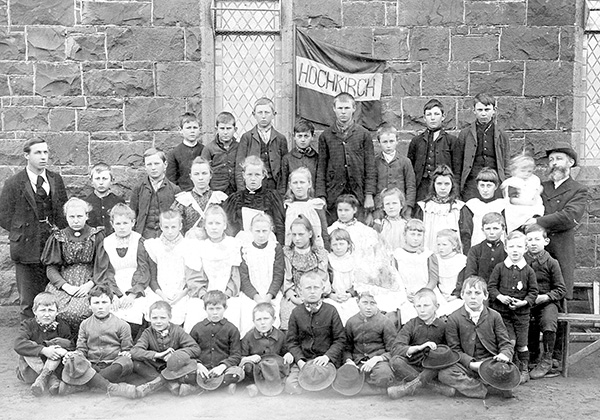
The teachers and pupils of the Hochkirch Lutheran school in a photo from around the year 1900.
Photo source: St Michael's Lutheran Archives, Tarrington
Name change

The postmark of Hochkirch on a stamp used in the year 1894.
Image source: Epistemos, CC BY-SA 4.0, via Wikimedia Commons

Towards the end of the First World War the local council, Dundas Shire Council, decided to change the name of the local post office (Hochkirch) presumably because it was German. The council wrote to the residents of Hochkirch, giving them the opportunity to suggest three alternative names for the post office (in effect, for their village). The people of Hochkirch held a public meeting and put forward three names in order of priority: Hochkirch, Churchville and Tarrington. J.A. Lehmann wrote to council on behalf of the residents and gave reasons why they preferred that the name Hochkirch be retained:
- the residents had been honourably associated with the name Hochkirch for 60 years, and the pioneers who had given the place this name had worked hard to the benefit of Victoria and the name was therefore of sentimental interest to their descendants;
- it would not be democratic to ignore the wishes of the residents of the place;
- the residents had not been told of any reason for the change;
- as Hochkirch is a small and fairly out-of-the-way place, the name is not important to the outside world; a change of the place name must involve expenses, at a time when it is important to limit costs.
The Dundas Shire councillors were surprised and angered by this reply and some of them wished that they had not offered the residents the opportunity to help select the new name.[5]
Councillor Learmonth said the meeting at Hochkirch appeared to have been absolutely hostile to the Britishers.
Hamilton Spectator, 03/11/1917, p.3
Councillor Learmonth was a Dundas Shire councillor.
The name was changed to Tarrington. According to a heritage study produced for the Southern Grampians shire, the name change "was an extremely sensitive and offensive issue to the townsfolk."[6]
Although the name of their post office had been changed to Tarrington, the members of the congregation at St Michael’s Lutheran church continued to call themselves St Michael’s Hochkirch in official church documents, including reports for the synod, until 1957.[7]
The historical name of Hochkirch is celebrated in the name of the winery Hochkirch Wines, which was established in 1990 at Tarrington.
Restore the old name?
In January 2001 some Tarrington locals started an initiative to gauge interest in changing the village name from Tarrington back to Hochkirch. According to ABC Local "there was a move to change the name back to Hochkirch, although surprisingly the older residents weren't in favour of the move, and the effort petered out."[8] This initiative caused controversy and debate in the local community, such that both of Melbourne's mass-circulation daily newspapers reported on it.
Denis Napthine, the local member of State parliament (and Premier of Victoria 2013–2014), and who lived in Tarrington for 10 years before moving to Portland in 1988, gave his opinion at the time in the Sunday Herald Sun: a name change back to Hochkirch “better reflects the history and tradition of that community, but it’s up to the community to decide.”[9]
A protest letter
Some opponents of the proposal had strong opinions about a name change. Some of them wrote a letter to the local newspaper Hamilton Spectator. The letter appeared in that newspaper on 16th January 2001 and was signed anonymously by ‘eight residents, Tarrington’. The writer of the letter did not mention the name Hochkirch in the letter, which had a noticeably anti-German tone. The writer claimed that people suggesting a return to the former name of Hochkirch wanted "to push Tarrington back 100 years into the dark years of German culture."[10] (The letter did not explain what was dark about the German culture in Hochkirch, Victoria, in 1901.)
The anti-German tone of the letter contrasted with the very positive international reputation that Germany enjoyed at the time the letter was written. Several decades earlier, four years after the Second World War, Germans knew that their nation was still ostracised and unpopular.[11] However, by the early 2000s Germany was admired in the international community. The British historian David Blackbourn wrote a history of Germany in the world in 2023 and said that the reputation of German culture stood very high at the start of the 21st century and that Germany “grew in global stature as it continued to demonstrate a finely honed talent for spreading its friendship around.”[12]
An annual poll by the British broadcaster BBC World Service in 2008 found that Germany ranked #1 in international popularity. In that year Germany was included in the poll for the first time, and often ranked #1 annually for the next 4-5 years. The BBC reported in 2013: “Germany is the most positively viewed nation in the world in this year's annual Country Ratings Poll for the BBC World Service. More than 26,000 people were surveyed internationally for the poll.”[13] The tone in the letter in the Hamilton Spectator was in contrast to Germany’s positive international reputation in 2001.
German culture continues to be celebrated in Tarrington, most notably at the annual Laternenfest, a community festival that celebrates the good works and kindness of Saint Martin. In the German-speaking countries children participate in paper lantern processions on St Martin's Day (11th November). The regional newspaper The Standard (based in Warrnambool) reported in November 2014: "Tarrington’s historical link with Germany will shine on Friday night when the town celebrates its 20th annual festival of lanterns."[14]
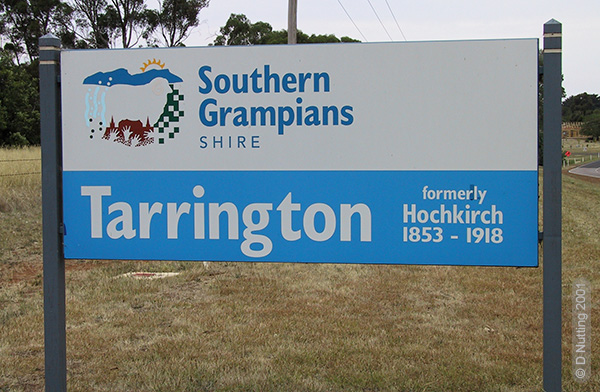
Sign at the entrance to Tarrington. The sign acknowledges the former name of the place.
♦ Notes:
1. Garden, Don. & Hamilton (Vic.) Council. (1984). Hamilton, a Western District history. North Melbourne : City of Hamilton in conjunction with Hargreen. pp.46-47 / Lodewyckx, Prof. Dr. A. (1932). Die Deutschen in Australien. Stuttgart: Ausland und Heimat Verlagsaktiengesellschaft. p.55 / Huf, Betty. (2025, February 5). Personal communication (email) - local historian.
2. Huf (2003), pp.14, 23, 25
3. Füssel, Marian. (2010). Der Siebenjährige Krieg: Ein Weltkrieg im 18. Jahrhundert. München: C.H.Beck. p.47 / Clark, Christopher. (2007). Iron Kingdom: The Rise and Downfall of Prussia, 1600-1947. London: Penguin. pp.204, 206-207
4. Bonwick, James. & Sayers, C. E. (1970). Western Victoria, its geography, geology, and social condition; the narrative of an educational tour in 1857. Melbourne : Heinemann [With an introduction and editorial commentary by C. E. Sayers / First published by Thomas Brown, Geelong, 1858.]. p.166
5. Huf (2003), p.83 / GERMAN NOMENCLATURE. (1917, November 3). Hamilton Spectator (Vic. : 1870 - 1918), p. 3. Retrieved January 25, 2023, from <http://nla.gov.au/nla.news-article119859064>
6. 'Data Sheet 404 - Tarrington Heritage Precinct'. (2004). Southern Grampians Planning Scheme Background Documents (Study #404). Southern Grampians Shire Council.
7. Huf (2003), p.86
8. Lee, Jeremy. (2011, February 4). A-Z of the South West Number 39 - Tarrington. ABC Local. Online article here. Accessed 04/07/2023.
9. Goddard, Geoffrey. (21/01/2001). Let’s rename our town. Sunday Herald Sun. p.12
10. 'No more dark years of German culture'. Eight (unnamed) residents of Tarrington. Letters to the Editor, 16th January 2001. Hamilton Spectator. p.4
11. Bommarius, Christian. (2018). 1949. Das lange deutsche Jahr. München: Droemer. (paperback edition 2023). pp.95, 108
12. Blackbourn, David. (2023). Germany in the World: A Global History, 1500-2000. New York: Liveright Publishing. pp.594, 644
13. 'BBC poll: for the fourth year in a row Germany is the world’s most popular country'. Press release, 10/03/2011. Federal Foreign Office of Germany. <www.auswaertiges-amt.de/en/newsroom/news/110310-bbc-country-rating-poll/242578> / 'BBC poll: Germany most popular country in the world'. (2013, May 23). BBC News. <https://www.bbc.com/news/world-europe-22624104> / ‘Germany gets high marks for good works: POLL.’ (2013, May 25). The Age (newspaper). Available online here.
14. Alexander, Mary. (2014, November 26). Tarrington celebrates 20th festival of lanterns. The Standard (Warrnambool newspaper) - online here.
♦ References:
Blake, Les. (1976). Place names of Victoria. Adelaide: Rigby. p.253
Huf, Betty. (2003). Courage, patience and persistence : 150 Years of German settlement in Western Victoria. Tarrington, Vic. : Sesquicentenary Committee, St Michael's Lutheran Church.
Murphy, Padraic. (21/01/2001). ‘Ich bin ein Tarringtoner … mate.’ The Sunday Age. p.3