Johann Joseph Eugen von Guérard
Landscape painter
Part 1 - his early life and training :: Ballarat goldfields :: artistic style :: homesteads on pastoral stations :: exhibitions :: Tower Hill, 1855
Part 2 - his home in Gipps Street :: influence from German Romanticism :: Georg von Neumayer & Mount Kosciuszko :: later years, return to Europe :: named after him
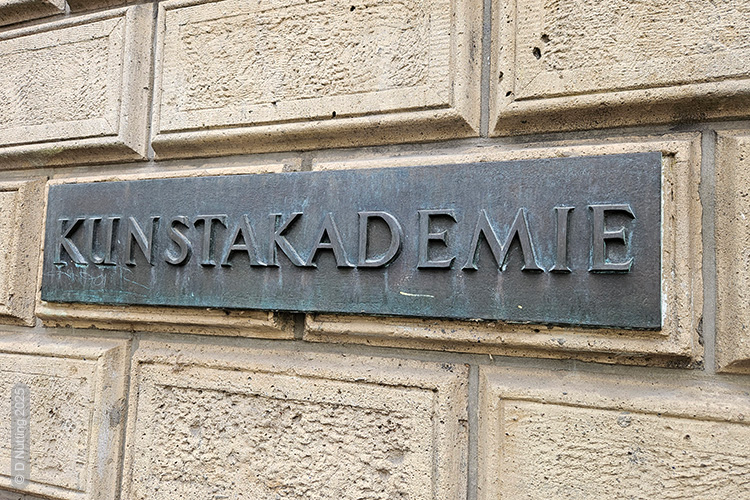
The sign outside the entrance to the Kunstakademie (art academy) at Düsseldorf where von Guérard studied painting.
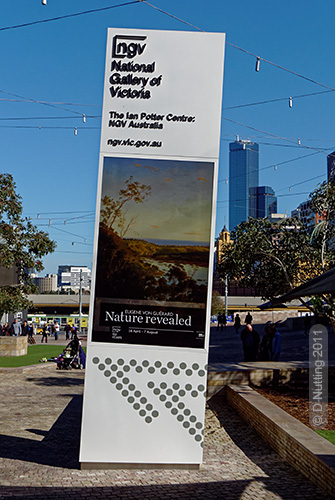
Banner outside the National Gallery of Victoria in 2011.
Johann Joseph Eugen von Guérard (1812-1901), known in Australia as Eugène, was easily the best Romantic landscape painter to ever work in Australia.[1] ‘Eugene von Guérard: Nature Revealed’ was a travelling exhibition that was displayed in several major Australian galleries from April 2011 to July 2012 and featured over 150 works by von Guérard from galleries in several Australian states and Europe.
He was born in Vienna; his father, Bernhard, was a court painter to Emperor Franz I of Austria and his mother was the daughter of a field marshal in Vienna.[2] Eugène displayed some talent in art and his father took him to Italy in 1826 where Eugène studied landscape painting in Rome. He decided to train to be an artist and for a few years he painted landscapes in southern Italy and Sicily.[3]
After the death of his father he went to Düsseldorf, where he studied at the Kunstakademie approximately from 1838-45. Von Guérard stayed in Düsseldorf until 1852, when he spent a short time working in England as drawing tutor to the son of Augustus Tulk, who later became the first librarian of the Melbourne Public Library.
Lured by the news of the gold rushes, von Guérard sailed to Victoria – he arrived at Geelong in late December 1852 in the ship Windermere. He first spent 13 months on the goldfields near Ballarat (and made many sketches of life on the diggings) but did not strike it rich. He set out for Melbourne to try his luck as a professional artist.[4] About three months later, on 15th July 1854, he married Louise Arnz, the daughter of a Düsseldorf publisher whom he had known back in Germany. As a married, professional artist with a daughter, money was often tight for von Guérard and in order to earn money he found himself travelling extensively in south-eastern Australia, sometimes as an artist attached to scientific expeditions.[5] He also made trips to other colonies: Tasmania in 1856 and 1875, South Australia in 1855, New South Wales in 1859. He also visited New Zealand in 1876.[6]
He is best-known for grandiose, romantic paintings of the Australian Alps and of scenes with waterways and of goldfields areas. He was admired for the fine precision and detail in his portrayal of plants and vegetation and of other objects in the landscape. Some British artists and writers who encountered Indigenous Australians wrote about them in disparaging terms, coming from a subconscious mentality of ‘Empire’, and viewing the First Australians as an obstacle to the growth of an English colony. The English sculptor Thomas Woolner, who was in Australia at the same time as von Guérard, is an example of such attitudes.[7] Von Guérard and German-born artists in Australia such as Ludwig Becker and Alexander Schramm combined a scientific exactness in their pictures with a general empathy for the Aborigines.[8]
Homesteads of wealthy squatters
Some of the most lucrative employment was for him as an artist was in painting views of homesteads for wealthy squatters (i.e. sheep farmers), especially those living in the Western District of Victoria.[9] In the days before photography (and well before the self-promotion possibilities of smartphones with social media), a high-quality framed painting of the wealthy land-owner’s house in the landscape was one of the ways to show off your success and what you had achieved. Such a painting was also a kind of declaration of the land-owner’s occupation of the land (land previously lived on by Indigenous Australians).
The station portraits [= paintings of pastoral stations, meaning large sheep farms, for example : editor of this website], especially those of Eugène von Guérard of the 1850s and early 1860s, depict in remarkably intricate (and accurate) detail the homestead, the outbuildings, the garden and plantings, the indigenous vegetation and the topography, as well as the kinds of human activities that took place at pastoral stations. (…) The commissioning of these paintings is evidence in itself of the squatter’s level of attachment for the land they occupied and the level of importance they attached to this occupation.
Heritage Study, Corangamite Shire Council[10]
Exhibitions
Von Guérard participated in Melbourne's earliest art exhibitions in 1854, held a lottery of his pictures at the Mechanics Institute in Melbourne in 1855, and exhibited in the Victorian exhibition of art in 1856 and the inaugural exhibition of the Victorian Society of Fine Arts in Melbourne in 1857.[11] The reviewer of an art exhibition in Melbourne in 1862 wrote that European artists who travel to Australia unintentionally interpret the Australian landscape and its light in a European way, but that von Guérard had adapted to Australian conditions and was able to interpret the Australian landscape "with unerring fidelity".[12]
Tower Hill
Tower Hill, between Warrnambool and Port Fairy on Victoria’s south-west coast, is a giant maar (a volcanic explosion crater). The volcano erupted approximately 30,000 years ago and is inactive. Within the outer crater rim there are cone-shaped hills (from subsequent smaller eruptions) and a crater lake. In 1855 James Dawson, owner of ‘Kangatong’, a farm near Mount Eccles to the west of Tower Hill, commissioned von Guérard to paint the beautiful view which Tower Hill presented at that time. This was von Guérard’s first major oil painting commission in Australia.[13] Over the years Tower Hill was used by farmers for grazing of cattle and by others for the quarrying of stone. A photo taken in 1907 shows the area looking very barren. By the 1920s the area had been completely drained and all the vegetation was cleared. James Dawson visited Tower Hill in 1891 and was shocked at the condition of the place and was relieved that he had had the foresight to commission the painting: “...fortunately for future generations, I commissioned a celebrated artist to paint the scene in oil on a large scale, and he carried out my wishes faithfully and beautifully. On visiting the scene later, I was amazed and disgusted to find everything altered, the fine trees on the cones, and in the craters of the island all gone excepting half a dozen or so.”[14]
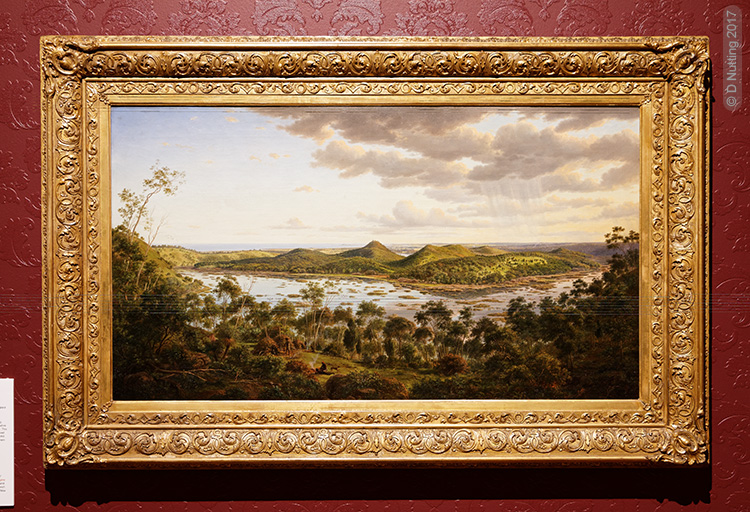
Tower Hill, 1855. Warrnambool Art Gallery.
James Dawson, like many immigrants in the Western District of Victoria, was from Scotland. He was good friends with Eugene von Guérard[15] and became a strong advocate for the interests of the Gunditjmara People and other Indigenous Australians of the Western District. Dawson wrote a book about their languages and cultures, published in Melbourne in 1881.[16] In the foreground of von Guérard's painting of Tower Hill you can see that Indigenous Australians lived there before cattle grazing and quarrying spoiled the landscape.
When a major effort began in 1961 to revegetate Tower Hill and restore it to its original state, von Guérard’s painting from 1855 was a crucial botanical template for this work. The meticulous detail in his panoramic painting made it possible for plant experts to identify grass and ferns on the island, wattles, sheoaks, banksias on the cone hills and reeds and tussocks in the marshes.[17] This has added to the fame of this painting. The position on the crater rim from which von Guérard viewed the scene is now known as “Von Guérard’s Lookout” (though Parks Victoria misspelled his name on the sign there).
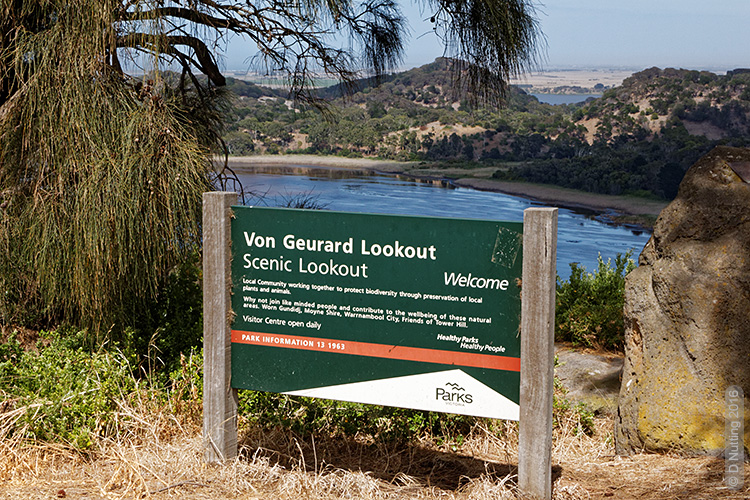
“Von Guérard’s Lookout”, at Tower Hill.
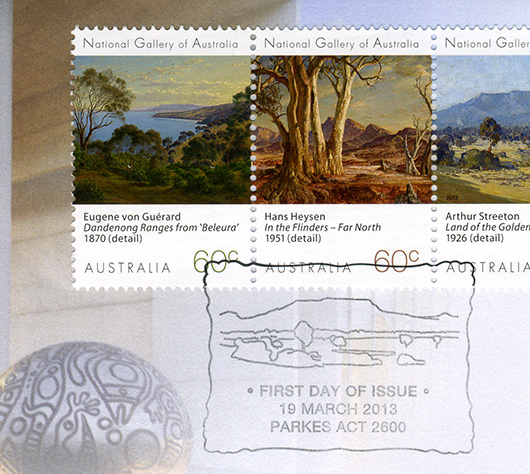
Australia Post's first day cover (detail) for the series "The Gallery Series (National Gallery of Australia) - Landscapes (2013)".
♦ Notes:
1. McDonald (2008), p.202
2. Tipping (1972)
3. Tipping (1972)
4. McDonald (2008), pp.184 & 186
5. Grishin (2013), p.99
6. Art Gallery of New South Wales. Featured artists. Eugene von Guérard. <www.artgallery.nsw.gov.au/collection/artists/von-guerard-eugene/> Accessed 27/02/2025.
7. Grishin (2013), p.97
8. Grishin (2013), p.99
9. Grishin (2013), p.99
10. Corangamite Shire Council. (2013). Volume 3 of the Corangamite Heritage Study (Stage 2). Thematic Environmental History. (Reviewed and revised version by Samantha Westbrooke & Ray Tonkin, in cooperation with Helen Doyle. p.32
11. Grishin (2013), p.99
12. THE EXHIBITION OF FINE ARTS. (1862, December 29). The Argus (Melbourne, Vic. : 1848 - 1957), p. 5. Retrieved March 11, 2025, from <http://nla.gov.au/nla.news-article6482142>
13. Information displayed at the Warrnambool Art Gallery, 2017.
14. Clark, Mary Ryllis. (1996). Discover historic Victoria / Mary Ryllis Clark ; foreword by Geoffrey Blainey. Ringwood (Vic.) : Viking. p.29
15. Camperdown & District Historical Society. (2018). Scotland to Australia felix : founding Scots of Victoria's Camperdown district / Camperdown & District Historical Society Scots Book Committee. Camperdown, Victoria : Camperdown & District Historical Society Inc. (In the Introduction)
16. Corris, Peter. (1972). 'Dawson, James (Jimmy) (1806–1900)', Australian Dictionary of Biography, National Centre of Biography, Australian National University, <https://adb.anu.edu.au/biography/dawson-james-jimmy-3381/text5117>, published first in hardcopy 1972, accessed online 15 March 2025. / ABC TV (Australia). Back Roads, Series 11, Episode 2. Camperdown, VIC. Broadcast on 16/01/2025.
17. Information displayed at the Warrnambool Art Gallery, 2017.
18. Stamp Bulletin Australia, No.321, 2013. Ferntree Gully (Victoria): Australia Post. p.12
19. Stamp Bulletin Australia, No.321, 2013. Ferntree Gully (Victoria): Australia Post. p.12
♦ References:
Eureka Centre Ballarat. (2020, November 30). Ballarat Goldrush (1854): Through the eyes of Eugene Von Guerard. [Video]. <www.youtube.com/watch?v=M8RKuryASLA> The presentation in this video shows how much detail von Guérard included in his painting of the early Ballarat goldfields.
Grishin, Sasha. (2013). Australian art : a history. Carlton (Victoria) : The Miegunyah Press.
McDonald, John. (2008). Art of Australia. Vol. 1, Exploration to Federation. Sydney: Pan Macmillan Australia.
Pullin, Ruth & Varcoe-Cocks, Michael & Clegg, Humphrey & National Gallery of Victoria. Council of Trustees. (2011). Eugene von Guérard : nature revealed / Ruth Pullin. Melbourne : Council of Trustees of the National Gallery of Victoria.
Tampke, Jürgen and Colin Doxford. (1990). Australia, Willkommen. Kensington (NSW): New South Wales University Press. p.52
Tipping, Marjorie J. (1972). 'Guerard, Johann Joseph Eugen von (1812–1901)', Australian Dictionary of Biography, National Centre of Biography, Australian National University, published first in hardcopy 1972, accessed online 7th February 2023.