Johann Joseph Eugen von Guérard
Landscape painter
Part 1 - his early life and training :: Ballarat goldfields :: artistic style :: homesteads on pastoral stations :: exhibitions :: Tower Hill, 1855
Part 2 - his home in Gipps Street :: influence from German Romanticism :: Georg von Neumayer & Mount Kosciuszko :: later years, return to Europe :: named after him
In 1862 von Guérard’s finances were healthy enough for him to move to the village of East Melbourne (now it’s a short walk from Melbourne’s CBD) and have a house built for him and his family in Gipps Street. This heritage-listed Georgian-style house was built with hand-made bricks. Von Guérard added a rooftop studio to the house in 1866, which is the single white room perched on top of the back section of the house with a window on each side in this photo. Von Guérard affectionately called this room ‘unser Thürmchen’ (our little tower) and in 1871 he completed over the course of three evenings a painting of the view from the tower, entitled “Fernsicht nach Yarra Bend / von unserem Thürmchen” ("Distant View Towards Yarra Bend From Our Little Tower"). From 1939 this house was home to Australia’s 16th Governor General Lord Casey and Lady Casey. In later years the house received the name ‘Little Parndon’.[1] The lane along the side of the house is called ‘Von Guerard Place’.
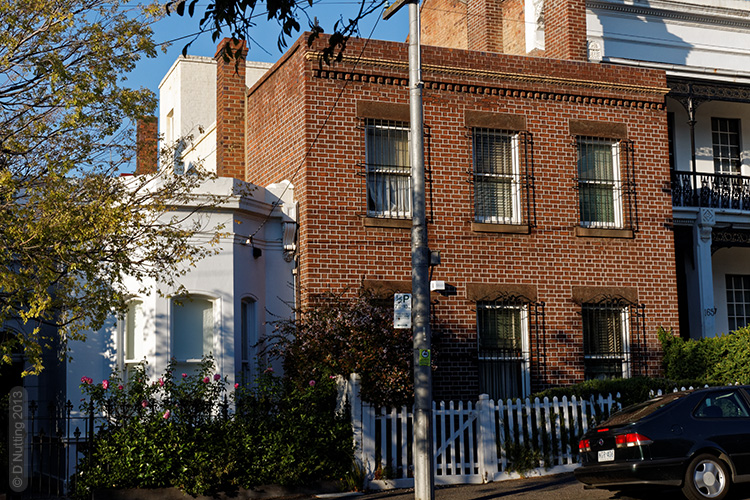
Louise and Eugene von Guérard's house in Gipps Street, East Melbourne.
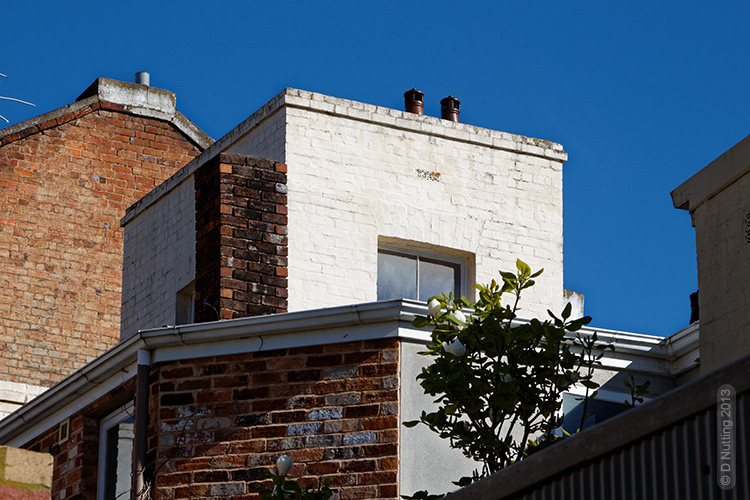
The studio room (‘unser Thürmchen’) above von Guérard's house in Gipps Street, East Melbourne.
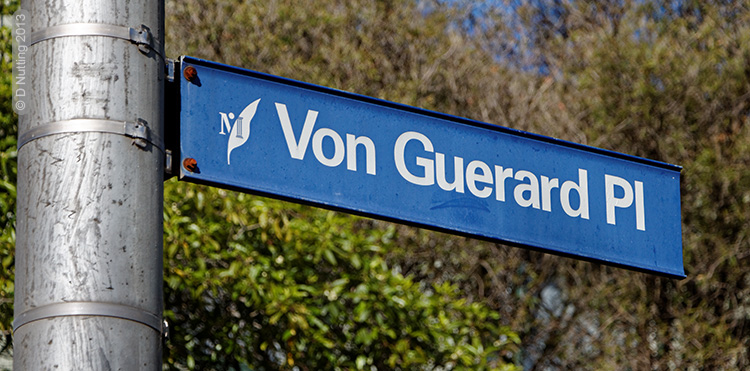
The street sign of Von Guerard Place, East Melbourne.
Art historian John McDonald sees similarities in von Guérard’s landscapes to the use of symbolism in the landscapes of the greatest German landscape painter of the first half of the 19th century, Caspar David Friedrich.[2] The paintings of both artists include also a great deal of precision in the details of scenes.[3]
The Art Gallery of New South Wales described von Guérard’s style as follows:
He worked in the German landscape tradition, which suggested the presence of divine powers in nature, and his paintings were celebrated by critics for their technique and grandeur. (...) Von Guérard’s landscapes expressed his personal religious feelings, alluding to the divine powers in nature.
Art Gallery of New South Wales[4]
The Mount Kosciuszko painting
When the German scientist Georg von Neumayer was conducting a magnetic survey of Victoria as part of an international investigation into the earth's magnetic field in 1862, von Guérard travelled with him. In November this expedition reached the Australian Alps and climbed to the summit of Australia’s highest mountain, Mount Kosciuszko. Von Neumayer reported that von Guérard drew many sketches of the mountain scenery while the rest of the expedition party were taking scientific measurements. Later in his Melbourne studio von Guérard turned these sketches into the painting North-east view from the northern top of Mount Kosciusko. The art historian Sasha Grishin described the painting as: “one of von Guérard's most Romantic paintings, celebrating the sublime in nature in the best traditions of Friedrich [the German Romantic painter Caspar David Friedrich : editor]. We are presented with an immense and inspiring vista, but one tinged with melancholy and evoking feelings of terror and awe.”[5] The figures in the foreground of this painting were probably von Guérard himself, together with von Neumayer and his scientific assistants.[6] Like in this Mount Kosciuszko painting, in Caspar David Friedrich’s landscape paintings human figures are usually facing into the scene (referred to as »Rückenfiguren« in German) and are often small, emphasising the grandeur and power of the landscape around them. Journalist Jamie Durrant described von Guérard's painting as follows: "In North-east view from the northern top of Mount Kosciusko there is absolutely no doubting the artist’s profound appreciation of the Australian landscape, which to him was surely the work of God. (...) Dwarfed by the mountains, (...) tiny figures remind us of the fleeting and precarious nature of human existence when compared with the enduring presence of nature."[7]
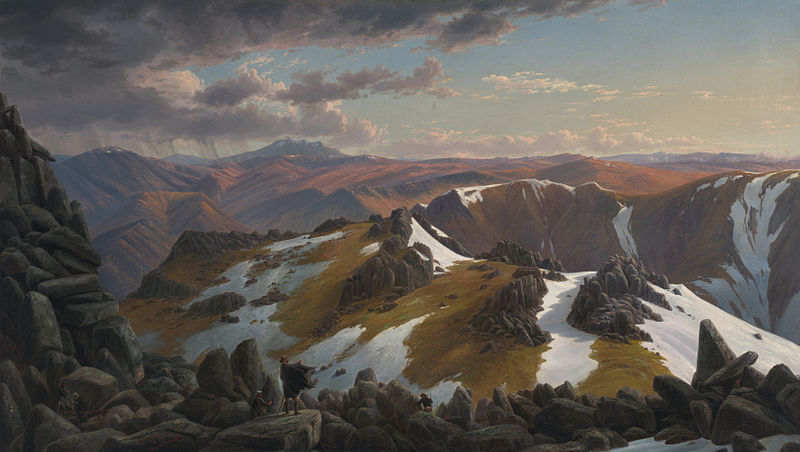
Von Guérard's North-east view from the northern top of Mount Kosciusko, 1863. National Gallery of Australia (Canberra).
Image source: Eugene von Guérard, Public domain, via Wikimedia Commons

Caspar David Friedrich painted Der Watzmann (a view of the Watzmann mountain, near Berchtesgaden in south-eastern Germany) in 1824-25. According to the art historian Boris von Brauchtitsch, Friedrich showed in Der Watzmann how you should paint a great mountain if you take the mountain seriously: imposing, monumental, commanding respect.[8] Von Guérard's painting of Mount Kosciuszko has similar qualities.
-WUS03228.jpg)
Caspar David Friedrich's Der Watzmann, 1824-25. Alte Nationalgalerie, Berlin.
Image source: Caspar David Friedrich, Public domain, via Wikimedia Commons
-WUS03228.jpg)
The later years
In 1870 von Guérard was appointed the first Instructor of Painting and Master of the School of Art at the new National Gallery of Victoria. He worked long hours at the art school, but his teaching methods and his painting were gradually criticised more and more, as public tastes changed. Von Guérard resigned from the art school in 1881 and took his family to Düsseldorf in Germany.[9]
In the mid-1880s James Oddie, a community leader in Ballarat and founder of the Ballarat Fine Art Gallery (the oldest regional gallery in Australia), commissioned von Guérard to paint a view of the Ballarat goldfields as they had looked in the early part of the gold rush. This large painting is known by the title 'Old Ballarat as it was in the summer of 1853-54'. Von Guérard based the content of the painting on a sketch that he had made in February 1854 not long before he left the goldfields. This painting toured to China as part of an Australian landscape exhibition in the first cultural exchange between Australia and China in the early 1970s.[10] The painting is very significant for the city of Ballarat. Gordon Morrison, the director of the Art Gallery of Ballarat in 2009, said it is not often that a talented artist depicts a city in the very early days of the city: "Very few cities anywhere in the world had an artist of anywhere near the stature of Eugene von Guerard present at the birth of a community."[11]
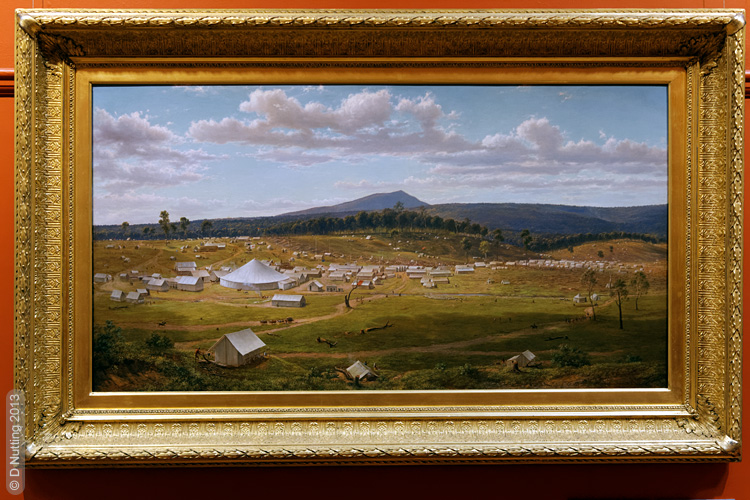
Von Guérard's Old Ballarat as it was in the summer of 1853-54. Art Gallery of Ballarat.
Von Guérard’s art was not very successful in Europe and he and his wife moved to London to be with their daughter, who married an Englishman. Von Guérard’s wife Louise died before him, and he died in 1901 in London while living with his daughter and her family.
Another similarity between Eugene von Guérard and Caspar David Friedrich is the fact that the style of their art was no longer in demand when they died, and their paintings generally disappeared from the public's consciousness for the next 50-70 years, after which there was a strong revival of interest in their works.[12]
Although he is known by the name Eugene in Australia, von Guérard signed his name using the German form of his name, Eugen, and he was fluent in English, French, Italian and German.[13]
Named after him
The following places in Australia are named after Eugene von Guérard:
- the street Von Guerard Crescent, in Lyneham, Australian Capital Territory;
- the street Von Geurard Parade, Doreen, Victoria (26 km north-east from Melbourne's Central Business District) – another case of his name being misspelled. All the streets in Doreen's 'Promenade Estate' were named after artists.
- Von Guerard Park, Lake Heights, New South Wales (near Port Kembla);
- Mount Von Guerard, in Victoria - 1220.94m in altitude[14] named by Alfred William Howitt (1830-1908) in the Dargo High Plains region, in 1860.[15]
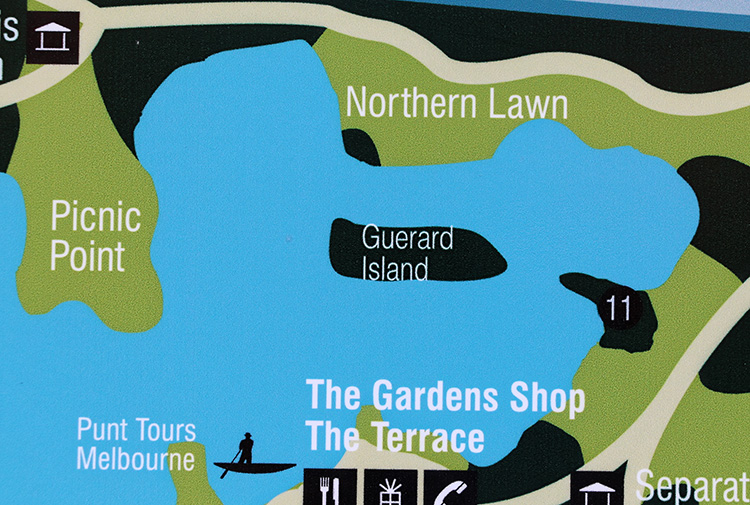
A small island in Melbourne's Botanic Garden is named after Eugene von Guérard, as seen on this map in the Botanic Garden.
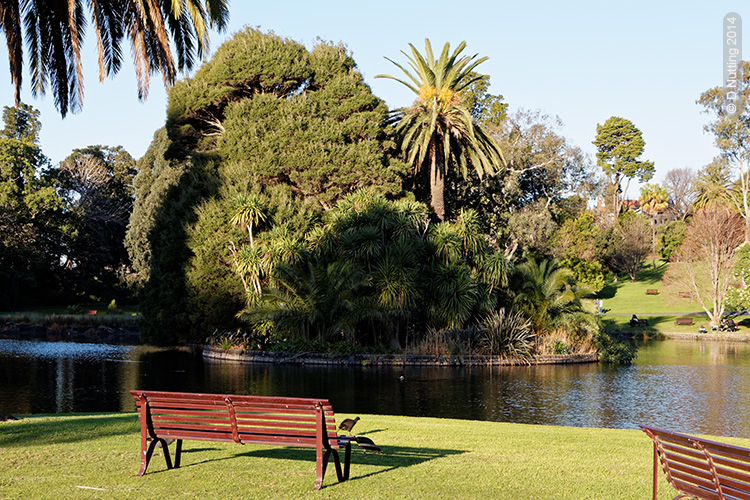
Guerard Island in Melbourne's Botanic Garden.
♦ Notes:
1. East Melbourne Historical Society. East Melbourne, Gipps Street 159, Little Parndon. Online here. Accessed 10/04/2014. / Thomas, David. Article in the website of <www.deutscherandhackett.com/>. Accessed 10/04/2014. Page no longer online. / Chancellor, Jonathan. (2013, June 17). Little Parndon, the East Melbourne gem sells as Eugene von Guerard painting set for auction from Reg and Joy Grundy collection. Article in the website of <www.propertyobserver.com.au>. Accessed 10/04/2014. Page no longer online.
2. McDonald (2008), p.184
3. Von Brauchitsch (2023), pp.265-266
4. Art Gallery of New South Wales. Featured artists. Eugene von Guérard. <www.artgallery.nsw.gov.au/collection/artists/von-guerard-eugene/> Accessed 27/02/2025.
5. Grishin (2013), p.101
6. Grishin (2013), p.101
7. Durrant, Jamie. (2019, November 16). Australian Story: Eugene Von Guérard’s Kosciusko. Essentials Magazine. <essentialsmagazine.com.au/art/australian-story-eugene-von-guerards-kosciusko/>
8. Von Brauchitsch (2023), p.219
9. McDonald (2008), p.202
10. Morrison, Gordon. (2009, March 15). Jewel: Eugene von Guerard. Interview on ABC Radio National. Online here. Accessed 04/03/2025.
11. Morrison, Gordon. (2009, March 15). Jewel: Eugene von Guerard. Interview on ABC Radio National.
12. Von Brauchitsch (2023), p.269 & 272 / Grishin (2013), p.102
13. Mackenzie, Andrew. (2000). "Eugene von Guerard, Biography". 'In the Artist's Footsteps'. <www.artistsfootsteps.com/html/vonGuerard_biography.htm>. Accessed 10/04/2014.
14. Mackenzie, Andrew. (2000). "Eugene von Guerard, Biography". 'In the Artist's Footsteps'.
15. Day, Alan. (2009). The A to Z of the Discovery and Exploration of Australia. Edition 27, annotated. Lanham (Maryland, USA): Scarecrow Press. p.108
♦ References:
Von Brauchitsch, Boris. (2023). Caspar David Friedrich. Biografie. Berlin: Insel Verlag.
Eureka Centre Ballarat. (2020, November 30). Ballarat Goldrush (1854): Through the eyes of Eugene Von Guerard. [Video]. <www.youtube.com/watch?v=M8RKuryASLA> The presentation in this video shows how much detail von Guérard included in his painting of the early Ballarat goldfields.
Grishin, Sasha. (2013). Australian art : a history. Carlton (Victoria) : The Miegunyah Press.
McDonald, John. (2008). Art of Australia. Vol. 1, Exploration to Federation. Sydney: Pan Macmillan Australia.
Macdonald, John Boyd. (2014, February 2). Re-Viewing Von Guérard ‘s ‘Snowy Peak’, 150 years on. Jokar Photography. [Blog]. <www.jokar.com.au/blog/tag/north-east-view-from-the-top-of-mount-kosciusko/>. This blog article by a skilled photographer reports on a hiking journey in the Australian Alps, retracing the steps of von Neumayer and von Guérard to the spot where von Guérard painted North-east view from the northern top of Mount Kosciusko. The photographer explains how he took many photographs there and through careful and creative work with a digital editing program produced a photographic interpretation of von Guérard's famous oil painting.
Pullin, Ruth & Varcoe-Cocks, Michael & Clegg, Humphrey & National Gallery of Victoria. Council of Trustees. (2011). Eugene von Guérard : nature revealed / Ruth Pullin. Melbourne : Council of Trustees of the National Gallery of Victoria.
Tampke, Jürgen and Colin Doxford. (1990). Australia, Willkommen. Kensington (NSW): New South Wales University Press. p.52
Tipping, Marjorie J. (1972). 'Guerard, Johann Joseph Eugen von (1812–1901)', Australian Dictionary of Biography, National Centre of Biography, Australian National University, published first in hardcopy 1972, accessed online 7th February 2023.