Alexander Schramm
A painter in South Australia
Schramm was born in 1813 in Berlin to Carl Friedrich Schramm and Carolina Friedericke Schramm, and was baptised in St Peter's (Lutheran) church in 1814. He first exhibited paintings at the Königliche Preußische Akademie der Künste (Royal Prussian Academy of the Arts) in 1834.[1] It seems likely that he spent time in Warsaw (Poland) in the early 1840s and painted scenes there. In 1849 he emigrated to South Australia on board the Prinzessin Luise, a ship that had been chartered by a Berlin emigration society.
On board that ship were many craftspeople, professional people including teachers, lawyers etc.[2] They are often called the "48-ers" - generally higher-educated Germans who were disappointed with the failure of the 1848 revolutions that had aimed at more democratic politics in the German territories. Schramm may have been looking for a warmer climate as beneficial to his health, and he may have thought South Australia would be a good place for an artist, given that there was a lot of competition for work among artists in Berlin. When he left Germany at the age of 35 he had at least 15 years of experience as a professional artist.[3]
As the British settlement of Adelaide expanded further and further outwards into the countryside, and illustrations and artworks were produced to promote immigration to the colony, these pictures generally tried to avoid emphasising proud Indigenous inhabitants; it was more beneficial for the colonial project and more comfortable for the conscience of white settlers if landscape pictures of the colony did not show the people who had been there thousands of years. "Where Aboriginal Australians were not omitted altogether, they were at best marginal or ornamental figures, devoid of individuality or even humanity."[4]
Perhaps the best-known painting by Schramm is one titled A scene in South Australia. It shows some settlers, who were probably German[5], standing outside their newly whitewashed house on a clear, bright morning. They are talking with a group of Aboriginal people who have come to visit. The scene suggests that everyone is getting along well and peacefully.
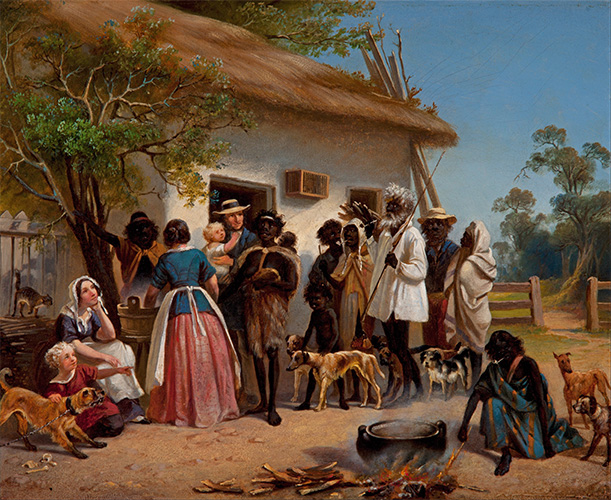
A scene in South Australia, a painting by Alexander Schramm (circa 1850).
Picture source: Art Gallery of South Australia, Public domain, via Wikimedia Commons

The woman who lives in the house is wearing a clean white apron. She is looking after a washtub while talking to two Aboriginal women. One of these women is carrying a child on her back in a sling. The other woman is leaning comfortably against a small tree. The conversation seems lively, as the white woman has tilted her head as she turns to speak to the Aboriginal woman with the child. Another Aboriginal woman, wearing a blue and brown blanket, is sitting by a fire in the front of the picture. She is looking after a large pot and smoking a pipe.[6]
The Aboriginal visitors are wearing simple clothing, but they look very relaxed in the company of the fully clothed Europeans. At the time of this painting, the young colony had many problems with race relations. Because of this, it might seem hard to believe the friendly and harmonious scene in the picture. However, if the Europeans being shown are German settlers, then Schramm might be suggesting that Germans were more tolerant and patient than the British people in the colony.[7]
In his attention to human detail Schramm’s paintings were different from the British depictions of Indigenous Australians at that time.[8]
Another painting by Schramm, titled Adelaide, a tribe of natives on the banks of the river Torrens, has a detailed depiction of many Aboriginal Australians relaxing in a park in Adelaide. You can watch a video about the painting and read information about it at this webpage of ABC Education published in 2022.
According to Australian historians Geoffrey Dutton and Ron Appleyard, Alexander Schramm was a “sensitive recorder of Indigenous-settler encounter on the colonial frontier” – he “depicted the Aborigines with great sympathy at a time when their tribal life was being disrupted by the colonists” [with] “an empathy unique in Australian colonial art”.[9] Schramm depicted First Australians as healthy, unlike some other European artists.[10]
Other artists in Australia who were working at the same time as Schramm, including Eugen von Guerard, also painted Aboriginal Australians. However, they usually showed them as less important figures on the edges of the scene (though in von Guerard’s early paintings the Aboriginal Australians were the central elements in the scene, for example in Aborigines met on the road to the diggings, 1854). In their artwork, you don't often see significant interactions between Aboriginal people and the European settlers. Alexander Schramm seems unique when compared to these other artists. His artwork placed Indigenous people at the center of the scene, rather than making them minor figures in the middle ground or the background.[11]
The Australian art historian Sasha Grishin has noted that most German, Austrian and Swiss artists who worked in colonial Australia depicted the Aboriginal Australians with empathy and wrote about them in their diaries in a neutral, matter-of-fact way, in contrast to many British immigrants, who saw them as an obstacle to the growth of a British colony.[12]
Although Schramm had arrived in Australia on the Prinzessin Luise together with many “48-ers” he didn’t really hook up with them in Adelaide – their writings rarely mention him. In Adelaide itself he lived an “unadventurous and solitary life”.[13]
Schramm died in Adelaide at the age of 50 of a lung-related bacterial infection.[14] For about a century after his death Alexander Schramm and his artwork was forgotten. Pretty much the same thing happened to the reputation and artwork of another German artist in Australia, the Melbourne-based landscape painter Eugen von Guerard. Von Guerard’s work experienced a resurgence of public interest about 70 years after his death.
However, the biggest reason why people became less interested in Schramm's work later in his life was his continued focus on "groups of aboriginal natives" and his detailed and specific way of depicting them. It's interesting that this same focus would actually cause people to become interested in Schramm again more than a century after he died.[15]
♦ Notes:
1. Woodburn (2017), p.26
2. Woodburn (2017), pp.45-47 / Lodewyckx, Prof. Dr. A. (1932). Die Deutschen in Australien. Stuttgart: Ausland und Heimat Verlagsaktiengesellschaft. p.50 / Lally & Monteath (2011), p.148
3. Woodburn (2017), p.48
4. Lally & Monteath (2011), p.145
5. Lally & Monteath (2011), p.153
6. Lally & Monteath (2011), p.153
7. Lally & Monteath (2011), p.154
8. Lally & Monteath (2011), p.157
9. Dutton, Geoffrey. (1974). White on black: the Australian Aborigine portrayed in art. Melbourne: Macmillan. p.57 - cited in WOOD pp.16-17
10. Woodburn (2017), p.231
11. Woodburn (2017), p.191
12. Grishin, Sasha. (2013). Australian art : a history. Carlton (Victoria) : The Miegunyah Press. p.97
13. Woodburn (2017), pp.47, 190
14. Woodburn (2017), p.47
15. Woodburn (2017), p.9
♦ References:
Lally, Janice & Monteath, Peter. (2011). "Essentially South Australian" - The artist Alexander Schramm. In: Monteath, Peter (ed.). (2011). Germans: travellers, settlers and their descendants in South Australia. Kent Town (S.A.): Wakefield Press. pp.144-165.
Woodburn, Susan. (2017). Alexander Schramm (1813-64) and the visual representation of Aboriginal people in mid-nineteenth century colonial Australia. (PhD thesis, University of Adelaide). Available online via this link.