Victoria
Dr Heinrich (Henry) Backhaus, Bendigo
Part 1 - childhood in Paderborn; training for the priesthood; time in Sydney and Adelaide
Part 2 - life in Bendigo; his influence and active contribution to civic life; founding of the churches St. Kilians und St. Liborius
Part 3 - retirement and death; his legacy for Bendigo
Backhaus retired in 1881 and bought an estate named Villa La Trobe of about 10 hectares between South Road and Holyrood St in today’s Hampton, a suburb of Melbourne. He renamed the estate Santa Margarita in honour of his mother. For several months Backhaus lived there before he became seriously ill and probably realised that he was dying. He asked friends, including his close friend John Crowley, to help him travel back to Bendigo – he wanted to spend his last days in the city whose development he had influenced.
Backhaus died in a room at Marlborough Lodge, designed by Vahland and Getzschmann in 1869. The house was owned by his friend John Crowley. Crowley, originally of County Cork in Ireland, was a co-owner of the Shamrock Hotel designed by Vahland and Getzschmann. The house was "within a stone's throw of the site for the Cathedral” which Backhaus’ business acumen later made possible.[1]
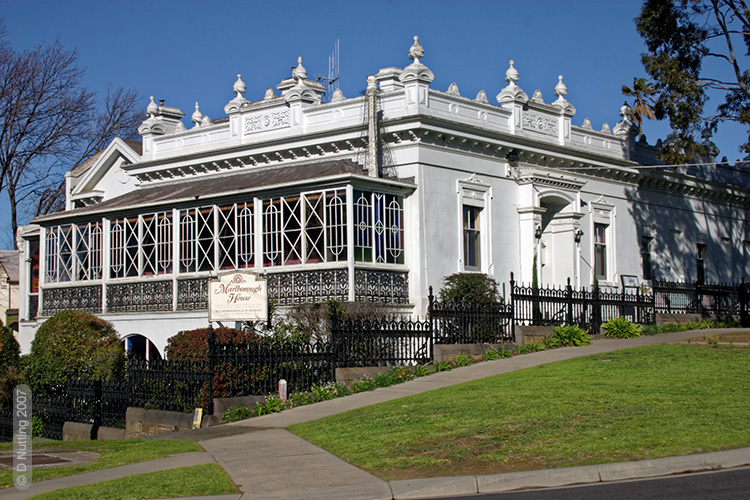
Marlborough Lodge in Bendigo. Backhaus passed away in a room in this house.
The biographer John Hussey wrote: “Henry Backhaus has often been described as a shrewd investor and a hard-headed businessman. There is no doubt that he was both, but, just as surely, there can be no doubt that he was very much more. Cities do not go into mourning at the death of a businessman.” Hussey wrote that the city’s reaction to Backhaus’ death showed how much love and respect the people of Bendigo had for Backhaus. After Backhaus’ death his body was moved from John Crowley’s house to St Kilian’s church, and many thousands of visitors (including many non-Catholics) walked through the church to pay their last respects to Backhaus.[2] The Bendigo Advertiser reported: “McCrae Street [where St Kilian’s is located] was full of life all day, with people going to or returning from the church, but, though the street was crowded, there was an air of sadness over the scene which could not be mistaken.” The funeral caused one of the greatest crowds that had ever occurred in Bendigo.[3]
Backhaus’ final will left valuable real estate in central Bendigo and farmland outside of Bendigo to the church of St Kilian’s. Backhaus made sure that the church could not sell this valuable real estate but receive the rental income from it. Many major street corners in the central business district of Bendigo are owned by the Backhaus estate. Neil Athorn, the properties manager for Sandhurst Trustees, a subsidiary of Bendigo Bank which oversees the Backhaus estate, told the newspaper Herald Sun in 2002: “It’s all based around corners and central locations. Backhaus was very smart.”[4]
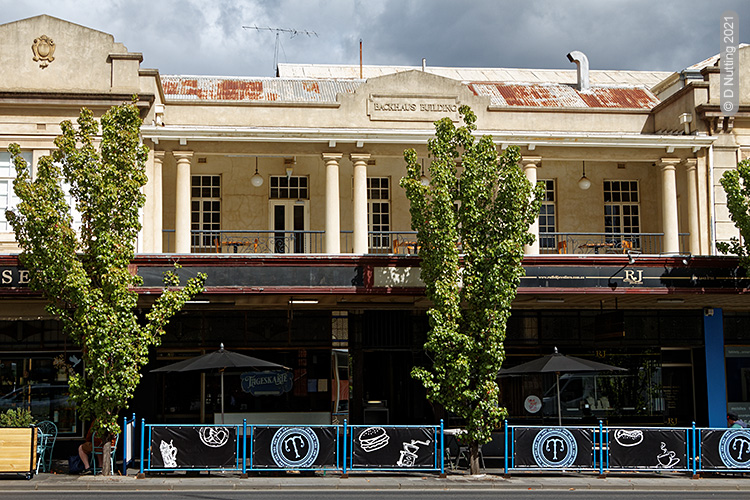
The Backhaus Building in Mitchell Street, Bendigo. At the time of this photo there was a German restaurant called Tageskarte in the building.
In Backhaus Arcade in central Bendigo the estate owns six shops. A bronze relief plaque on a wall in the arcade commemorates Dr Backhaus, and the artist’s illustration symbolises Backhaus’s wealth through coins spilling out of money bags.
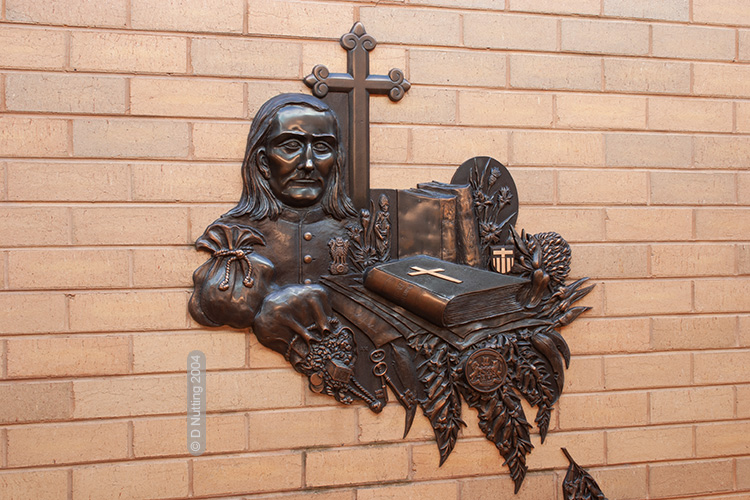
Bronze plaque in Backhaus Arcade honouring Heinrich Backhaus. Made for the 1988 centenary of St Kilian's Church. Design by Annemieke Mein.
Bendigo's Sacred Heart Cathedral is unusually large for a cathedral in a regional city in Australia and is the third tallest in Australia after St Patrick's Cathedral and St Paul's Cathedral in Melbourne. Its tower is easily visible above the roofs of most parts of Bendigo. Richard Everist described the cathedral as follows: "The Sacred Heart Cathedral site was acquired by Rev. Dr Backhaus in 1855. The foundations are of Harcourt granite. The interior features a variety of marbles, pews of blackwood and ceilings of oregon and kauri. This cathedral owes so much to Dr Backhaus. Indirectly he provided the land, the vision and the money to make it possible."[5]
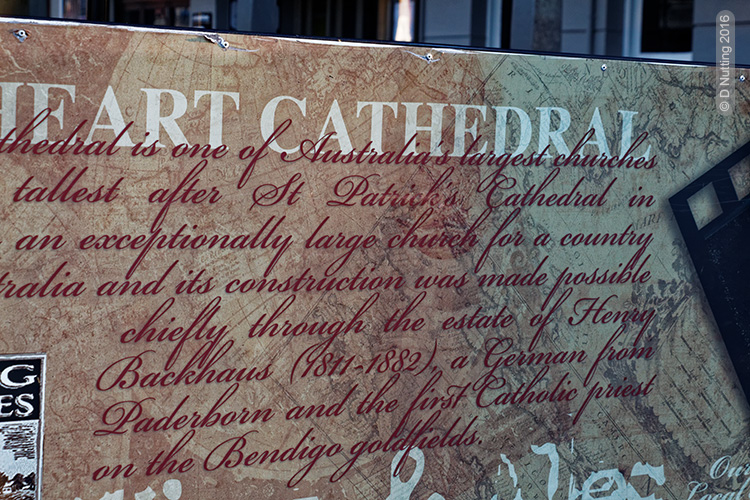
A commemorative banner about the cathedral - the banner acknowledges Dr Backhaus. The banner was located near the Town Hall but is no longer there.
Work began on constructing the Cathedral of the Sacred Heart in 1897, and was made possible by the income that came regularly from the Backhaus Estate. Its design is fifteenth century English Gothic. John Hussey described it as follows: "a majestic building, of great beauty, that can take its place proudly amongst the cathedrals of the world."[6]
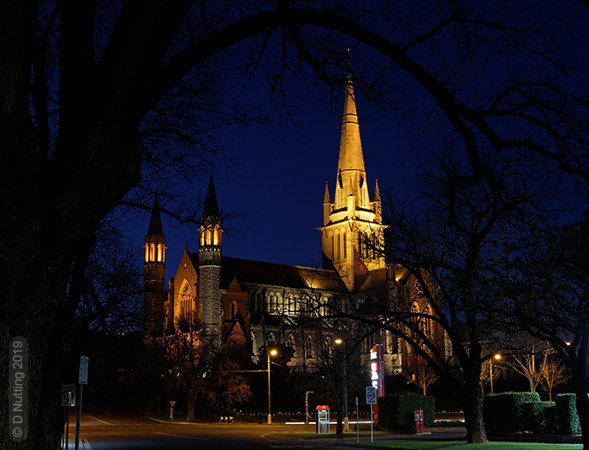
Sacred Heart cathedral, Bendigo
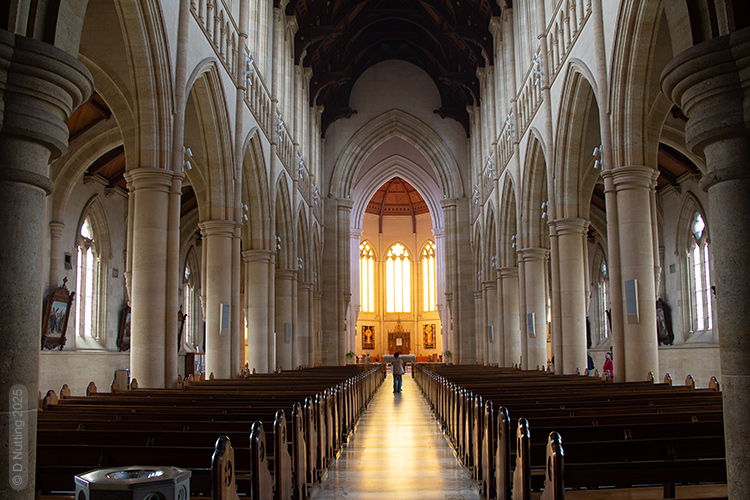
The majestic interior of Sacred Heart cathedral in Bendigo
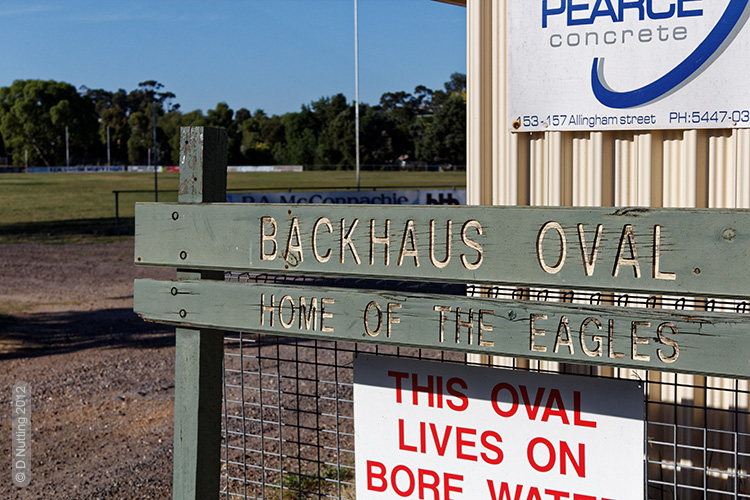
Backhaus Oval, a sports ground in Bendigo
The Santa Margarita Estate in Hampton was sold off in 1924 and subdivided into residential streets. Some street names there are a link to Backhaus and his time living there. In an article about street names in the local newspaper The Hampton Bugle the historian Graeme Disney wrote: "How many people who live in Margarita Street realise that they have a distant connection with the small town of Paderborn in Westphalia, West Germany? (…) He [Backhaus] purchased a house called 'Villa La Trobe' which stood on 20 acres adjoining South Road, Brighton in what was then Moorabbin but is now Hampton. (…) The streets that traverse his old property [in Hampton] preserve his name - Backhaus, St Kilian and Bendigo are obvious, while Margarita was his mother's name."
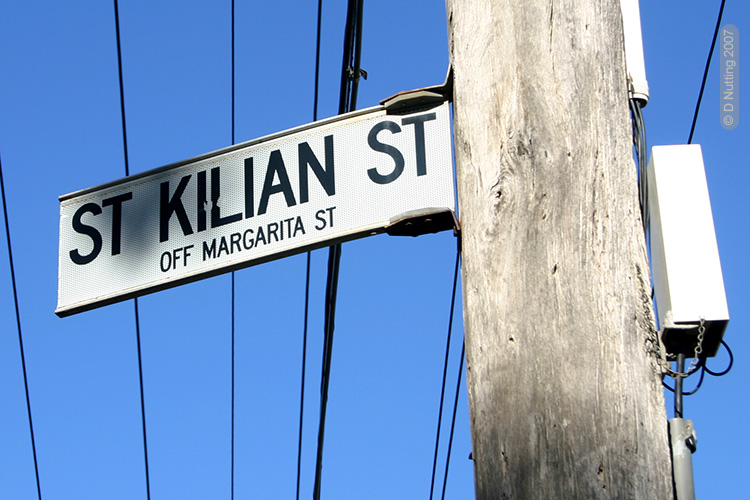
St Kilian Street in the Melbourne suburb of Hampton
It seems likely that the street 'Backhaus Avenue' in Sunbury (Victoria) is named after Heinrich Backhaus, since the names of several other streets nearby are the surnames of significant church leaders in 19th century Australia, for example Reverend James Adams (first resident Anglican priest in Townsville), Arthur Davenport (Archdeacon of Hobart from 1880 to 1888), August Kavel (a founder of Lutheranism in Australia) and Father James Breen (big crowds attended his funeral in Brisbane in 1916).
♦ Notes:
1. Everist (2006), p.28
2. Hussey (1982), pp.169-170
3. THE LATE VERY REV. DR. BACKHAUS. (1882, September 9). Bendigo Advertiser (Vic. : 1855 - 1918), p. 2. Retrieved January 23, 2024, from <http://nla.gov.au/nla.news-article88575785>
4. Sherborne, Craig. (2002). "Investor priest’s bequest lives on". Herald Sun, Monday 26th August 2002, edition #1, p.7
5. Everist (2006), p.28
6. Hussey (1982), p.202
7. Hussey (1982), pp.185-187 / Britannica, T. Editors of Encyclopaedia (2023, September 28). George William Mundelein. Encyclopedia Britannica. <www.britannica.com/biography/George-William-Mundelein> / Grossman, Ron. (2014, July 20). Chicago's first cardinal not afraid to lead in city -- and the world. Chicago Tribune. <www.chicagotribune.com/news/ct-cardinal-mundelein-flashback-0720-20140720-story.html>. Accessed 22/01/2024.
♦ References:
Cusack, Frank (editor). (1998). Bendigo - the German Chapter. Bendigo (Victoria): The German Heritage Society. pp.113-116
Everist, Richard (2006). The traveller's guide to the goldfields : history & natural heritage trails through Central & Western Victoria. Geelong West (Victoria): Best Shot! Publications Pty Ltd.
Hussey, John. (1982). Henry Backhaus, Doctor of Divinity, pioneer priest of Bendigo / John Hussey. Bendigo [Vic.] : St. Kilian's Press
Owens, A. E. 'Backhaus, George Henry (1811–1882)', Australian Dictionary of Biography, National Centre of Biography, Australian National University, https://adb.anu.edu.au/biography/backhaus-george-henry-43/text4199, published first in hardcopy 1969, accessed online 29 December 2023.