Victoria
Dr Heinrich (Henry) Backhaus, Bendigo
Part 1 - childhood in Paderborn; training for the priesthood; time in Sydney and Adelaide
Part 2 - life in Bendigo; his influence and active contribution to civic life; founding of the churches St. Kilians und St. Liborius
Part 3 - retirement and death; his legacy for Bendigo
Heinrich Backhaus was a Catholic priest and a major figure in Bendigo (Victoria) and the surrounding area in the second half of the 1800s. He was an admired and influential person in the early decades of the city of Bendigo, and not just among the Catholic community of the area. His surname is familiar to many people in Bendigo today, as buildings, a sports oval, streets and a shopping arcade have been named after him.
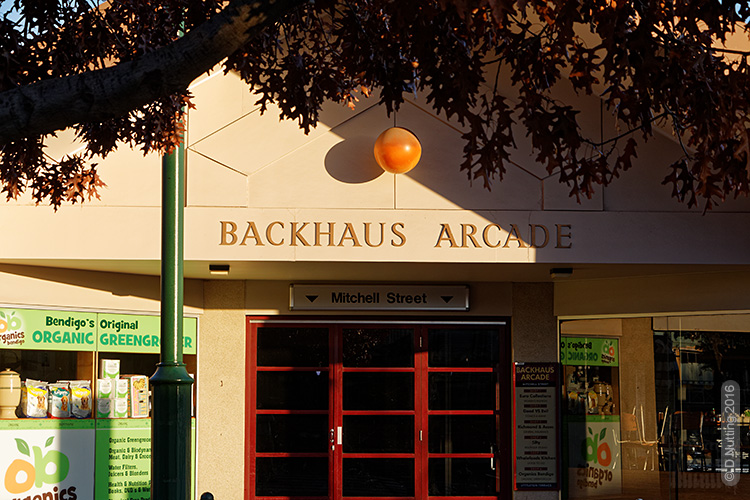
The entrance to Backhaus Arcade in central Bendigo
Of all those identified with the early history of Bendigo, no one was better known or held in higher respect than the Very Rev. Dean Backhaus, whose decease yesterday afternoon, at the residence of Mr. John Crowley, in Rowan Street, it is our painful duty to record this morning.
Bendigo Advertiser, 08/09/1882[1]
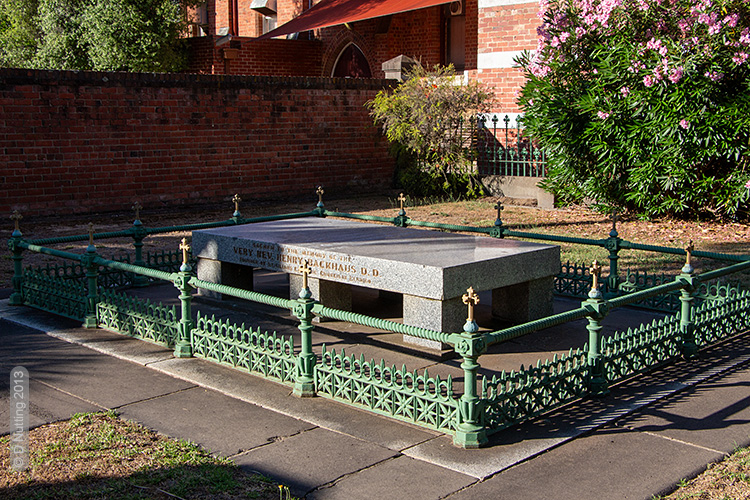
Dr Backhaus' grave in a corner of the grounds of St Kilian's Church, Bendigo
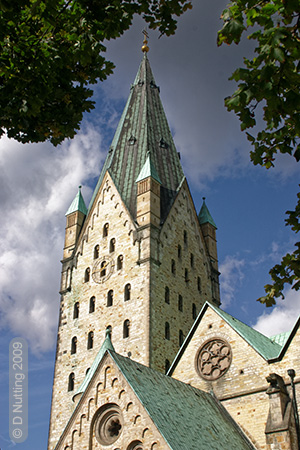
Tower of the Paderborn cathedral.
Why did Heinrich Backhaus name his church in Bendigo St Kilian’s? St Kilian was an Irish monk who travelled to Germany to do mission work in the area of Franconia (a region in the north of the modern German state Bavaria) in the seventh century. Kilian and two companions who helped him evangelise and convert pagans in that area were murdered in the year 689. St Kilian is the patron saint of the Franconian city of Würzburg, and after Kilian’s murder the veneration of St Kilian was spread further north by Würzburg missionaries, including to the area of the present-day city of Paderborn. One of his relics was later transported to Paderborn, and St Kilian, along with another saint, St Liborius, is one of the patron saints of the cathedral of Paderborn, the city where Backhaus grew up.[2]
Backhaus was born in 1812 as the first child of a bootmaker Anton Backhaus and his second wife, Maria Margarete Leifeld (Anton’s first wife had died two years earlier). Eventually there were nine children to feed in the family and the family had to be very careful with their money. Heinrich Backhaus grew up “in an atmosphere of thrift and simplicity. Luxury and extravagance were unknown”[3], and Heinrich did not forget the lessons of simple and modest living that he learned in his Paderborn. He was known for these qualities later when he lived in Bendigo.
In his childhood Backhaus attended services in the great cathedral of Paderborn, and he would have often walked through the entrance called the Paradise Portal and seen the wooden statues of St Kilian and St Liborius above the Portal, and he would have heard the stories about these saints’ lives.[4]
The Paradise Portal of the cathedral dates from before the year 1240 and displays three key figures, the three patrons of the cathedral: Mary (with the baby Jesus in her arms) and two centuries-old wooden carvings representing Saint Kilian (on the left) and Saint Liborius (on the right). Heinrich Backhaus named churches in Bendigo after each of these two saints.
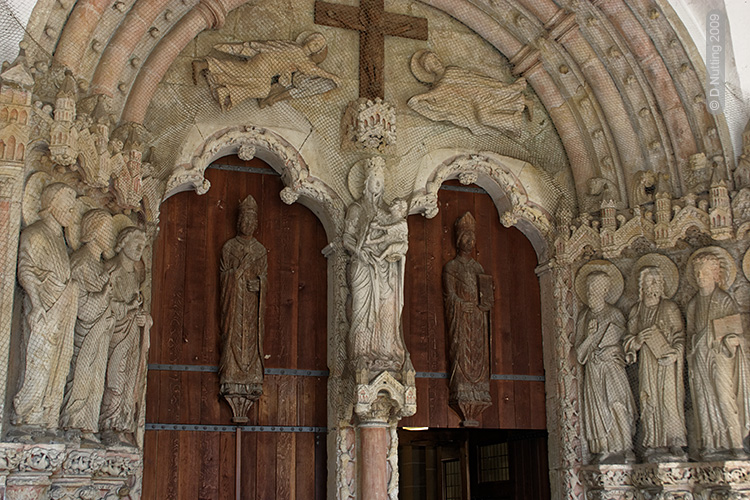
The Paradise Portal with wooden figures representing Kilian and Liborius.
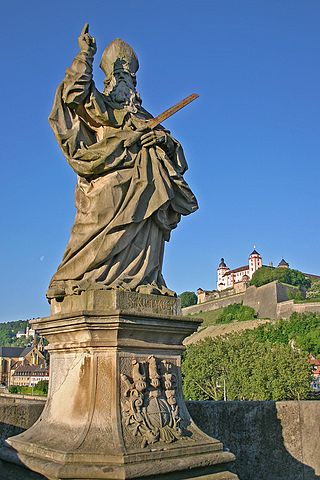
Statue of Saint Kilian on the 'Old Bridge' over the river Main in Würzburg.
Photo source: Christian "VisualBeo" Horvat, CC BY-SA 3.0, via Wikimedia Commons

At the beginning of 1831 Backhaus went to the city of Würzburg and studied at the university there. At Würzburg he would have thought more about the life of St Kilian as a foreign missionary; on the old stone bridge over the river Main at Würzburg, with its many arches, there is a statue of St Kilian. After just one year in Würzburg, Backhaus went to Rome to study at a college there and he graduated as Doctor of Divinity and was ordained a priest there in 1836.
The college in Rome sent Backhaus to work as a missionary in Bengal in India. There he was based in the city of Calcutta (now known as Kolkata), which was the most important city in British India (the colonial rule of the British Crown on the Indian subcontinent). Backhaus spent 10 years there, and in 1846 travelled to Australia, spending some time on the way in Singapore and Batavia (now called Jakarta, in Indonesia).
Heinrich Backhaus stayed in Sydney for 11 months, working for the Catholic population there, and he impressed people in that city with his musical ability through his involvement with the Sydney Metropolitan Choir. When he heard that the Catholic Church in Adelaide was having difficulty obtaining priests, he decided that he was needed there.
In Adelaide he became respected in a short time to such an extent that when the Legislative Council of the South Australian parliament was established, a petition was sent to him that was signed by 84 voters, who wanted to nominate him for parliament, to represent them. This is quite surprising, because Backhaus had only been in SA for three years, and because most of these petitioners were English or Irish (not German immigrants). Furthermore he was a foreigner, and a Catholic priest (the Catholic Church played a minor role in South Australian society at that time).[5]
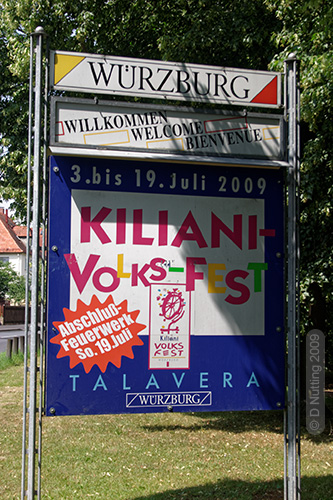
A sign promoting the Kiliani Volksfest in Würzburg, Germany
The Kiliani Volksfest in the city of Würzburg is a traditional festival with folk music, traditional costumes and fun rides. The festival honours Saint Kilian, the patron saint of the city.
♦ Notes:
1. DEATH OF THE VERY REV. DR. BACKHAUS. (1882, September 8). Bendigo Advertiser (Vic. : 1855 - 1918), p. 2. Retrieved January 23, 2024, from <http://nla.gov.au/nla.news-article88575762>
2. Hussey (1982), pp.4-6
3. Hussey (1982), p.13
4. Hussey (1982), p.16
5. Hussey (1982), pp.51-52
♦ References:
Cusack, Frank (editor). (1998). Bendigo - the German Chapter. Bendigo (Victoria): The German Heritage Society. pp.113-116
Hussey, John. (1982). Henry Backhaus, Doctor of Divinity, pioneer priest of Bendigo / John Hussey. Bendigo [Vic.] : St. Kilian's Press
Niggemeyer, Margarete. (2006). The High Cathedral at Paderborn. A Guide to the Cathedral. Paderborn: Bonifatius Verlag.
Owens, A. E. 'Backhaus, George Henry (1811–1882)', Australian Dictionary of Biography, National Centre of Biography, Australian National University, https://adb.anu.edu.au/biography/backhaus-george-henry-43/text4199, published first in hardcopy 1969, accessed online 29 December 2023.