South Australia
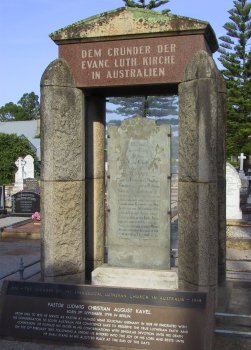
Memorial to Pastor Augustus Kavel
in the Langmeil cemetery at Tanunda, S.A.
The top of the memorial states in German: To the founder
of the Lutheran Church in Australia. The inscription on the tablet reads
as follows below (word-for-word, including its abbreviations - "Gemeine" is an
obsolete spelling. It is a synonym for "Gemeinde"):
[English translation]
Denkmal des sel. Herrn
Pastors
Ludw. Chrisu.
August
KAVEL
geb. zu Berlin den 3. Sept 1798
Von 1826-1835 war er Pastor in
Klemzig bei Züllichau
Um des rein lutherischen Glaubens
u. Bekenntnisses willen wanderte er
1838 mit seiner Gemeine nach Süd
Australien aus. Mit seltener Treue
verwaltete er sein Amt in seinen
Gemeinen bis an sein Ende. Am 12.
Feb: 1860 ging er in Folge eines
Schlagflusses ein zu seines Herrn
Freude und ruhet, bis dasz er auf=
stehe in seinem Theil am Ende d: Ta.
English:
Memorial to the late Pastor Ludwig Christian August Kavel, born in Berlin on
3rd September 1798. From 1826-35 he was Pastor in Klemzig near Züllichau
(now in Poland). In 1838 he emigrated with his congregation to South Australia
for conscience sake to preserve the true Lutheran faith and confession. With
exceptional devotion he carried out his duties in his congregations up until
his death. On 12th February 1860 as a result of a stroke he joined
his Lord and rests until he shall stand in his allocated place at the end of
the days.
Recognition of Kavel's achievements
Pastor Kavel is considered one of the significant figures in the development of South Australia in the 19th century. Streets have been named after him:
- Kavel Court in Tanunda, S.A.;
- Kavel Drive in Hahndorf, S.A.;
- Kavel Street in Torrens, A.C.T. (the streets in Torrens are named after pioneer figures in the history of South Australia),[1] and
- Kavel Court in Sunbury, VIC (It seems likely that this street is named after August Kavel, since the names of several other streets nearby are the surnames of significant church leaders in 19th century Australia, for example Reverend James Adams (first resident Anglican priest in Townsville), Heinrich Backhaus (founder of the Catholic Church in Bendigo), Arthur Davenport (Archdeacon of Hobart from 1880 to 1888) and Father James Breen (big crowds attended his funeral in Brisbane in 1916)).
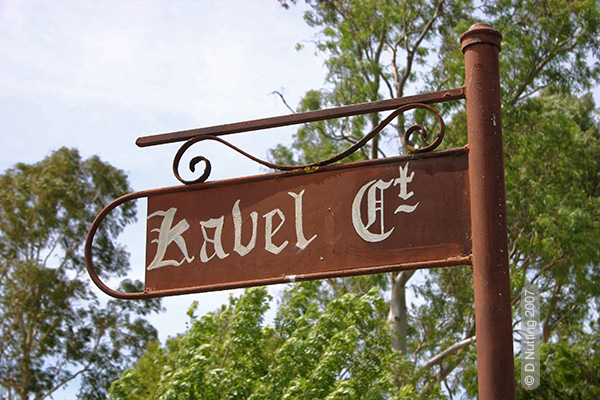
Sign in Kavel Court, Tanunda, S.A.
In South Australia the electoral district of Kavel was created for the state parliament in 1969 and covers part of the Adelaide Hills.
Theodor Hebart, in his book about the history of the Lutheran Church in Australia, wrote: “The historians of South Australia, Sir Archibald Price, Edwin Hodder and Reverend John Blacket, place Kavel in the ranks of the great founders of the State.”[2]
The emigration to South Australia of Pastor Kavel’s ‘Old-Lutheran’ groups from eastern Germany is a fairly well-known and distinctive event in Australian history, and has appeared in a newspaper crossword – the Giant Crossword in The Sunday Age - on 11/04/2021, p.32.
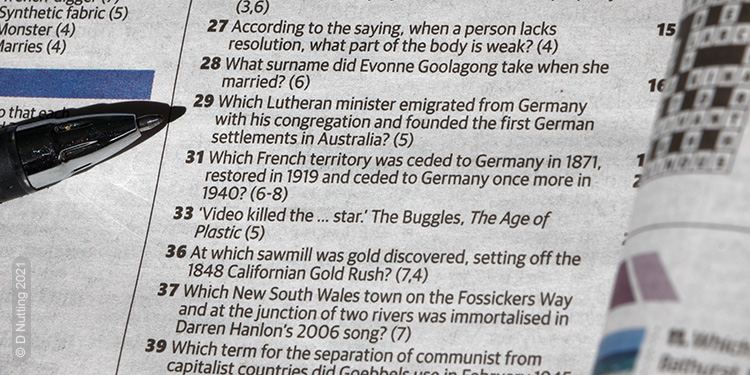
Kavel clue in the Giant Crossword in Melbourne's The Sunday Age on 11/04/2021
Not long afterwards the Giant Crossword, on 20/06/2021, page 39, featured Kavel again: “Who was the founder of Lutheranism in Australia?”
♦ Notes:
1. Carrick, Fiona. Personal communication, email - April 13, 2021. (President, Woden Valley Community Council, A.C.T.)
2. Hebart (1938), p.63
♦ Reference:
Hebart, Theodor. (1938). The United Evangelical Lutheran Church in Australia (U.E.L.C.A.): its history, activities and characteristics, 1838-1938. North Adelaide: Lutheran Book Depot