Second World War
Germans in Australia and German-Australians during World War 2
Part 1 - Nazi agitators in the 1930s; internment
Part 2 - early years of the war; the focus on Japan; name changes
In Australia during the First World War anyone or anything to do with Germany, whether person, place or product, suffered discrimination or internment, name change or rejection. To what extent were things different during the Second World War for Germans in Australia and for Australians of German descent?...[1]
Nazi agitators in the 1930s
Nazi organisations did exist in Australia in the late 1930s but did not have more than about 180 members. Nevertheless they were very active in trying to convince people of the achievements of National Socialism. They had very little impact on Germans or German-Australians in the rural communities and they didn't have much success in influencing the German clubs in the cities.[2]
The National Socialist Party was established in Australia by Johannes Heinrich Becker, a German World War I veteran. He was born at Schmalkalden in Thüringen, Germany and studied medicine at the University of Marburg. He migrated to South Australia in 1927 on the ship Main and worked as a doctor in Tanunda. In the 1930s the Nazi government in Germany contacted selected Germans in overseas countries and asked them to set up NSDAP branches in those countries.
Johannes Becker put the leadership of the Adelaide German Club under great pressure to agree to his demands, and he also made sure that the rights to import and distribute German products within South Australia went to Nazi sympathisers in the state.[3] He maintained records of the comments and behaviour of Germans in Australia, such as seamen on cargo ships. Becker could make life difficult for Germans who visited Germany, for example a German named Mayr was put into prison in Germany because of a negative comment he had made in a Tanunda hotel.[4]
Becker and his small group of followers produced a lot of propaganda about Nazi ideology and the supposed virtues of Hitler’s Germany and sent this propaganda to Germans in Australia and to Australians of German descent. They tried to reach rural South Australians of German descent by sending their propaganda to the Lutheran pastors of regional communities.[5]
Becker’s tactics and ‘style’ antagonised many people[6] and his campaigns were not popular with most Germans in South Australia. Eventually there was conflict between Germany’s Consul-General, Dr Rudolf Asmis and Becker – it seems Becker had grown ‘too big for his boots’, and Asmis managed to persuade the German government to dissolve Becker’s party branches. Asmis replaced Becker with Walter Ladendorff - Asmis thought his more subtle approach to promoting Nazi idealogy would be more suited to Australia than Becker's style.[7] The leading Nazis in Australia came to the attention of the Australian security services and they were arrested at the start of the Second World War.[8] During the war Johannes Becker was interned at Tatura in Victoria and in 1947 he was deported to Germany.
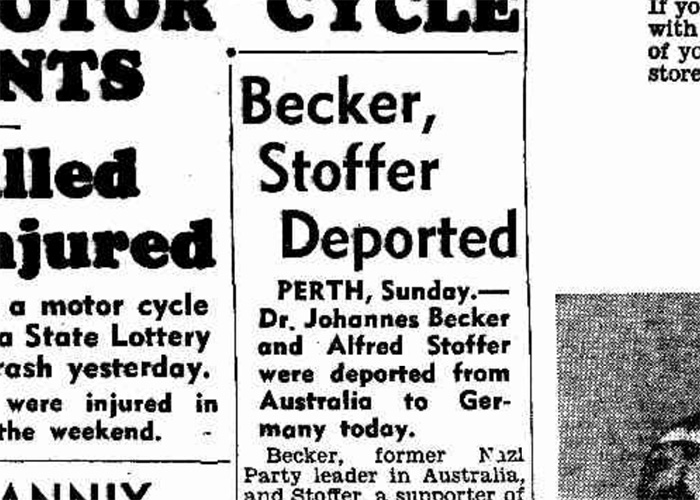
'Becker, Stoffer Deported' (1947, December 1).
The Daily Telegraph (Sydney, NSW : 1931 - 1954), p. 9
The historian Barbara Poniewierski has reported that there were clusters of supporters of Nazi Germany in the Barossa Valley, and that two Australian families of German descent in the Riverland area of South Australia were very openly fans of Hitler’s Germany.[9] She also found that there was an Australian-born farmer of German descent in Mount Torrens who was vehemently against his sons joining the Australian armed forces to fight against Germany. His three sons did enlist to fight for Australia, and he did not attend the district’s farewell party.[10]
Internment
Internment Camps were located in every state in Australia - the main camps for internees were located at Hay in NSW; Enoggera in Queensland; Tatura (Rushworth) in Victoria, Loveday in South Australia and Rottnest Island in Western Australia. In some states there were also other smaller or temporary camps that accommodated prisoners-of-war and internees, often before they were transferred to one of the larger camps.[11] Although a large number of Australians were of German family-background, comparatively few of them were interned, certainly in comparison with the First World War.[12] 7251 German citizens were interned[13], sometimes without charge. Some pastors of the Lutheran Church were interned at the start of the war, particularly if they were German citizens. For example, Pastor Ewald Steiniger of the German Lutheran Holy Trinity Church in East Melbourne was interned for 930 days between 1942 and 1944 without charge, at Camp Loveday in the Riverland district of South Australia and later at Tatura in country Victoria.[14]
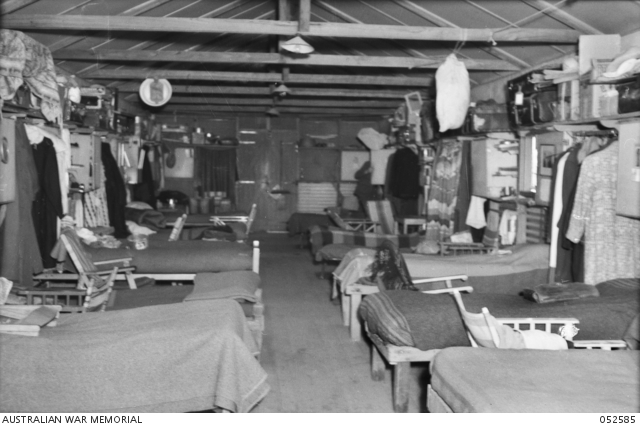
Tatura, Victoria. 1943-06-19. Interior of one of the living huts at No. 1 Camp, Tatura Internment Group. Australian War Memorial, accession number 052585. Photographer: James Tait. Public domain.
The internment of Lutheran pastors did not happen necessarily because their behaviour was politically pro-Germany, but rather to appease parts of the Australian population.[15] Nevertheless the historian Barbara Poniewierski has shown that there were a couple of pastors in the Barossa Valley who were openly in praise of Hitler’s ‘new’ Germany.[16]
♦ Between the lines – an Australian story, published by the Association of German Teachers of Victoria, contains resource materials for schools about a family impacted by internment in Australia during WWII. It is available from the AGTV website as a PDF file.
♦ Notes:
1. Molony, John N. (1987). The Penguin bicentennial history of Australia : the story of 200 years. Ringwood (Victoria) : Viking. p.221
2. Tampke (2006), p.132
3. Poniewierski (2011), pp.273-274
4. Poniewierski (2011), p.273
5. Poniewierski (2011), p.277
6. Poniewierski (2011), p.274
7. Tampke (2006), p.130
8. Tampke (2006), pp.130-133
9. Poniewierski (2011), pp.284-285
10. Poniewierski (2011), p.287
11. Young & Chang (2014)
12. Duan (2021), pp.10 & 27
13. Tampke (2006), p.133
14. Gosling, C. & Dr Brigitte Lambert (editors). (2021). Between the lines – an Australian story. Melbourne: Association of German Teachers of Victoria. (Resource materials for schools about a family impacted by internment in Australia during WWII.) p.i
15. Young & Chang (2014)
16. Poniewierski (2011), pp.283-284
♦ References:
Duan, Trent. (2021). A Quarrel with the German People? The Totalising Logic of Enmity, Narratives of Enmity and the “German Question” on the Australian home front during the Second World War. (PhD thesis, University of Melbourne). Minerva Access, online at <https://hdl.handle.net/11343/280313>.
Poniewierski, Barbara. (2011). National Socialism in South Australia. In: Monteath, Peter (ed.). (2011). Germans: travellers, settlers and their descendants in South Australia. Kent Town (S.A.): Wakefield Press. pp.269-303
Tampke, Jürgen. (2006). The Germans in Australia. Port Melbourne (Victoria): Cambridge University Press
Young, Matt & Chang, Charis. (2014, April 25). The forgotten history of Australia’s prisoner of war camps. Herald Sun (newspaper). Melbourne. Available online at <https://www.heraldsun.com.au>.