Victoria
Tatura Internment & P.O.W. Camps
Part 1 - why Tatura?; the structure of the camps
Part 2 - daily routine, entertainment and leisure for interned families
Part 3 - the German War Cemetery
During the Second World War many German and Austrian civilians and soldiers were sent to internment camps and Prisoner-Of-War (P.O.W.) camps in Australia. These camps had to be located far from Australian cities and the coast and the people in the camps were not to have contact with Australians. During the Second World War seven internment and prisoner-of-war (P.O.W.) camps were established in the Tatura area, approximately 180 km north of Melbourne. Four of the camps were for the civilians (internees) and three were for the prisoners of war. The Tatura area was chosen because it was near the Waranga Basin (a large, man-made irrigation reservoir), close to the railway system and to substantial food sources and more than 160 km distance from the sea (a security factor).[1]
The camps were divided into compounds and the authorities accommodated different nationalities in different compounds as far as possible.[2] In the course of time the Tatura camps became a large camp complex and had over 8,000 civilian internees and prisoners-of-war. With the guards and administrative staff the whole complex had a population much larger than Tatura itself or other nearby towns.[3]
The accommodation huts were made of corrugated iron and were cold and uncomfortable because they were not weatherproof. The huts for interned families were divided into compartments in order to give the families some privacy and internees tried to make their rooms more comfortable through ingenuity and creativity.[4]
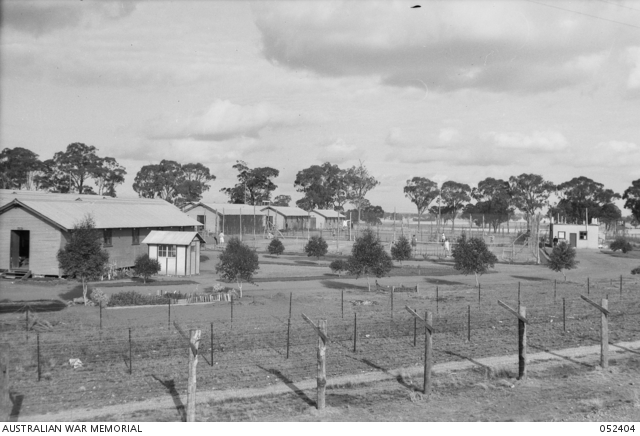
Tatura, Victoria. 10/06/1943. Tennis courts in the compound with living huts in the background, at Camp #1, Tatura internment group (German). The small building on the right is a coffee stall attached to the skittle alley (Kegelbahn).
Photo source: Australian War Memorial (public domain).
There was a well-established daily routine in the camp, and internees had cleaning and cooking jobs to do. A major problem for the internees was a mental one - the uncertainty about the length of their internment, not knowing how long the war would last and when they would be freed from internment. Boredom was also a problem, so some internees did their best to be active during their leisure time by making things, painting, building toys from scrap materials for the children in the camp, doing sport and planning and performing musical and theatre shows.[5] The camps did not close at the end of the war; the last camp that was closed was Camp #1 in 1947.
Camp #1 housed 1,000 single German and Italian men in two compounds. These men were interned in early 1940 and included German wool buyers, Lanz tractor engineers and business men (anyone considered to be a threat to Australia's security).
Compound A comprised of mess halls, kitchen, orderly room and camp office, halls for teaching (school), residences, workshops, cold showers, toilets, wash houses, hot showers and laundry, store, dentist, café, canteen, hospital and library.
Compound B comprised of a hospital, hot shower, cold shower, wash houses, toilet, store and workshop, eating halls, kitchen and residences. The internees developed tennis courts, a newspaper and flower and vegetable gardens.
Camp #2 housed 1,000 single German and Italian men. This included men who had been interned in Britain, whose government transported them on the infamous ship HMT Dunera with Jewish refugee boys and men. These internees were firstly sent to an internment camp at Hay, NSW, and later they were sent to Camp #2 at Tatura, before they were eventually allowed to join the (unarmed) 8th Employment Company of the Australian Military Forces (AMF). In Camp #2 a special kitchen was established for the Jewish internees and one hut was converted into a Jewish synagogue. Winston Churchill's British government later apologised for the appalling treatment that the refugees received on the Dunera. You can read more about the Dunera passengers and their journey and internment.
The artist and teacher Ludwig Hirschfeld-Mack was a refugee on the Dunera who was an internee in Tatura. He produced the woodcut you see below, depicting the camp.
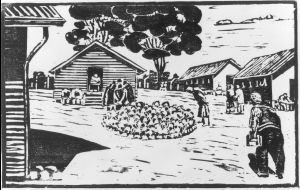
Ludwig Hirschfeld-Mack, 1893-1965,
German/Australian.
Internment Camp, Tatura 1941,
woodcut, 15.0/24.1cm,
gift of Mrs Franz Philipp 1971,
National Gallery of Victoria, Melbourne
Camp #3 was a family camp, housing 1,000 German and Italians divided into four compounds. This included a few residents of Australia but the largest group of internees in Family Camp No.3 were the Templer-Germans from Palestine who were deported from their long-established communities there by the British and transported to Australia on the Queen Elizabeth in 1941. For quite a while they didn't know where the ship was headed for. One compound held the German Lutheran (missionary) families from New Guinea; another compound held Austrian Jewish refugees who had fled from Vienna in 1938 after "Kristallnacht" (an antisemitic riot coordinated by the Nazi regime). Camp #3 closed in February 1946.
In Family Camp #3
the internees established a school, in which the children received a good education despite
the difficulties, taught by suitably qualified German internees.[6] Difficulties included lack of teaching resources and textbooks,
too little classroom space and the need to teach children of different age groups
together. However, in this school the older students were actually able to complete
their Abitur (school leaving certificate). They were able to do the following
subjects: German, English, French, Latin, Geography, History, Chemistry, Physics,
Biology, Art and Physical Education. The students' Abitur certificate
was later recognised by German universities and the University of Melbourne.
Read the report by Wilhelm Eppinger
(School Principal) on the difficulties of the camp school (1943, in German).
Photos could only be taken with the permission of the Australian camp commander and were taken by a military photographer. This is the reason for the small sign showing a catalogue number, which you can see in the photos below.
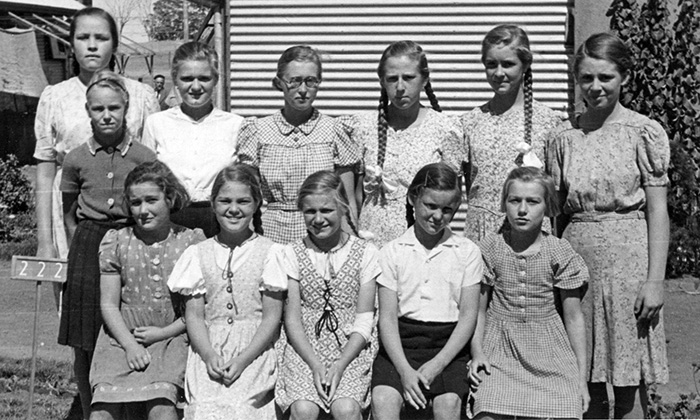
School students in Family Camp #3
Photo source: Albert Blaich Family Archive
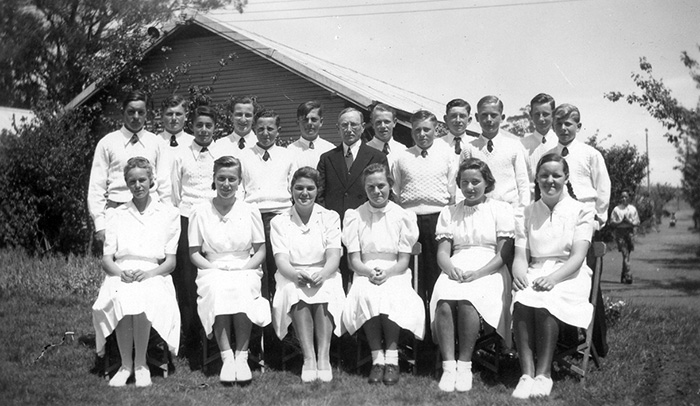
Templer Germans - Confirmation class, 1946
Photo source: Albert Blaich Family Archive
Camp #4 was a family camp for Japanese internees.
Dhurringile mansion, not far from Tatura, was also used for prisoners of war. It was a large two-storey mansion that a wealthy sheep farmer had built in the 19th century. From August 1941 to July 1945 it was used as a prisoner-of-war camp for German and Italian officers. The most famous prisoners there were German officers and crew from the ship HSK Kormoran, the raider that sank the Australian warship HMAS Sydney in 1941.
Camp 13: One of the seven camps in the Tatura complex of camps was called Camp 13, for Italian and German prisoners-of-war who were not officers.[7]
Graytown: southwest of Tatura was a camp that held prisoners who came from Camp #13 - they were often engaged in wood-cutting in the surrounding forests (which are now part of a National Park).
♦ Notes:
1. Monteath (2018), p.141
2. Monteath (2018), p.141
3. Monteath (2018), p.143
4. Monteath (2018), pp.157-159
5. Monteath (2018), pp.161, 163
6. Monteath (2018), p.163
7. Monteath (2018), p.191
♦ References:
Association of German Teachers of Victoria, Inc. (1999). Tatura Heritage Trail.
Bossence, William Henry. (1969). Tatura and the Shire of Rodney / by William Henry Bossence. Melbourne : Hawthorn Press. pp.265-284
Exhibition notes displayed at the Tatura Irrigation & Wartime Camps Museum, and information kindly supplied by the museum staff.
Monteath, Peter. (2018). Captured lives : Australia's wartime internment camps / Peter Monteath. Canberra, ACT : NLA Publishing
"Werner Blaich's Story" (Werner was a Templer German born in Palestine who was interned with his family in Tatura, Victoria. He stayed in Australia after the war. Werner describes among other things the ship's journey to Australia and life in the internment camp. PDF-file, 51Kb. No Adobe Acrobat?)