Second World War
Germans in Australia and German-Australians during World War 2
Part 1 - Nazi agitators in the 1930s; internment
Part 2 - early years of the war; the focus on Japan; name changes; post-war
Early years of the war
In the early years of the war a large number of Australians and the media that they read or listened to tended to make a distinction between the German people and the Nazi regime, meaning that people believed that Germany’s Nazi government was the problem and that many ‘good’ Germans were not tainted by Nazi attitudes.[1] There were regular visitors to Germany (particularly from the UK and the USA) in the 1930s “who despised the Nazis but continued to love and admire Germany. Many in this category had travelled or studied in the country before the First World War and had found the experience transformative. It is not difficult to understand why. Even more enticing than Germany’s physical beauty was its extraordinarily rich cultural and academic tradition - one that despite the First World War continued to play a key role in British and American life.”[2]
There seems to be evidence that in the early stages of World War II Australian governments and Australian media had learned lessons from the rampant anti-German hysteria of the First World War, and that many Australians were keen to avoid the hate propaganda that was promoted during that war.[3] Specifically anti-German policies and actions were far more measured and less widespread in the Second World War than in the First World War.[4]
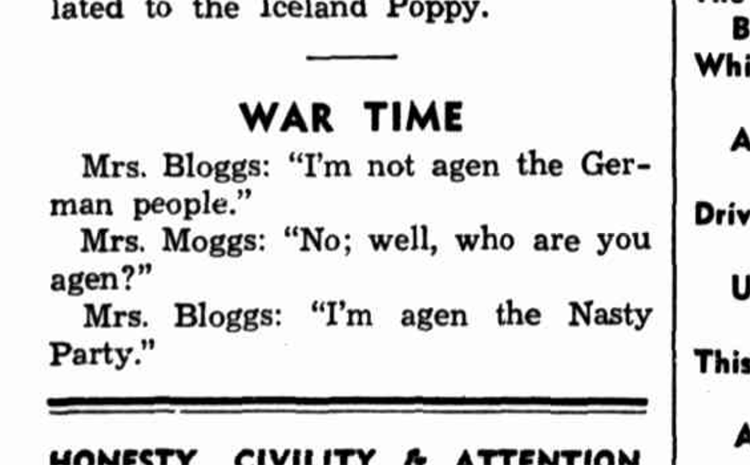
Francis Davitt’s column entitled “Passing Shots: War Time” in the Melbourne newspaper Advocate in January 1940 included a short humorous conversation between characters named “Mrs. Bloggs” and “Mrs. Moggs”, seen in the picture here. (“agen” = against).[5]
Popular Australian magazines varied in their attitude to Prime Minister Menzies’ distinction between the German people and Nazism – the Australian Women’s Weekly was scornful of this idea and had an editorial (1st June 1940, p.20) entitled “The Hun At His Worst!”, but the magazine Man supported the idea that the you couldn’t blame the German people for the actions of the Hitler regime.[6]
The focus on Japan
Feelings towards Germans and Australians of German descent were less bitter in World War II than in the First World War of 1914-18. Direct land battles between Australians and Germans were mainly limited to North Africa and did not last very long. In World War II Japan became the enemy that most focused the attention of Australians. From 1942 onwards the majority of Australia’s armed forces were involved in the war in the Pacific against Japanese forces, and the brutal and horrifying treatment of thousands of Australian prisoners by Japanese soldiers (for example during the enforced construction of the Thai-Burma railway by prisoners-of-war)[7] meant that Nazi atrocities in Europe did not perhaps feature as strongly in the news.[8]

Promotional poster for the movie Kokoda (2006)
For Australia Japan was the enemy that was geographically closer and which actually threatened the Australian mainland. Darwin and Broome and other sites were bombed by Japanese planes on several occasions. The battles between Australian and Japanese soldiers along the Kokoda track (a path nearly 100 km long through very mountainous jungle in Papua New Guinea) have become very prominent in Australia’s military history. Australians of German descent have a central role in the story told by the Australian war movie Kokoda, which was made in 2006. The Australian patrol in the movie is led by Max Scholt, from a German-Australian family, and also includes his brother Jack. Coincidentally, Max is played by the actor Simon Stone, who was born in Basel in German-speaking Switzerland, and Jack is played by Jack Finsterer, an Australian actor who is of German background. In one scene in the movie the unit is waiting for the Japanese to attack near Isurava. The two Scholt brothers are chatting quietly, and they test each other on German words that they remember from their childhood. Max Scholt says to his brother Jack: "Das ist der [sic] Bank. Das ist das Rathaus. Das ist die Post. Das ist... hey, what's 'library' again?"
Max Scholt is injured and has to be left behind in a hut. When Jack finally leaves the hut the last thing he says to his brother is: "Bibliothek - it's German for library."
Later in the movie Max is chatting with a young soldier named Johnno who is suffering from severe dysentery and who volunteered to stay at the hut and look after Max. Johnno says at one point: "Never thought I'd be mates with a kraut in all this. Things change I suppose." (A Wikipedia article explains how the German word ‘Kraut’ has been used in the English language.)
In an interview with Urban Cinefile (it was an Australian online movie magazine – no longer on the Internet) in April 2006 the actor Jack Finsterer explained that one of the reasons why he felt a connection with the character of Jack Scholt was that both he and his character are half-German and named Jack.[9]
Name changes
In South Australia, the state with the longest history of large group migrations from Germany, German-descended Australians’ experience of World War Two on the home front was milder and less vitriolic than it had been at times in World War One. The historian Ian Harmstorf has reported that in the First World War 179 people in South Australia changed their name from German to Anglo-Celtic names. During World War II only three people in South Australia changed their German surnames.[10]
During World War 2 German placenames in Australia (those that had survived World War 1) were less under threat than in WW1. In 1917 the South Australian placename Klemzig was one of the many German names that the South Australian government changed by act of parliament. Klemzig became Gaza (the new name commemorated a WW1 battle in Palestine). In 1935 the government reinstated the German name Klemzig. During World War Two some residents of Klemzig asked the government to change the placename back to Gaza, but the government turned down this request.[11]
Post-war
The deterioration of Western/Soviet relations and Cold War politics in the years following World War II were a reason why Australians’ attitudes to Germans improved sooner than they did after World War I. Western Germany was integrated into western Europe and Australians’ attitudes towards the Soviet Union became more distrustful.[12] Despite Germany's poor international reputation in 1945, in the first opinion poll taken after the war, in 1948, Australians placed Germans second after the British as desired immigrants.[13]
Many Germans who had spent the war in internment camps resented the years of being locked up, but for some of them staying in Australia looked more attractive than returning to Germany that was divided and ruined at that time. The original German-speaking homelands of some of these internees were no longer in Germany due to border changes after the war. In order to stay in Australia many Germans were prepared to forgive and to disregard what their years of internment had been like.[14]
♦ Notes:
1. Duan (2021), pp.238-239
2. Boyd, Julia. (2018). Travellers in the Third Reich. London: Elliot and Thompson Books. p.412
3. Duan (2021), p.242
4. Duan (2021), pp.10, 26-27
5. (1940, January 4). Advocate (Melbourne, Vic. : 1868 - 1954), p. 10. Retrieved May 26, 2025, from <http://nla.gov.au/nla.news-page20418132>. Francis Davitt, “Passing Shots: War Time”.
6. Duan (2021), pp.94-95
7. Ray, M. (2025, February 13). Burma Railway. Encyclopedia Britannica. <www.britannica.com/topic/Burma-Railway>
8. Tampke (2006), p.138
9. Kokoda. In 'The World of Film in Australia - on the Internet' (www.urbancinefile.com.au – website no longer on the Internet). Published April 20, 2006.
10. Harmstorf, Ian. (1994). South Australia’s Germans in World War II. In: Insights into South Australian History, vol. 2, South Australia’s German History and Heritage. Historical Society of South Australia Inc. p.70
11. Kupke, Lyall. (2017). The restoration of German place-names in South Australia. Journal of Friends of Lutheran Archives, 27, p.58
12. Duan (2021), p.248
13. Tampke (2006), p.138
14. Monteath, Peter. (2018). Captured lives : Australia's wartime internment camps / Peter Monteath. Canberra, ACT : NLA Publishing. pp.231, 233
♦ References:
Duan, Trent. (2021). A Quarrel with the German People? The Totalising Logic of Enmity, Narratives of Enmity and the “German Question” on the Australian home front during the Second World War. (PhD thesis, University of Melbourne). Minerva Access, online at <https://hdl.handle.net/11343/280313>.
Tampke, Jürgen. (2006). The Germans in Australia. Port Melbourne (Victoria): Cambridge University Press