Victoria
The Wimmera
The Wimmera is a large farming region in the west of Victoria that is known for the production of grains and other agricultural products. A considerable number of people in the Wimmera are of German descent. When the government of the colony of Victoria opened up the Wimmera to small-scale farming in the late 1860s it became much easier for people to buy land in the Wimmera, and many German-Lutherans moved to the region from South Australia and from the Hamilton area in the south-west of Victoria.[1] An article appeared in The Horsham Times in 1938 (100 years after the arrival of the first groups of Lutherans in South Australia) entitled The First Lutherans in Australia. The article highlighted the ‘strength of the Wimmera parishes’ of the Lutheran Church, and related the history of the development of parishes throughout the Wimmera and also the mission station at Antwerp.[2] Today there are active Lutheran communities at Dimboola, Horsham, Minyip, Murtoa and Natimuk.
The first German settlement in the Wimmera region was established in 1871 with the name Kornheim, east of Dimboola. In Horsham about 60 people attended a Lutheran church service in April 1872. A Lutheran church was built at Kornheim in 1874, and the Katyil post office, which had existed since the 1st February 1883, was renamed Kornheim Post Office on the 1st October 1883. During the anti-German sentiment in the First World War, this post office was renamed Edolsfield RO (= Receiving Office, i.e. a kind of part-time post office that did not offer all the services of a post office) in November 1917, and the post office here was closed in May 1921.[3]
The numbers of Lutheran farmers settling in the Wimmera increased substantially so that the Evangelical Lutheran Synod of Australia (based in South Australia) formally established Lutheran parishes centred on Natimuk (1874), Murtoa (1875), Dimboola (1883) and Ni Ni Well (north-east of Nhill, 1888).[4] Sizeable German communities settled at Green Lake, Lake Natimuk and Vectis.[5] The Germans, generally considered to be skilled farmers and model citizens, were in the main accepted by the British-Australian settlers.[6]
In 1890 Lutherans set up a training college at Murtoa to train, in the first place, teachers for their church schools, and in 1893 the college also started training theological students to become pastors. It was named Concordia College and Seminary and the first trainee pastors graduated from there in 1898. After several successful years some difficulties cropped up with the college at Murtoa and in 1904 it was closed and reestablished as the Concordia Seminary in Adelaide in 1905.[7] German missionaries established the Ebenezer mission (about 18 km north of Dimboola) in 1859 in order to help and 'civilise' the Indigenous Australians of the area.
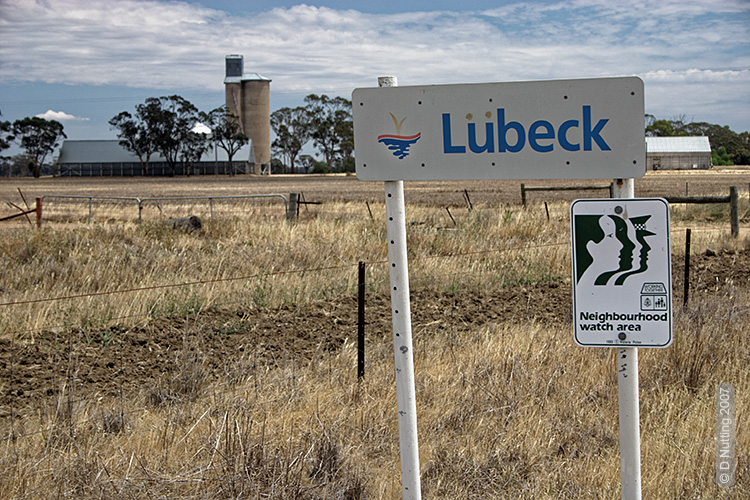
A place name sign on the edge of the small town of Lubeck in the Wimmera. Lubeck was named after the city in the north of Germany, whose name is spelled with a U-Umlaut. Somebody has helpfully added the Umlaut above the 'U' on this sign in the Wimmera.
Paul Tepper was a German-Lutheran farmer in the Wimmera and had a strong interest in botany, horticulture and entomology (the study of insects). His early collections of insects resulted in four insects being named after him, according to a list produced by the South Australian Museum in 1889, and he was in regular contact with the government botanist Ferdinand von Mueller in Melbourne. Tepper was not happy with the wheat varieties used in farming at that time; he wanted a wheat that was more resistant to both drought and rust. He crossed various wheat samples and bred his own variety of wheat, which won for him the silver cup at the Paris Exposition of 1889.[8]
Many Germans settled in groups and maintained some degree of cultural identity. The Lutheran schools and churches retained their use of German language. In the 1880s the Horsham Times regularly published ‘Our German Column’, which covered the news from Europe and was ‘translated specially’ for the paper. A Horsham Liedertafel [choir] was established in 1885. Yet while German settlers generally kept their Lutheran faith, and their language to some extent, other signs of German identity gradually became lost or eroded.[9]
Count Reinhold Philipp Johann of Anrep-Elmpt was a Baltic German from an old noble family. He travelled through many parts of Australia in the late 1870s and early 1880s and wrote a detailed book about his travels. He noted that there were a considerable number of Germans living in the Horsham area.[10]
William Schulze and Martha Preusker, whose surnames show that they were of German background, were married at the Lutheran church in Arkona on the 17th February 1914 (i.e. several months before the start of World War 1). A newspaper report listed the names of many who attended the wedding and almost all of those names were German surnames. The newspaper reported that Pastor Jericho, of Jeparit, conducted the ceremony in English, but German hymns were sung.[11] A newspaper reporter named Margaret Gilruth from the Herald newspaper in Melbourne visited the Wimmera in 1937 and wrote warmly about the German traditions and characteristics of the German-descended people there (the article was entitled Victoria's Little Germany - you can read the full article here). Gilruth reported that the grandmothers at a community event spoke accented English, as did their grandchildren. She found that the children at that time still spoke German in the home and that church services were still conducted in the German language. However, these Wimmera Germans had little interest in the land of their ancestors, and no apparent interest in spending money to visit Germany.[12]
It is interesting that the Arkona wedding ceremony in 1914 was conducted in English (though the hymns were sung in German) and that Margaret Gilruth reported that church services were still conducted in German in 1937. Perhaps what she was told was an exaggeration, or maybe there were differences from one part of the Wimmera to another.
A feature of the Wimmera region was the number of schools established by the German settlers. These were private Lutheran schools but some of them converted later to State schools.[13] At Dimboola South Primary School (State School #1859) attendance in the mid-1880s remained low due to considerable numbers of German children attending the Lutheran school in that area.[14] In the early Lutheran schools of the Wimmera the students were taught entirely in German. At the start of the 20th century, all Lutheran schools had a daily schedule where they taught in German in the mornings and English in the afternoons. German was used mostly for religious lessons and German language classes, while English was for other subjects.
By the time World War I began, it seems that English had almost completely replaced German as the main language used for teaching. German was now taught as a separate class. The church believed that learning German would help young people better understand the language of important Lutheran texts, like the German Bible, the Catechisms, and traditional Lutheran hymns.[15]
A meeting of the Council of Public Education (Victoria), about whether the German schools in Victoria should be closed, was held in 1916 during the First World War. Dr. Cameron (director of Agriculture) said that “professional and businessmen resident in towns in the Wimmera district had assured him that the German schools inculcated into the children the principles of German nationalism. Mr. Tate [the Director of the Education Department in Victoria] said that one of the department's inspectors had closely inspected the German schools, and, being an excellent German scholar, had examined the children. The only subject upon which he reported them as inefficient was in the teaching of the German language. (The newspaper reporter at the meeting noted ‘Laughter’ at that point.)”[16]
Lutheran schools are still part of the communities in the Wimmera. Olympic rower Lucy Stephan attended Nhill Lutheran Primary School[17] and won the Gold medal at the 2017 World Championships at Sarasota (USA) and at the 2017 World Championships at Ottensheim (Austria), and she also won the Gold medal in the coxless four at the 2020 Tokyo Olympic Games.
Many descendants of the Germans in the Wimmera still live in the area, and German surnames are widespread, as you can see on the Australian football premiership cup of the Horsham and District League of 2022 (see the photo). Several of the surnames of players that are engraved on the plaque are German, e.g. Schaper, Weidemann, Trotter, Kreuzberger, Ruwoldt, Niewand.
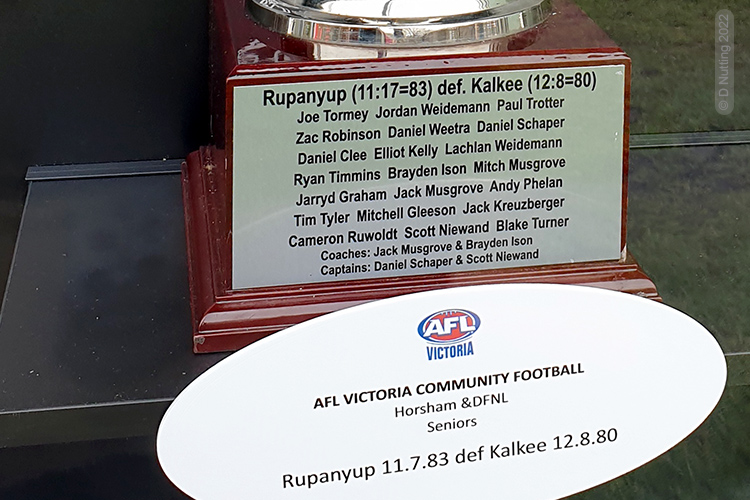
Premiership cup for football in the Horsham & DFNL League, 2022.
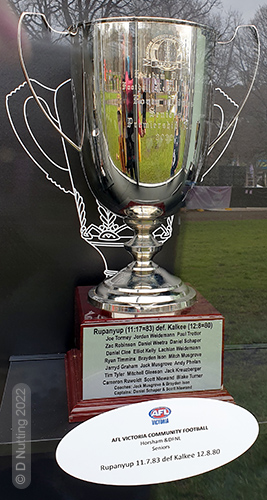
Premiership cup for football in the Horsham & DFNL League, 2022.
Back Roads is an Australian television documentary series that looks at Australian regional towns and rural communities. In one episode from the year 2018 the presenter visited the small town of Natimuk in the Wimmera, "where the community is a mix of rock climbers and German-Lutheran farmers". The presenter interviewed Natimuk farmer Brian Uebergang, whose ancestors moved to the area from South Australia in 1907. A typical German wagon in the traditional red and blue colours was visible in one scene on the farm.[18]
A German Festival was held annually in the 2000s at Dimboola, and later the city of Horsham held an Oktoberfest until the year 2019.
♦ Notes:
1. ‘Wimmera Region’, Victorian Places (2014). <https://www.victorianplaces.com.au/wimmera-region>. Accessed on 06/10/2025
2. FIRST LUTHERANS IN AUSTRALIA (1938, May 17). The Horsham Times (Vic. : 1882 - 1954), p. 10. Retrieved August 30, 2025, from <http://nla.gov.au/nla.news-article72589364>
3. Lodewyckx, Prof. Dr. A. (1932). Die Deutschen in Australien. Stuttgart: Ausland und Heimat Verlagsaktiengesellschaft. pp.55-56, 69 / Phoenix (Philatelic) Auctions - Post Office List, at <www.phoenixauctions.com.au>
4. Leske (1996), p.136
5. Doyle et al (2014), p.63
6. Doyle et al (2014), pp.63-64
7. Leske (1996), p.177
8. Leske (1996), p.119
9. Doyle et al (2014), p.64
10. Lamping, Gerlinde & Heinrich Lamping. (1994). "Die Australienreisen von Reinhold Graf Anrep-Elmpt (1878-1883)." In: Australia - Studies on the History of Discovery and Exploration. (Heft 65, Frankfurter Wirtschafts- und Sozialgeographische Schriften.) Frankfurt/Main : Institut für Wirtschafts- und Sozialgeographie der Johann Wolfgang Goethe-Universität. p.220
11. Wedding Bells. (1914, February 24). Dimboola Banner and Wimmera and Mallee Advertiser (Vic. : 1914 - 1918), p. 3. Retrieved October 2, 2021, from <http://nla.gov.au/nla.news-article152647561>
12. Deutschland im Wimmera (1937, November 20). The Herald (Melbourne, Vic. : 1861 - 1954), p. 37. Retrieved June 22, 2025, from <http://nla.gov.au/nla.news-article244534819>
13. Blake, L. J. (general editor) & Education Department of Victoria. (1973). Vision and realisation : a centenary history of state education in Victoria. Melbourne: Education Department of Victoria. Volume 2, p.176
14. Blake (1973), Volume 2, p.179
15. Meyer, Charles. (date unknown). The Lutheran congregational schools. pp.3-4
16. LUTHERAN SCHOOLS. (1916, May 3). The Argus (Melbourne, Vic. : 1848 - 1957), p. 11. Retrieved August 2, 2025, from <http://nla.gov.au/nla.news-article2101675>
17. Lucy Stephan - interviewed on ABC Local Radio 23/08/2022.
18. ABC TV (Australia). Back Roads, Series 04, Episode 3. Natimuk, VIC. Broadcast on 25/06/2018.
♦ References:
Doyle, Helen & Grieve Gillett Pty Ltd & Horsham Historical Society. (2014). Horsham Heritage Study (Stage 2), August 2014, Volume 3 – Thematic Environmental History. Horsham Rural City Council, Victoria.
Leske, Everard. (1996). For Faith and Freedom: the Story of Lutherans and Lutheranism in Australia 1838-1996. Adelaide: Openbook Publishers