The German wagon
A distinctive vehicle of Australia's past
The German wagon was one of the most common and distinctive objects to be seen on the farms of German Australians in South Australia and many parts of eastern Australia. These wagons were different from their British counterparts, and were recognised as being "typically" German in design. It was a horse-drawn wagon built mainly of wood, with no suspension springs, and with outward sloping sides. The slats in these sloping sides could be taken out, which made the German wagon very versatile, so that it could be used for many transportation purposes; they could carry goods of all shapes and sizes. They were cheap to build but immensely strong.[1] The spoked front wheels were smaller than the rear wheels.
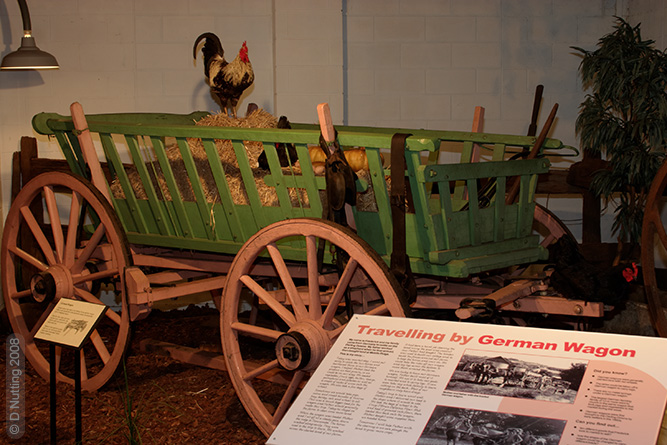
German wagon at the Cobb+Co Museum at Toowoomba in Queensland. The museum is a branch of the Queensland Museum, and is the home of the National Carriage Collection and focuses on horse-drawn vehicles and heritage trades.
The German wagon was popular and well-known for farming purposes, but in the German settlement areas of Australia the wagon also carried people to special events. On Sundays large families of 12 or more crowded into their wagons for the dusty trip to church.[2] These wagons were also an important part of wedding processions, and they were suitably decorated for these occasions. Noris Ioannou wrote about the Barossa Valley:
A long procession was formed and all followed the bride’s garland-decorated German wagon – the usual form of transport to the church at least up to the early 1900s. The procession of traditionally-coloured red and blue German wagons, drawn by horses also adorned in ribbons and rosettes, took the bridal party to the church.[3]
Noris Ioannou
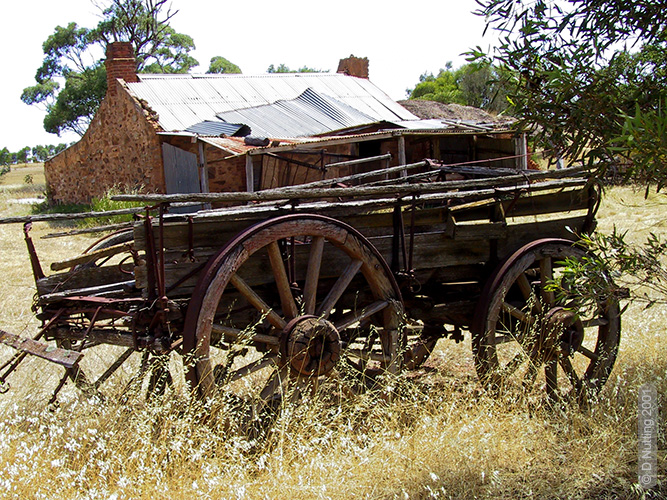
An old German wagon at a farming property at Moculta, Barossa Valley
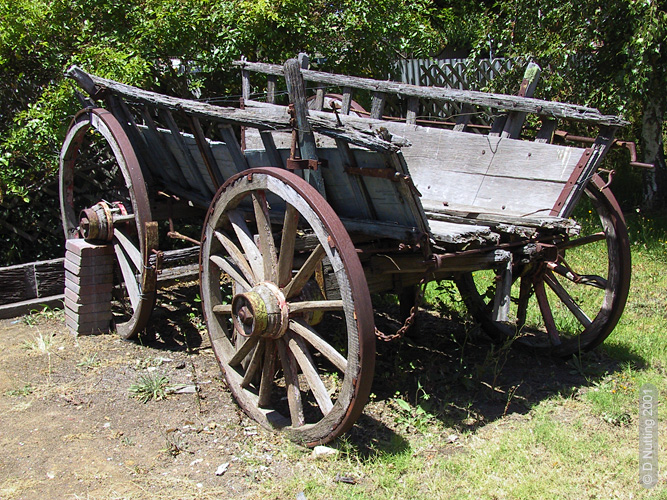
An old German wagon in Hahndorf, S.A.
In 1864 German immigrant farmers established a village south of Brisbane with the name Bethania.[4] Family photos were not a frequent event for rural families in 1871. In the photo above of a German farming family in the Bethania area, it appears that they have made an effort to show how well they are doing in their adopted country. They are wearing their best clothes, and are standing in front of an impressive farm building, and have included their German wagon and some horses in their posed photo.
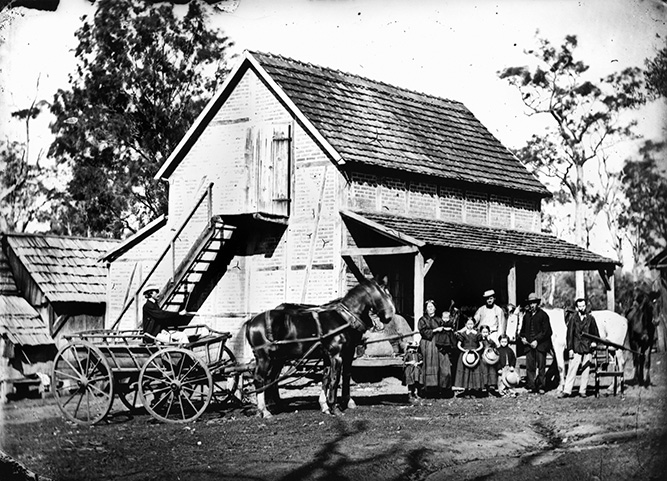
German family outside a farm building in the Bethania area, Queensland, ca. 1871
Photo: John Oxley Library, State Library of Queensland, Negative No: 20265. <https://hdl.handle.net/10462/deriv/66502>
The term ‘German wagon’ became so common in Australia that it was also used for wagons that were not in the distinctive German style. The Australian National Dictionary includes the expression as part of its collection of Australian words and phrases. Its definition of “German wagon” is: “Any of a range of open, all-purpose, (usu. horse-drawn) wagons.”[5]
In the 20th century, as cars and trucks became more common, the use of German wagons gradually declined, but they (and the name ‘German wagon’) were still in use in the 1950s in some places, as some newspaper reports of that era show. Some of these reports show that people were still using them who were not of German descent. The image below shows an example of this.
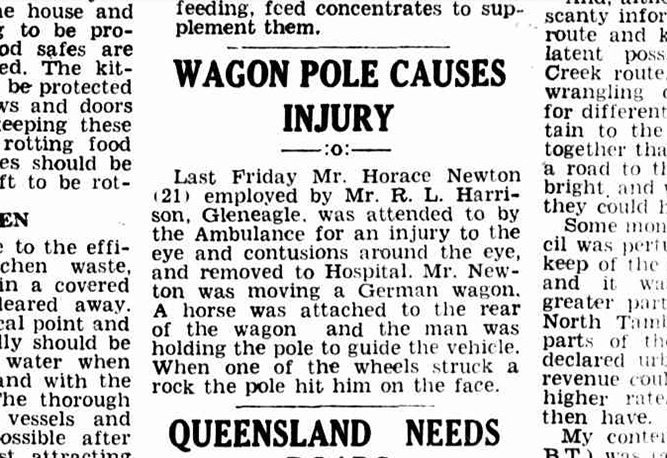
Article from a regional Queensland newspaper (The Beaudesert Times), reporting on an incident involving a German wagon in 1950.[6] (screenshot)
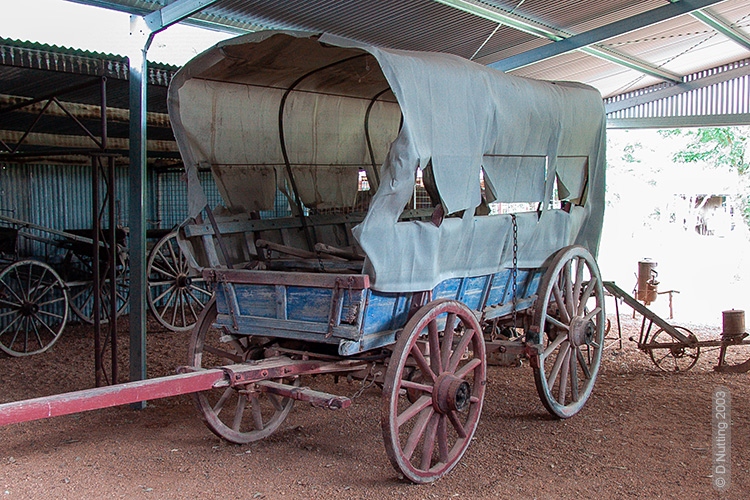
An original German wagon that took part in the Trek-migration from the Barossa Valley to the Riverina in NSW in 1868 (pictured at the Jindera Pioneer Museum)
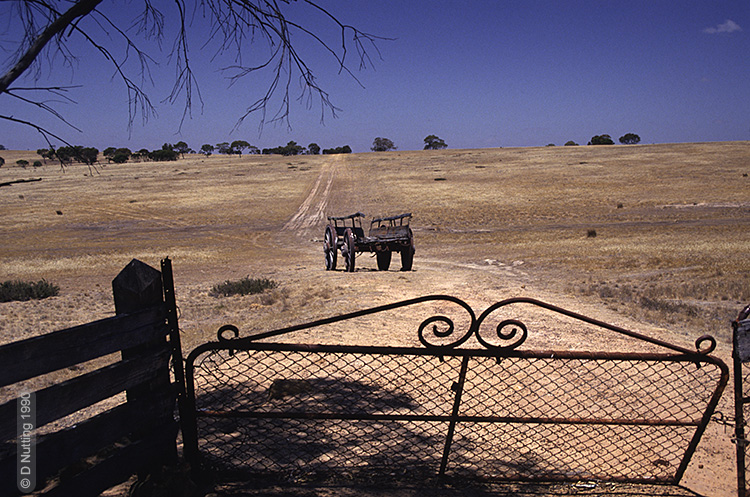
An old German wagon on a farm in the Wimmera, western Victoria
♦ Notes:
1. Harmstorf (1994), pp.30-31
2. Cobb & Co Museum, display information
3. Ioannou (2000), p.49
4. Erdmann (1988), p.120
5. Ramson (1988) - definition of German wagon
6. WAGON POLE CAUSES INJURY (1950, August 25). The Beaudesert Times (Qld. : 1908 - 1954), p. 5. Retrieved May 16, 2022, from <http://nla.gov.au/nla.news-article216170417>
♦ Reference:
Cobb & Co Museum, Toowoomba. (Part of Queensland Museum). (2008). Information board next to the German wagon display.
Erdmann, Claudia. (1988). Rural settlements founded by German immigrants in South Australia and Queensland during the 19th century. In: Manfred Jurgensen & Alan Corkhill & University of Queensland, Department of German (Eds.), The German presence in Queensland over the last 150 years : proceedings of an international symposium August 24, 25 and 26, 1987 University of Queensland, Brisbane, Australia (pp.112-124). St. Lucia [Qld.] : Dept. of German, University of Queensland
Harmstorf, Ian. (1994). Insights into South Australian History, vol. 2, South Australia’s German History and Heritage. Historical Society of South Australia Inc.
Ioannou, Noris. (2000). Barossa Journeys: into a valley of tradition. (Second edition) Sydney: New Holland Publishers
Ramson, W. S. (1988). The Australian national dictionary : a dictionary of Australianisms on historical principles. Melbourne : Oxford University Press. Access to the first edition of the Australian National Dictionary is available free online.