Victoria
The Wimmera - 'Victoria's Little Germany'
This article appeared in the Herald newspaper in 1937. The reporter Margaret Gilruth visited the Wimmera region in the west of Victoria. She described the German customs and traditions that the people had maintained.
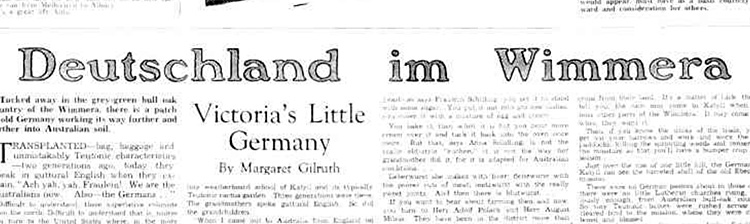
"Deutschland im Wimmera" - headline of the article in the Herald newspaper of Melbourne
Tucked away in the grey-green bull oak country of the Wimmera, there is a patch of old Germany working its way further and further into Australian soil.
TRANSPLANTED - bag, baggage and unmistakably Teutonic characteristics - two generations ago, today they speak in guttural English when they explain, "Ach yah, yah, Fräulein! We are the Australians now. Also - the Germans..."
Difficult to understand, these superlative colonists from the north. Difficult to understand that is, unless you turn to the United States where, in the more isolated parts, you find strange settlements sunk century deep in the past. They adopt a new country. They plough it, harrow it, reap its harvests. But to all intents and purposes, they are passing the years in the little feudal European villages inhabited by their great-grandparents.
The Germans of the Wimmera are like that. So thrifty, Dimboola townsfolk tell you, that they begrudge every tree its ground, because you reckon ground up that way in bushels of wheat. So religious that little Lutheran churches have sprung up in the paddocks. So patriarchal that - again we quote the townsfolk - no son marries before his father dies, no daughter dreams of careers carved out surrounded by the glitter of city life.
So kindly, call it sentimental if you like, that when the 50th anniversary of the little weatherboard Katyil school was celebrated early this month, transport was despatched to bring little old Herr Gustaf Wiedermann the 14 miles from Dimboola to take his place as a prominent guest because, as proprietor of Dimboola's general store, he sent out goods and allowed unlimited credit when the Germans of Katyil were weathering the 1902 drought.
Such good farmers that you can point unerringly to the best crops, the prettiest homesteads, and contend without fear of contradiction they belong to the Schmidts, the Schwartz, the Schillings.
THE women of "Deutschland im Wimmera" are busy carrying on the hausfrau tradition. City housewives run down the street to the store to buy a pound of bacon or a few slices of ham when husbands suddenly decide to bring somebody home for a snack.
But up there in the bull-oak country when you go into a hausfrau's kitchen you see great sides of bacon hanging from the ceilings and hams, home salted and cured, waiting in abundance for the eating. Sauerkraut provides a vegetable all the year round; you have sausage - not sausage turned out by the hundred by a suburban butcher - but leberwurst and mitwurst and gepresstwurst made in the good old-fashioned German way.
For the great 50th birthday celebrations, the German community turned out in force to surround the tiny weatherboard school of Katyil and its typically Teutonic cactus garden. Three generations were there. The grandmothers spoke guttural English. So did the grandchildren.
"When I came out to Australia from England on exchange," said the schoolteacher, Mr J. B. White, "I thought I had gone mad. I went into the school-room that first morning. I was greeted with a chorus of German. I looked out the window. The sun was beating down on typical Australian scenery. My wife was wondering how she would manage in the heat with so little water. Outback Victoria, I thought. Outback Victoria 10 miles from the nearest railway station. Yet there were those youngsters speaking practically nothing but German. So I rushed out to the wife and asked her to come in and for goodness sake try to find out what Ossie Schilling is saying."
Now those young German-Australians talk creditable English, although they hear nothing but German talked in their homes and on Sundays they attend German church services.
But ask them, their fathers, their grandfathers what part of Germany the family originally came from, and they will show mild surprise. They haven't thought about Germany as a concrete country where their blood relations are living for scores of years. They don't even think of carrying on a correspondence or spending a portion of their bank balances going there.
They would just comment mildly upon your strange notions if you suggested such a thing...
YET I have seen nothing more German in any Rhineland village than Fraulein Anna Schilling, of the Wimmera. She terms herself an old maid. She keeps immaculate house for two bachelor brothers. She works in the fields in the sturdy peasant tradition. She cooks - how she cooks!
Take her "kuchen," for instance. It might have stepped straight out of a German kitchen. If you want to try your amateur hand at it, you take some yeast so says Fraulein Schilling - you set it to stand with some sugar. You put it out into shallow dishes, you cover it with a mixture of egg and cream.
You bake it, then when it is hot you pour more cream over it and tuck it back into the oven once more. But that, says Anna Schilling, is not the really old-style "kuchen," it is not the way her grandmother did it, for it is adapted for Australian conditions...
Leberwurst she makes with liver: fleisswurst with the poorer cuts of meat; metzwurst with the really sweet joints. And then there is blutwurst...
If you want to hear about farming then and now, you turn to Herr Adolf Polack and Herr August Mibus. They have been in the district more than 50 years, and they are undoubtedly the patriarchs of the place.
Herr Polack - or is it Herr Mibus? - remembers his first crop from freshly cleared land. Eight bags of wheat reaped from 20 acres. And then it was heavily sprinkled with mallee roots... He laughs heartily over this now, throwing back his square head and roaring with joy in the way great-hearted, good-natured Germans like to do...
But in those days there were dingoes and emus and foxes to contend with; so different from today, when hard-working German farmers harvest great crops from their land. It's a matter of luck, they'll tell you; the rain may come to Katyil when it'll miss other parts of the Wimmera. It may come just when they want it.
Then, if you know the tricks of the trade, you'll get out your harrows and work and work the idle paddocks, killing the sprouting weeds and conserving the moisture so that you'll have a bumper crop next season.
Just over the rise of one little hill, the Germans of Katyil can see the turreted shell of the old Ebenezer mission. There were no German pastors about in those days; there were no little Lutheran churches rising, curiously enough, from Australian bull-oak country. So tiny Teutonic babies were rushed across uncleared land to the mission, where they were christened and blessed.
And, of course, they were little Schillings, Schmidts or Schwartzs.
♦ Reference:
Deutschland im Wimmera (1937, November 20). The Herald (Melbourne, Vic. : 1861 - 1954), p. 37. Retrieved June 22, 2025, from <http://nla.gov.au/nla.news-article244534819>