Names
Australian Placenames of German Background
Heidelberg, Victoria
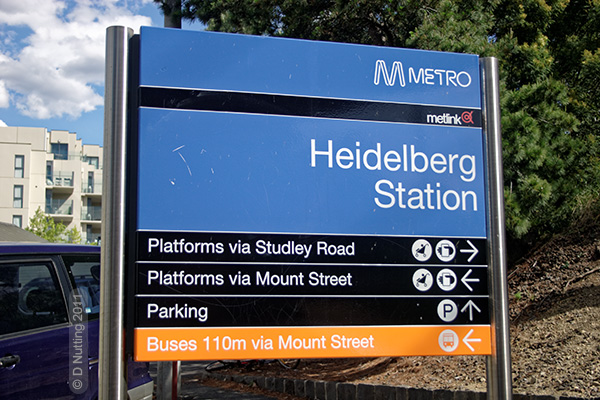
Sign at the entrance to Heidelberg Station, Victoria.
There is no documentary evidence of the formal naming of this area as Heidelberg. However, it is generally accepted that the name was first used by the flamboyant land agent Richard Henry Browne, who acted for himself and for the Sydney-based estate agent Thomas Walker. R.H. Browne was known as “Continental” Browne because he often talked enthusiastically about his travels in Europe. He had business connections with the well-off settlers in the area of present-day Heidelberg – these were wealthy and prominent people in the early days of the city of Melbourne who wanted to create out-of-town estates for themselves. R.H. Browne bought land in the area for himself and lived there for most of 1839. In July 1839 he used the name Heidelberg as his address.
In talking up the ‘romantic’ beauty of the scenery Browne highlighted the similarity he saw between the Yarra Valley and the valley of the Neckar River in the famous German university town of Heidelberg. Certainly both places “lie beside a river winding its way along a valley with hills rising to either side.”[1]
In his 2014 book about the must-see sights of Germany the author Bernd Imgrund described Heidelberg Castle as a synonym for the romanticism of German castles.[2] In Melbourne in the 1840s ‘Continental’ Browne probably thought the same thing. The German city of Heidelberg was already a tourist magnet in the 1800s. The website of Heidelberg Castle explains how the German city of Heidelberg came to be so popular and romanticised by visitors in the 1800s:[3]
The nearly forgotten castle was rediscovered in 1800. Artists of the Romantic period, in search of true feeling, were enchanted by the picturesque ruins. Heidelberg became the paragon of Romanticism, immortalized in countless poems and paintings.
website of Schloss Heidelberg
Lothar Becker, a German naturalist from Silesia who was in Australia from 1849–1852 and from 1855–1865, agreed with Browne's comparison. Becker wrote articles for German journals and magazines about exploration and natural history, such as Die Gartenlaube, Das Ausland, Globus and Die Natur. He visited Heidelberg near Melbourne and wrote (here in translation):[4]
Downstream of the Plenty mouth lies the handsome village of Heidelberg, on the right bank of the Yarra inhabited by British. The founder of this place gave it this name, because he believed to find here a certain similarity to the region of Heidelberg in Germany and, as it seems, the designation is not unsuitable, when one looks on the dusky eucalypt hills on the one hand and on the pine forests of the Black Forest on the other.
Lothar Becker
The university in Heidelberg, Germany, was quite well known in England. In the 1800s a considerable number of foreign students, including many from England, went to Heidelberg to study at the famous university.[5]
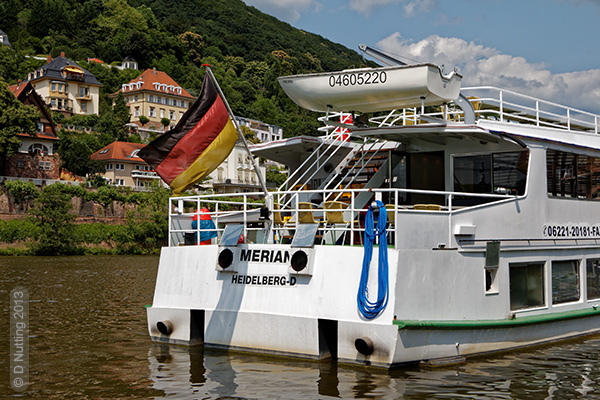
Excursion boat moored on the River Neckar at Heidelberg, Germany.
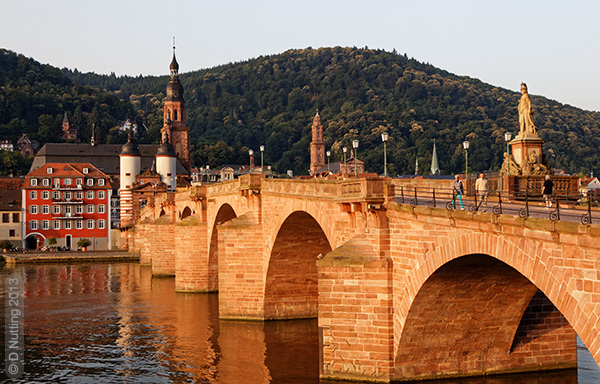
The Old Bridge over the Neckar River in Heidelberg, Germany. This is one of the views of Heidelberg that enchanted the land agent “Continental” Browne.
Melbourne's Heidelberg stayed 'Heidelberg'
Early in World War I the anti-German feelings of that time caused debate in the Heidelberg area about the name of the suburb and about the German/Germanic names of some streets, and attitudes swung this way and that throughout the war. A few streets in Heidelberg Heights and Eaglemont were renamed - Bismarck St in Heidelberg Heights became Thames St in 1917, and Helensburg Street and Ehrenberg Street in Eaglemont were changed to Durham and Devon streets in 1922.
Heidelberg Shire Council held a meeting on September 12, 1914 to consider a proposal to change the suburb name to something British. Some people wrote letters to the Heidelberg News requesting that the name Heidelberg be changed to a British name. Suggestions included the name Georgetown, after the King or the British Prime Minister at the time David Lloyd George — or a community competition to choose the name. However, other letter writers felt that Heidelberg was a beautiful name and suited the attractive suburb. A prominent lawyer, Herbert Darvell, wrote that a name change "was unnecessary and the pleasant sound of [the name] Heidelberg was not altered by the word’s origin."[5]
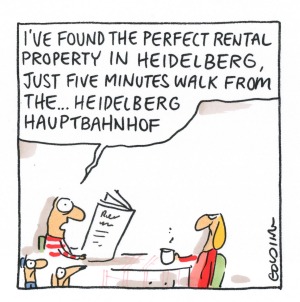
In the Sunday Age newspaper of 5th June 2016 a cartoon supported an article about difficulties faced by people seeking and renting accommodation in Melbourne. The article explained how renters in Germany have more rights than renters in Australia. The cartoon showed someone being initially enthusiastic and relieved when they thought they had found a house for rent in Heidelberg (Melbourne), which then turned out to be in fact a lot further away, in Heidelberg in Germany. (Cartoon image: used with permission - Matt Golding / The Age)
♦ Notes:
1. Garden (1972), pp.19-20
2. Imgrund, Bernd. (2014). 101 deutsche Orte, die man gesehen haben muss. Darmstadt: Konrad Theiss Verlag. 4. Auflage. p.88
3. Longing leads to Heidelberg - Romanticism. Website of Schloss Heidelberg. <www.schloss-heidelberg.de/en/interesting-amusing/collections/romanticism>
4. Becker, Lothar. (1855). Beschreibung eines Ausfluges in die blauen Berge Neu-Hollands. Zweiter Abschnitt. In: Das Ausland: Wochenschrift für Erd- und Völkerkunde. 28. 1855. Stuttgart, Augsburg : Cotta. In the collection of the Bayerische Staatsbibliothek - digitised at <https://mdz-nbn-resolving.de/urn:nbn:de:bvb:12-bsb10530695-8>. English translation of this extract by Dr Tom Darragh.
5. Blackbourn, David. (2023). Germany in the World: A Global History, 1500-2000. New York: Liveright Publishing. pp.186, 329
6. Armitage, Laura. (2015, March 5). Heidelberg not immune to suburb and street name changes after start of World War I. Heidelberg Leader.
♦ References:
Blake, Les. (1976). Place names of Victoria. Adelaide: Rigby. p.121
Cummins, Cyril R. & Heidelberg Historical Society (Vic.). (1982). Heidelberg since 1836 : a pictorial history. Heidelberg, Vic : Heidelberg Historical Society. p.7
Garden, Donald S. (1972). Heidelberg : the land and its people, 1838-1900. Carlton (Vic.): Melbourne University Press.