Names
Australian Placenames of German Background
Coburg, Victoria
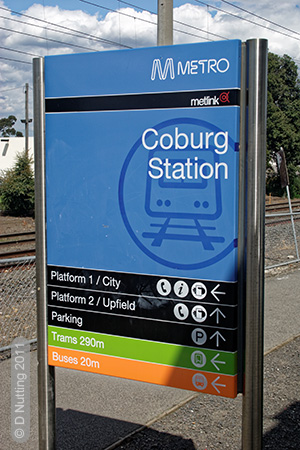
Sign at the entrance to Coburg Station, Victoria.
Coburg was originally called Pentridge. A surveyor lived in the area from around 1840 with his wife. His wife was born in the village of Pentridge in Dorset, England.[1] Since 1850 there had been a prison stockade there which was gradually expanded by the government into what became the famous HM Prison Pentridge (maximum security).[2]
The stockade became a symbol for evil and the people of the village of Pentridge became embarrassed by telling people that they ‘lived in Pentridge’ – most members of the public referred to the prison simply as ‘Pentridge’. The residents believed that the value of their land and their houses was being ruined by the name Pentridge, associated with the prison.
In 1867 a priest named Monsignor Charles O’Hea called a public meeting in order to campaign for a change of name for the district. The Irish-born residents were hoping the new name could be Tipperary, Limerick or Donegal. Robert Mailer of Glencairn suggested that the new name be 'Coburg', in order to honour the Duke of Edinburgh, who was soon to visit the colony of Victoria. The Duke was a member of the German royal house of Saxe-Coburg and Gotha, because his father Prince Albert (husband of Queen Victoria) originally came from the Duchy of Saxe-Coburg and Gotha in Germany.
The government received the petition from the residents of Pentridge and agreed to the new name Coburg, which took effect from March 1870.[3]
➽ You can read more in this article about the German husband of Queen Victoria, Prince Albert, and about how his name and his German royal title ('Saxe-Coburg und Gotha') led to place names in Australia.
With the start of World War One in late August 1914 anti-German feelings arose in most parts of Australia. The City of Coburg's “Councillor William Cash proposed in September 1914 that the name of Coburg with its German associations should be changed, perhaps to Linlithgow, but no other councillors or ratepayers seemed interested.”[4]
Sign outside a music school in Coburg, Germany
♦ Notes:
1. Broome (1987), p.40
2. Broome (1987), p.94
3. Broome (1987), pp.96-97
4. Broome (1987), p.192
♦ References:
Broome, Richard. (1987). Coburg, between two creeks. Melbourne : Lothian