Victoria
JF Krummnow and the Herrnhut Commune
1) Krummnow in South Australia
2) In Victoria - founding of Herrnhut commune
3) Years of success
4) Hill Plain commune moves to Herrnhut
5) Krummnow's death
Krumnow died of progressive paralysis at 10:30pm on Sunday 3rd October 1880, at age 69.[1]
August Hildebrandt, Herrnhut’s baker and long-term member of the commune, conducted the burial service and delivered the eulogy at Krummnow’s funeral. Hildebrandt praised Krummnow’s spirituality and other positive attributes, and excused Krummnow’s weaknesses as just being part of human nature.[2] Hildebrandt had lived together with his daughter Mary in Krummnow’s house (she had been Krummnow’s housekeeper since about 1870[3]), and in his eulogy he said that Krummnow’s weaknesses were ‘his relationships, as an old bachelor, with some of his female followers, and his tendency to drink during his last years’.[4]
There are some stories about Krummnow's burial which are part of the oral folklore of the area. They are not believed to be true. For example:
1) It is said that he was buried face-downwards. Grandchildren of one of the commune members told the researcher Charles Meyer in the 1970s that Krummnow was buried face downwards.[5] Krummnow used to boast that when his time came he would rise up to heaven and be taken into the clouds as Christ was. The Lutheran neighbours regarded this as blasphemous, so they spread the story that Krummnow was buried face-downwards, so that if his prediction of raising himself came true, he would not go in the direction of heaven, but rather, go the opposite way to hell, where many felt that he belonged. An embellishment to this story is that a very large rock was placed over his body, so that if Krummnow was smart enough to work out that he was going the wrong way, the rock would ensure that he stayed where he was meant to be.
However, August Hildebrandt respected Krummnow greatly and would have buried him in an appropriate way.
2) It is also said that at the burial a grieving swagman, who had often worked for the commune and liked Krummnow, tried to jump into the grave.[6]

Road sign: 'Krumnow Lane', a rural road where the commune was located, was named after the leader of the commune
Professor Lodewyckx wrote in 1932 that it is difficult to evaluate the various claims made about Krummnow, that it is extremely hard to distinguish between truth and fiction. A personality like Krummnow's was probably exposed to lots of gossip from neighbours (on nearby farms) who were not very well disposed towards him.[7]
After Krummnow's death
The Herrnhut commune declined rapidly after Krummnow's death. Only eight people still lived in the commune when he died. The commune was in debt, but the remaining members continued working the property as best they could, whilst embarking on complicated and extended legal proceedings. Ownership of the commune land was granted to the remaining communards on December 20, 1886. Unfortunately, there was an accumulated debt of almost 5000 pounds and in 1889 the property was transferred to Alfred Hodgson, a Melbourne lawyer, to settle the debt. Negotiations with the purchaser resulted in the remaining Herrnhut communards being allowed to occupy the stone buildings for as long as they needed to. Today most buildings have been taken apart and the material used for building elsewhere.
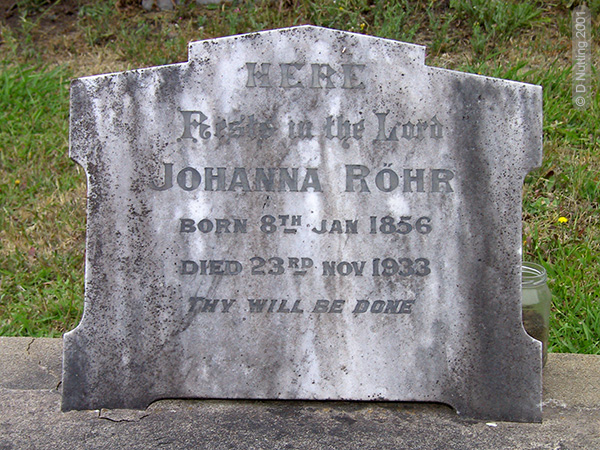
Grave of Johanna Röhr, Tabor cemetery
Johanna was one of the children that were born in the commune.
She lived her whole life at Herrnhut, for decades after Krummnow’s death, with her sisters and her nephew. In the last two decades of her life they lived in very poor circumstances.[8]
A house name
A descendant of August Hildebrandt, the commune's baker and long-term faithful follower of Krummnow, lives in the south-east of Melbourne and named his house after Herrnhut. The photo shows the name of the house.
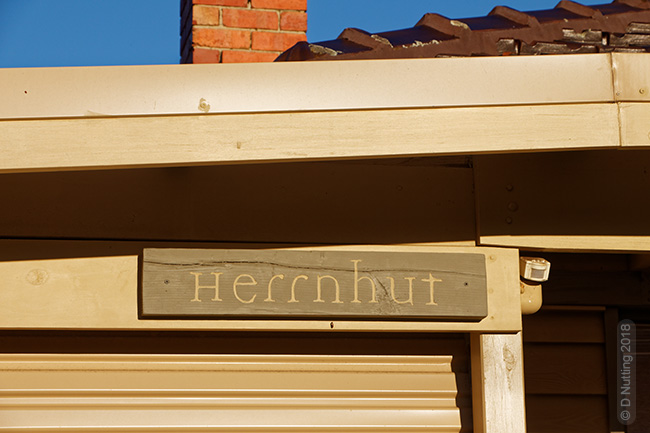
A house named Herrnhut in Melbourne
Krummnow and Herrnhut - a conclusion
The researchers Betty Huf and Bill Metcalf summarised the significance of the Herrnhut commune in this way:
One writer concluded in 1965 about Johann Friedrich Krumnow: 'A mixture of idealist, mystic, confidence man, and despot, he was driven by an overmastering ambition to command the loyalty and obedience of his followers'.[9] Yet this same writer neglected to mention all that was achieved by the Herrnhut communards under the leadership of Krumnow. They were, after all, a very prosperous community for over a generation. They helped shape their area of western Victoria. They were Australia's first commune and still hold the title for being Australia's longest lasting communal group. They provided room, board and casual work for hundreds of homeless people, and a safe haven for hundreds of Aboriginal people who were being persecuted, and occasionally murdered, by other settlers.[10]
Betty Huf and Bill Metcalf
♦ Notes:
1. Metcalf & Huf (2002), p.91
2. Lodewyckx (1932), p.144
3. Metcalf & Huf (2002), p.80
4. Lodewyckx (1932), p.144
5. Meyer (1978), p.209
6. Metcalf & Huf (2002), p.92
7. Lodewyckx (1932), p.144
8. Metcalf & Huf (2002), pp.123, 126-127
9. The Age newspaper, 27/11/1965, p.22
10. Metcalf & Huf (2002), p.138
♦ Information summarised from:
Huf, Betty (2001, January). Personal communication (local historian).
Metcalf, Bill, & Betty Huf (2002). Herrnhut. Australia's First Utopian Commune. Carlton Sth (Victoria): Melbourne University Press.
Lodewyckx, Prof. Dr A. (1932). Die Deutschen in Australien. Stuttgart: Ausland und Heimat Verlagsaktiengesellschaft. pp.137-144
Meyer, C. (1978). Two Communes in 19th Century Victoria. In: Victorian Historical Journal, Vol. 49, (No.4).