Victoria
JF Krummnow and the Herrnhut Commune
1) Krummnow in South Australia
2) In Victoria - founding of Herrnhut commune
3) Years of success
4) Hill Plain commune moves to Herrnhut
5) Krummnow's death
Krummnow went to Victoria where he convinced some fellow Germans to give him their money and to go with him to establish a commune called Herrnhut near Hamilton. On 27 May 1853 Krummnow applied for and bought 642 hectares of Crown Land about 24 km south-east of Hamilton for £1584. At first the community lived in buildings made of wood and thatch. A bushfire went through the district in January 1860 and it is believed that those buildings were destroyed and that the bluestone buildings were built then. 12-15 buildings made of bluestone (the walls were about 60 cm thick) arose.[1] Krummnow conducted baptisms and holy communion in the church, which was completed in 1854. The ruins of two of the buildings remain today. Here you can read an article about Herrnhut that appeared in the Melbourne newspaper The Argus in 1857.

Foundations of the church
The origin of the name Herrnhut
Herrn Hut means 'the Lord's watchful care' or 'the Lord's protection'. The Moravian Brethren, also known as the Moravian Church (and in German as the Mährische Brüder or the Herrnhuter) is a pietist community with a strong focus on missionary work. The community was founded in 1722 on the estate of Count Nikolas von Zinzendorf, in upper Lusatia in the east of present-day Germany. He offered religious refugees a safe haven and a place to stay. The village that grew up with this mix of religious refugees came to be called Herrnhut, meaning ‘on watch for the Lord’. The Herrnhuter, or Moravian Brethren, were and still are very active in missionary work, particularly in the Caribbean and in Africa.[2]
Friedrich Krummnow felt a strong connection with the thinking of the Moravian Brethren (including the rejection of violence, for example), and he named his Australian commune after the German town in Saxony where the Moravian Brethren originated.[3]
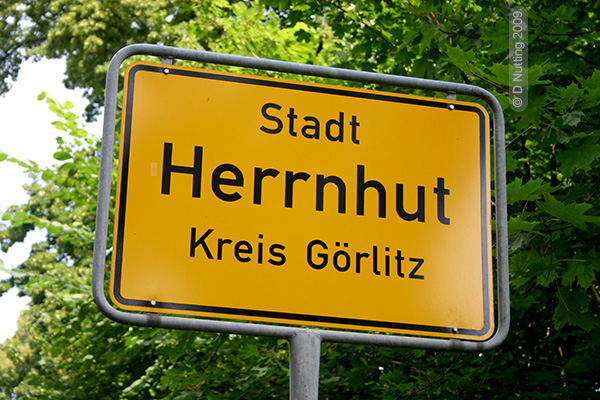
Town entry sign at Herrnhut, Germany
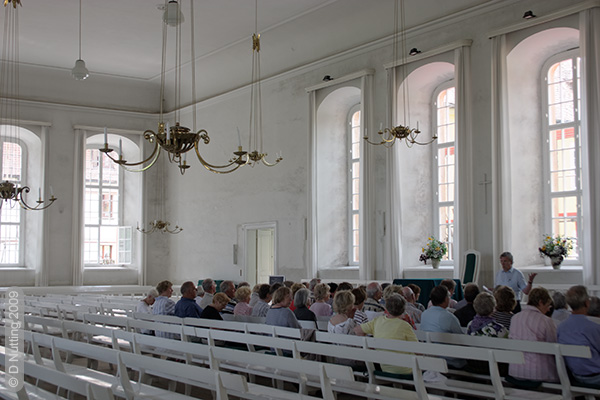
The interior of the church hall of the Evangelical Moravian Brethren in Herrnhut, Germany
The foundation walls of this church hall in Herrnhut, Germany, date back to 1756. The hall is the most important assembly room for the parish and its guests. The white colour of the walls and of the bench seats symbolises purity, joy and salvation.[4]
You can read more about the beginnings of Herrnhut in Germany at the website of the project “European Cities of the Reformation”.
♦ Notes:
1. Lodewyckx (1932), p.139 ("fast 2 Fuß dick" = the walls, almost two feet thick)
2. Stiberc, Andrea. (2007). Heimweh, Kitsch & Co. Gekürzte Neuausgabe. Freiburg i.Br. : Herder. p.150
3. Metcalf & Huf (2002), p.21
4. Kirchensaal - Evangelische Brüdergemeine Herrnhut <www.herrnhut.ebu.de/kirchensaal> (accessed 13/03/2022)
♦ Information summarised from:
Blake, Les. (1976). Place names of Victoria. Adelaide: Rigby. p.121
Huf, Betty (2001, January). Personal communication (local historian).
Metcalf, Bill, & Betty Huf (2002). Herrnhut. Australia's First Utopian Commune. Carlton Sth (Victoria): Melbourne University Press.
Lodewyckx, Prof. Dr A. (1932). Die Deutschen in Australien. Stuttgart: Ausland und Heimat Verlagsaktiengesellschaft. pp.137-144
Meyer, C. (1978). Two Communes in 19th Century Victoria. In: Victorian Historical Journal, Vol. 49, (No.4).