South Australia
The Lutheran Church in the Barossa Valley
Part 1 - Lutheran churches as a cultural and scenic phenomenon in the Valley
Part 2 - Splits in the church :: villages with two (or more) Lutheran churches
Part 3 - Language, the German spoken in the Valley :: language and symbolism in cemeteries - signs of history
Language and the Lutheran Church
The first public buildings that Lutheran German immigrants established when they settled as a new community were the church and the school. Often the church was the first building and it functioned simultaneously as the first school room during the week, until a separate schoolhouse was built. Frequently the pastor was also the schoolteacher, and lessons were conducted in the German language, as it was important to the parents that their children could read the Bible in German. It was important to the Lutheran immigrants that their community’s church services be conducted in German because German was the language into which the religious reformer Martin Luther had translated the Bible in 1521-22 (translated from Latin and Greek). ‘Luther’s language adorned the interior of the churches’ in German communities in S.A. and in other Australian colonies/states, for example on altars or on pulpits.[1]
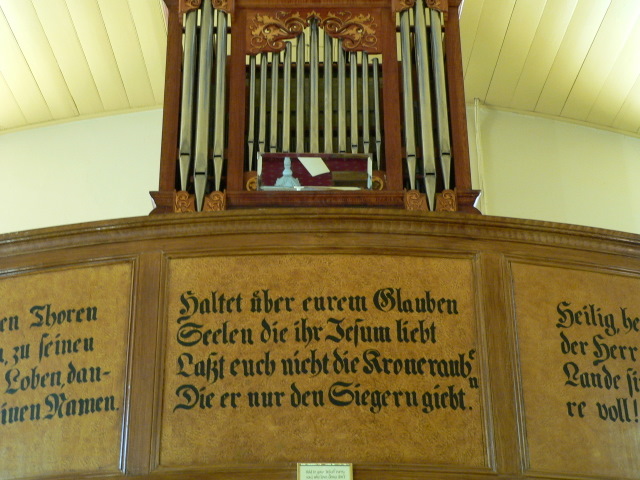
The interior of the Gruenberg Lutheran church at Moculta. Biblical quotes in German below the church organ.
Photo source: Fairv8, CC BY-SA 3.0, via Wikimedia Commons

The rural isolation of many South Australian German communities and the importance of the German language in the church meant that the everyday use of the German language continued longer in the Barossa Valley and its surrounds than among Germans in urban towns and cities. The language researcher Claudia Maria Riehl wrote (here in translation) that: “The most important factor for language preservation is undoubtedly membership of the Lutheran community." The rituals in church services were held in German until 1940, and the pastors had a great deal of authority in the village and were very much in favour of preserving German virtues.[2]
Riehl interviewed in 2015-16 the last few speakers of Barossa German in the Barossa Valley, and one of the features of their German that was striking was the reduction in use of case markers in the Dative case. In many situations where a preposition triggers a Dative ending in the following noun phrase in standard German, the interviewees usually dropped the ending or replaced it with an ending of the Accusative case. When using German verbs that require a Dative ending in the following noun phrase (e.g. the verb folgen, to follow) in standard German, the Barossa interviewees almost never applied a Dative ending (usually the Accusative case instead) – the exception was dem Weihnachtsmann. This phenomenon has been seen in other areas of German settlement as well, such as the Lockyer Valley in Queensland.[3]
Professor Riehl has also consulted minutes from congregations in the Barossa Valley, which are housed in the Lutheran Archives in Adelaide. Minutes from a church in Tanunda between 1909 and 1912 were written in a very sophisticated German, without English words and with use of the subjunctive and passive voice. In minutes from the 1930s onwards (for example from a church in Nuriootpa), influences from English are noticeable, for example English terms and words for events such as Vice President, Afternoon Tea, Sale of Gifts, which were often integrated into the German text by capitalisation (Afternoon Tea).[4]
The minutes (of meetings) of the parish of St Kitts (in the north-eastern corner of the Barossa Valley) were written in German until 1954. Until 1939, the minutes were written in Kurrent script, but after that in the Latin script used today. Nouns were often written in lower case (e.g. die gemeinde) instead of being capitalised.[5] (Kurrent is an old form of German-language handwriting based on late medieval cursive writing, also known as Kurrentschrift ("cursive script").)
In the 1960s the Australian linguist Michael Clyne examined the use of German in the Barossa Valley and found that people’s German included numerous archaisms (old-fashioned words) and expressions. (Here in translation from a German book by Michael Clyne) "There are countless archaisms in the German of most of the settlers, as their last German reading consisted of the Luther Bible, the hymn book, old school books (...)." Examples of such archaisms were: gewohnet, Sommerzeit, wahrlich.[6]
In his 1968 article Michael Clyne noticed a few "peculiarities" in the English spoken by bilingual German/English speakers in old German settlements in southern Australia and by their monolingual English-speaking children. One of his examples was "to come with" (German: mitkommen).[7] In 2007 a young salesperson at a winery near Tanunda in the Barossa Valley used this sentence structure when speaking to the author of this website.
In 2014 linguistics researchers from the University of Adelaide, led by Dr Peter Mickan, started a project to help revive the almost-forgotten German language in the Barossa Valley. The project aimed "to bring German speakers together to share their stories, songs and experiences, and to help foster new generations of German speakers and readers wherever the interest may be strong".[8]
Language and symbolism in cemeteries
Cemeteries are one of the best-preserved parts of the historical character of the Barossa region.[9] In the Barossa Valley there are also small private cemeteries estabished by family groups. An example is the Habermann and Mengler family cemetery, a walled private burial ground situated at the foot of Mengler Hill with a view over the valley. An imported angel is shown continually sprinkling flowers. The cemetery contains about 30 graves.[10]
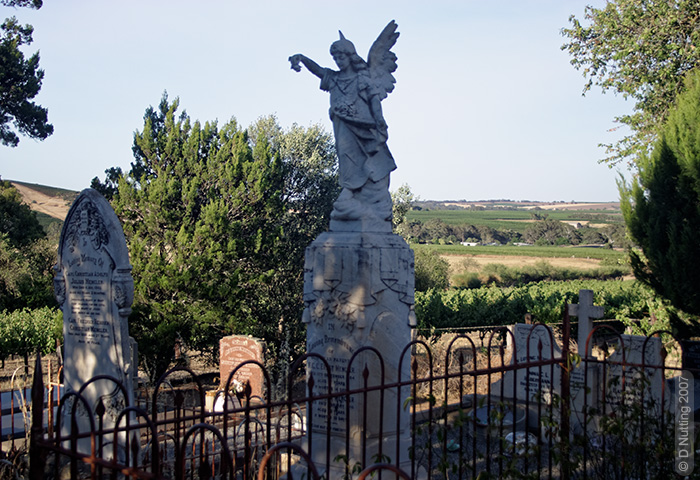
The Habermann and Mengler family cemetery
In cemeteries like the Bethany Pioneer Cemetery the gravestones provide a fascinating range of information about the settlers: their place of origin, where they lived in the valley, their jobs and how many years they worked there, family tragedy, their religious faith. Verses from the Bible are often quoted in the gravestone inscriptions. It is likely that there are more gravestone inscriptions in the German language in South Australia than in any other language other than English.
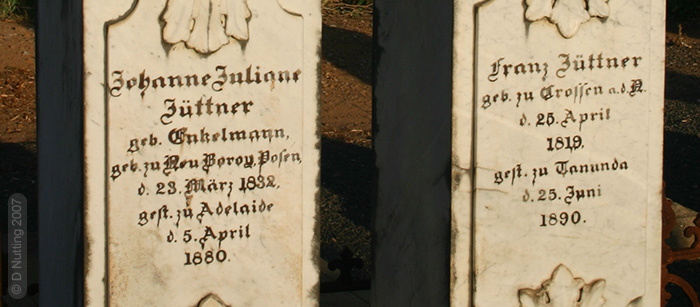
Part of the inscriptions on a grave in the Bethany Pioneer Cemetery. The inscriptions state where the deceased was born in the German-speaking lands, and where they died in South Australia.
Many symbols can be seen on gravestones in the Barossa Valley, and some of them carry more than one meaning.[11]
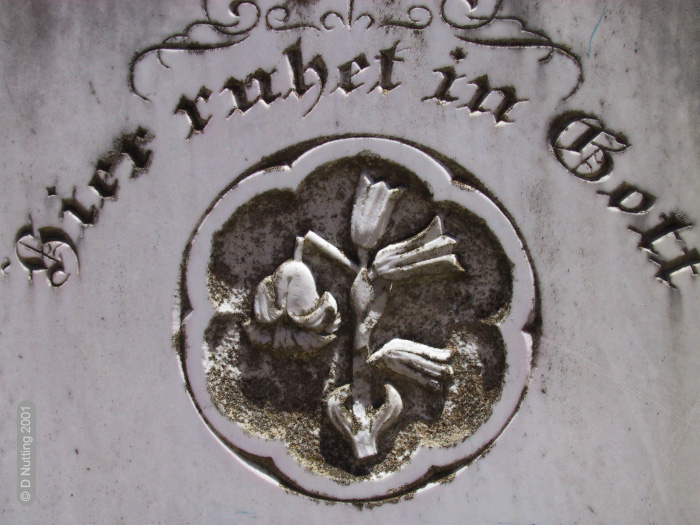
Wilting flowers symbolise death
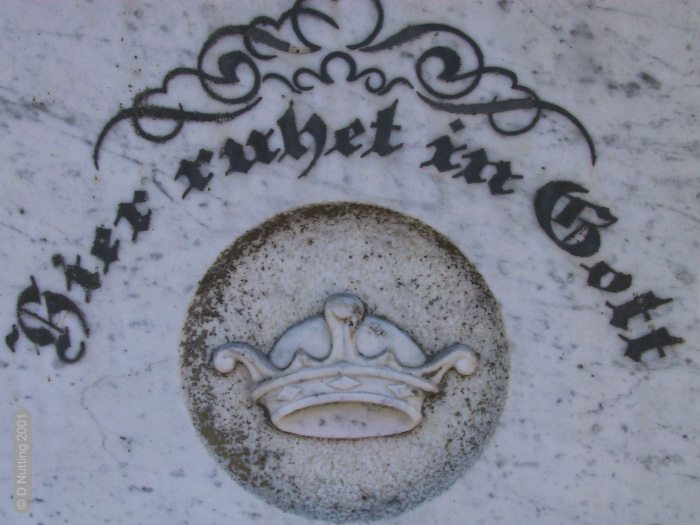
A crown symbolises reward and glory for the deceased
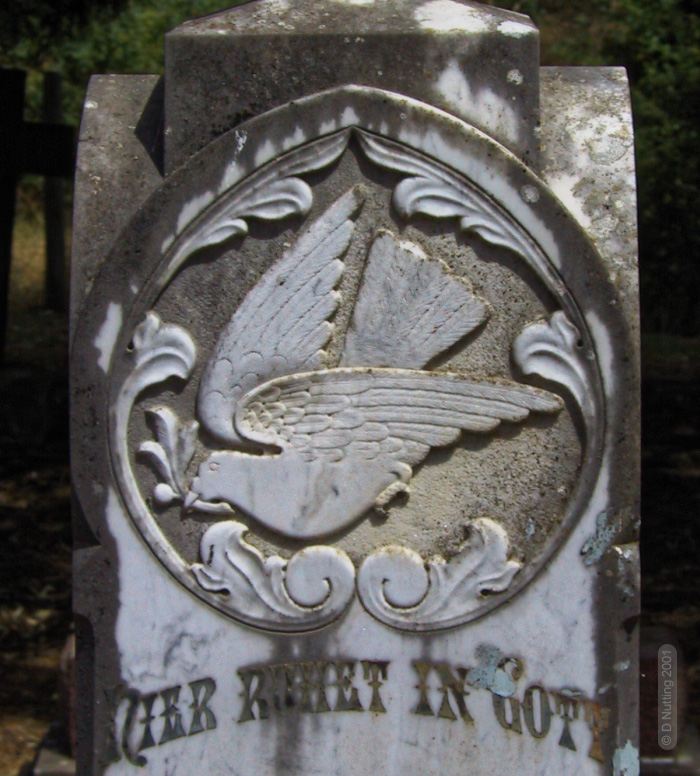
Doves symbolise the Spirit of God, or peace and security

Hands clasped symbolise the husband and wife reunited in Heaven
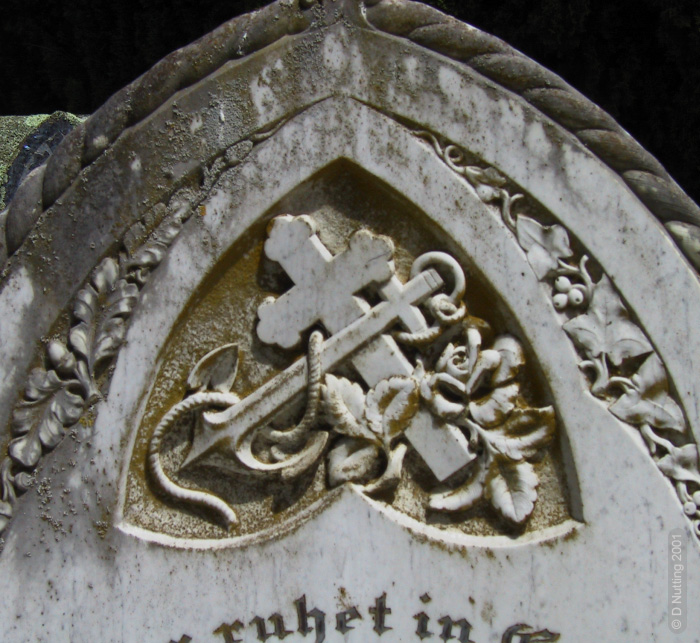
An anchor symbolises hope, safety or security
(The meanings of gravestone symbols were taken from: Discover the Barossa by Brian Ward et al., p.71)
♦ Notes:
1. Voigt, Johannes H. (1987). Australia-Germany. Two Hundred Years of Contacts, Relations and Connections. Bonn (Germany): Inter Nationes. pp.34, 37
2. Riehl (2018), p.27
3. Riehl (2018), pp.23-24
4. Riehl (2018), p.18
5. Riehl (2018), p.19
6. Clyne, Michael (& Centre for Migrant Studies, Monash University). (1981). Deutsch als Muttersprache in Australien : zur Okologie einer Einwanderersprache. Wiesbaden: Franz Steiner Verlag. p.20
7. Clyne, M.C. (1968). "Decay, Preservation and Renewal: Notes on Some Southern Australian German Settlements." In: A.U.M.L.A. No. 29, May 1968, p.40
8. The University of Adelaide. (2014, 21 February). Reviving German language in the Barossa Valley. News. Online: <https://www.adelaide.edu.au/news/news68622.html>.
9. Ward et al (2003), p.68
10. Ward et al (2003), p.69
11. Ward et al (2003), p.71
♦ References:
Riehl, Claudia Maria (2018): Deutsch in Australien. In: Handbuch der deutschen Sprachminderheiten in Übersee, hg. von Albrecht Plewnia und Claudia M. Riehl. Tübingen: Narr. pp.9-32.
Ward, B. J. (Brian J.) & Heathcote, R. L. (Ronald Leslie) & Barker, Sue & Royal Geographical Society of South Australia. (2003). Discover the Barossa / editors: Sue Barker, Les Heathcote, Brian Ward. Adelaide : Royal Geographical Society of South Australia