South Australia
The Lutheran Church in the Barossa Valley
Part 1 - Lutheran churches as a cultural and scenic phenomenon in the Valley
Part 2 - Splits in the church :: villages with two (or more) Lutheran churches
Part 3 - Language, the German spoken in the Valley :: language and symbolism in cemeteries - signs of history
Disunity and splits
Another reason for the number of Lutheran churches in the Barossa Valley and its surrounds was a split that occurred in 1846 within the Lutheran church in Australia, which was still very new at that time. A synod (a kind of church conference) was held at Bethany in that year and significant differences emerged between the two influential pastors Kavel and Fritzsche in questions of religious doctrine (i.e. the beliefs and philosophy of the church). After much argument Kavel and Fritzsche took their respective followers down separate paths at the end of that synod meeting in Bethany and two different branches of the Lutheran church in Australia arose.[1]
The independence in religious thought that led to this split had only become possible in the free atmosphere of the Australian continent where religion was not subject to the supervision and oppressiveness of kings and queens or states.[2]
It is ironic that these splits occurred – the first groups of Lutheran immigrants in South Australia left Prussia in order to have freedom to worship in their own chosen way, and this freedom of opinion and of argument led to disunity and fragmentation of the Lutheran Church in Australia. This fragmentation (into different synods and groupings) lasted many decades. Over those decades some differences in the theological standpoint of the various overseas training institutions from which the Lutheran congregations obtained their ministers also affected the disagreements among Australian Lutherans.[3]
One result of these splits in the Lutheran Church in South Australia was that many small country towns had two Lutheran churches, which surprises some visitors.[4]
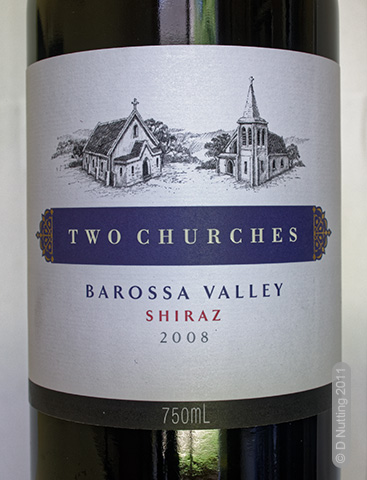
'Two Churches' wine from the Barossa Valley.
This characteristic of the valley was celebrated by a winery which produced a wine named Two Churches – the label stated: “The Barossa’s early scattered, small German communities sometimes accommodated two Lutheran congregations – and two churches. Our label commemorates these strong willed wine industry pioneers.” The existence of two Lutheran churches in the one town or village occurred outside the Barossa Valley as well, for example in 1882 German settlers established their respective Trinity and St Martin's churches at Katyil in the Mallee region of north-west Victoria.
The many theological questions about salvation (the belief that God saves people and can conquer misery and death) must have seemed hair-splitting and theoretical to simple immigrants: they enjoyed the ‘sense of security’ offered by the community around them in which the minister, as the leading figure (and even authoritative person in many worldly matters) exercised much influence.[5]
Over the 50-60 years following the 1846 Synod in Bethany, there was increasing fragmentation among the Lutheran congregations in Australia, so that by the time of the First World War there were six different synods of the Lutheran Church in Australia.[6]
The synods in 1917:
- Evangelical Lutheran Synod in Australia
- Evangelical Lutheran Immanuel-Synod in Australia,
- Evangelical Lutheran General Synod of Australia
- United German and Scandinavian Lutheran Synod of Queensland
- Australian District of the Ohio Synod
- Evangelical Lutheran Church of Australasia
The fate of the dual churches after 1966
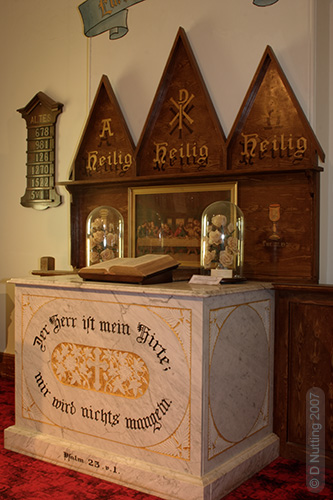
The altar of Bower's former Immanuel church, photographed in the museum in Tanunda.
The divisions in the church were finally healed in 1966 with the formation of the Lutheran Church of Australia, at a synod held at Tanunda. This union in 1966 did not automatically mean that some churches were no longer needed – it depended on the size of the congregation. At Tanunda several Lutheran churches, which all have their own individual history, continue to operate. However, in the course of time some churches were closed and the future of those buildings varied from place to place. Some were sold and after modifications became private homes (e.g. the two churches St Paul’s and St Petri at St Kitts), or if next to a Lutheran school they were absorbed into the school’s infrastructure (e.g. St Jakobi at Lyndoch), or they were demolished (e.g. at Gomersal – formerly Neumecklenburg).[7]
In outlying areas of the valley (such as St Kitts) where congregations were small, a number of churches have been closed and most became private homes. Bower is outside of the Barossa Valley and had two Lutheran churches. Because of many poor seasons some farming families left the area and eventually the Immanuel church, built there in 1899, was closed and sold, and is now used as a private home. The altar of Bower's Immanuel church was taken to the museum in Tanunda and is on display there (see the photo).[8] The German inscription on the altar reads: “Der Herr ist mein Hirte, mir wird nichts mangeln.” (In English translation: ‘The Lord is my shepherd, I shall not want.’). This is a line from Psalm 23 in the Bible - the 23rd Psalm ‘The Lord is my shepherd’ is one of the best known and most popular texts in the Bible.
♦ Notes:
1. Tampke, Jürgen. (2006). The Germans in Australia. Port Melbourne (Victoria): Cambridge University Press. p.32
2. Voigt (1987), p.35
3. Munchenberg et al. (1992), p.81
4. Harmstorf, Ian. (1994). Insights into South Australian History, vol. 2, South Australia’s German History and Heritage. Historical Society of South Australia Inc. p.20 / Churches of the Barossa Valley. (2015). Wendish Heritage Society, Australia. Article online at <www.wendishheritage.org.au/book/churches-of-the-barossa-valley/> / Tampke, Jürgen. (2006). The Germans in Australia. Port Melbourne (Victoria): Cambridge University Press. p.32
5. Voigt (1987), p.37
6. Lodewyckx, Prof. Dr. A. (1932). Die Deutschen in Australien. Stuttgart: Ausland und Heimat Verlagsaktiengesellschaft. p.111
7. Ross, Don. (2023). Personal communication (email), 30/07/2023. / "Drive to the Unique Historic township of Dutton and Wendish Settlement of St Kitts" (PDF). (n.d.). Truro and District Community Association Inc. Online at: < https://truro.sa.au/assets/document/1307354483-dutton_stkitts_drive.pdf>
8. Ross, Don. (2023). Personal communication (email), 30/07/2023.
♦ References:
Munchenberg, Reginald S et al. (1992). The Barossa, a Vision Realised. The Nineteenth Century Story. Barossa Valley Archives and Historical Trust Inc.
Voigt, Johannes H. (1987). Australia-Germany. Two Hundred Years of Contacts, Relations and Connections. Bonn (Germany): Inter Nationes.