South Australia
The Lutheran Church in the Barossa Valley
Part 1 - Lutheran churches as a cultural and scenic phenomenon in the Valley
Part 2 - Splits in the church :: villages with two (or more) Lutheran churches
Part 3 - Language, the German spoken in the Valley :: language and symbolism in cemeteries - signs of history
A tourist map of the Barossa Valley describes the landscape of the Valley as follows:[1]
In charming towns, interspersed by vineyards and rolling farmland, olive groves and grazing land and stately gums, Lutheran churches remain as a testament to the fervour of religious pioneers.
The churches in the towns and villages of the Barossa Valley, with their usually steepled towers, are one of the most distinctive features in the landscape of the valley.[2] A Barossa Council heritage review claimed in 2001 that: "The distinctive square church towers with pointed roofs form an important part of both the architectural and cultural landscapes of the Barossa."[3]
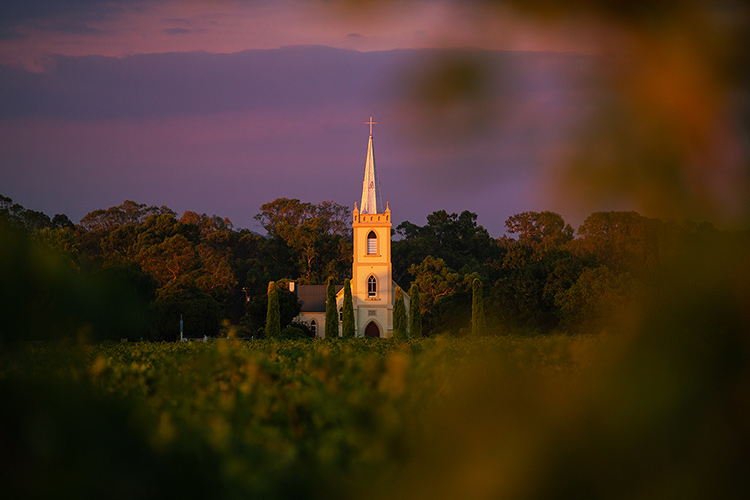
Immanuel Lutheran Church, built in 1886, at Light Pass, Barossa Valley
Photo © Dragan Fine Art Photography and appears here by kind permission of Dragan Radocaj
There is an unusually high number of them in this valley and its surrounds.[4] Around sixty percent of the valley's churches are Lutheran.[5] The majority of churches in the valley are Lutheran because most of the German immigrants in the valley came from the 'Protestant' states of Germany (rather than Catholic states, for example).[6] A heritage report noted that “Two-thirds of the Lutheran churches are in rural areas, whereas, in contrast, two-thirds of the non-Lutheran churches are in the larger towns and are less prominent because of the development around them.”[7]
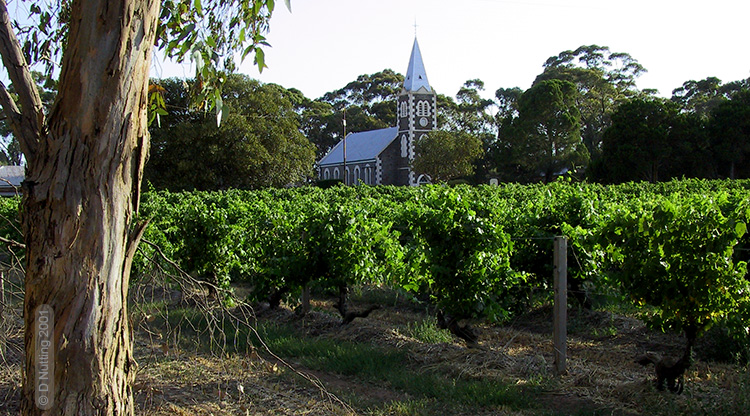
The Gnadenberg Lutheran church, built in 1860, Barossa Valley.

The Grünberg Lutheran church, built in 1853, Barossa Valley.
There are a few factors behind the number of Lutheran churches in the valley. In the 19th century transport was more limited. When travel had to be on foot or by a primitive means of transport on rough roads, the distance to the nearest church was a fairly important factor.[8] Each community built its own church.
Another reason for the number of churches was the fact that when Germans arrived in South Australia as a group, they liked to stick together and belong to the same church congregation. This sometimes meant that they established their own community in a new settlement. Yet another reason for the number of churches in the valley was when members of an existing congregation moved further away (perhaps due to the purchase of land) and they built a new church at the place to which they had moved. As some members of the Langmeil congregation (in today’s Tanunda), which had been founded by Pastor Kavel, began to live further away in the valley, separate congregations gradually evolved at Light's Pass (first church 1850) and Gnadenfrei (around 1855).[9]
Gnadenfrei means 'free by the grace of God'. In 1918 during World War One (in the anti-German atmosphere of that time) the place name changed from Gnadenfrei to Marananga, however the church is still known as St Michael’s Gnadenfrei Lutheran Church. A heritage report has described the Gnadenfrei church as follows: “The Gnadenfrei Lutheran Church with its fine tower is undoubtedly an outstanding piece of architecture, beautifully sited on high ground, dominating the settlement and providing a scenic landmark.”[10] The present-day church was rebuilt in 1873 and the square tower was added in 1913.
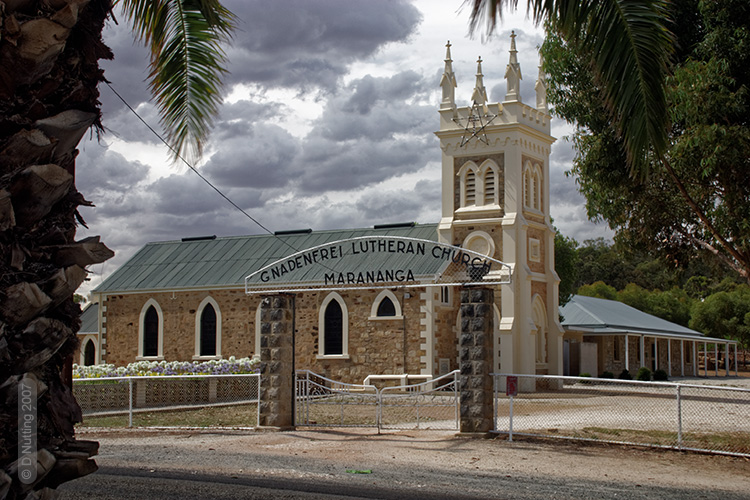
The Gnadenfrei Lutheran church, Marananga, Barossa Valley.
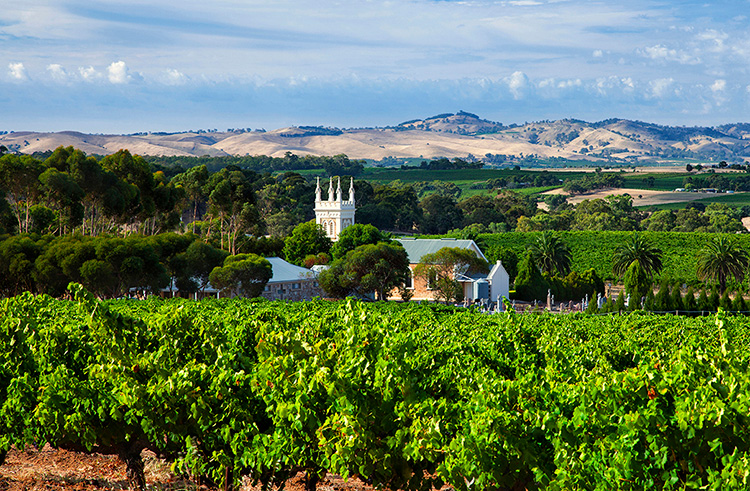
A vineyard and the Gnadenfrei Lutheran church, Marananga, Barossa Valley
Photo © Dragan Fine Art Photography and appears here by kind permission of Dragan Radocaj
♦ Notes:
1. UBD map, Barossa Valley, map 581, 6th edition (1993). Adelaide: Universal Press Pty Ltd.
2. Lester et al (1981), p.45
3. McDougall & Vines (conservation and heritage consultants). (2001). Barossa Council Heritage Review Volume 1. Angaston (South Australia): Barossa Council. p.12
4. Munchenberg, Reginald S et al. (1992), p.81
5. Lester et al (1981), p.49
6. Munchenberg, Reginald S et al. (1992), p.81
7. Lester et al (1981), p.49
8. Munchenberg, Reginald S et al. (1992), p.81
9. Munchenberg, Reginald S et al. (1992), p.83
10. Lester et al (1981), p.128
♦ References:
Lester, Firth and Murton Pty Ltd. (1981). Barossa Valley Heritage Study. Adelaide: Barossa Valley Heritage Study Steering Committee & the District Councils of Angaston, Barossa, Light and Tanunda. Available online at <https://data.environment.sa.gov.au/Content/heritage-surveys/2-Barossa-Valley-Heritage-Study-1981.pdf>.
Munchenberg, Reginald S et al. (1992). The Barossa, a Vision Realised. The Nineteenth Century Story. Barossa Valley Archives and Historical Trust Inc.