The 'German bands'
Travelling brass bands
Today many Australians associate "German bands" with the lively, extroverted "oom-pah" music played at Oktoberfest celebrations or in Bavarian-themed restaurants. However, during the second half of the 19th century, travelling German brass bands were a regular sight on Australian streets and at public events. These musicians arrived in large numbers during the gold rush of the 1850s and became a major part of local entertainment until they suddenly disappeared when World War I started.[1]
Australia’s perception of these street performers was shaped by British culture, where German bands were already a common sight at seaside resorts and on city streets.[2]
By 1891 Germans had become the largest non-English-speaking migrant group in Australia, numbering nearly 45,000 German-born residents. This growing community quickly established cultural societies, clubs, and "German Unions."[3] These venues, alongside German-run hotels and beer gardens (Biergärten), gave the brass bands steady work. The British in Australia and Australians of British descent also enjoyed these German festivals and picnics. For young people living so far away from Europe, listening to a German band play traditional tunes felt like an exciting way to experience international culture.[4]
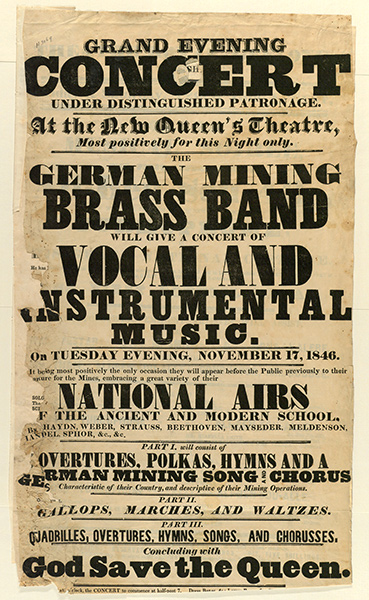
Playbill for performances at the New Queen's Theatre, Adelaide, Tuesday 17 November 1846.
Concert: The German Mining Brass Band.
Source: State Library Victoria (MS8827/11/664).
The 'German band' phenomenon began early, even before the gold rushes. In November 1846, a "German Mining Brass Band" arrived in Adelaide to perform classical works by composers like Beethoven and Handel before going north to perform in the towns of the South Australian copper mines.
By 1851, musical German families were hosting dances in Sydney hotels. However, the real 'era of the German band' began in 1854. Travelling bands quickly spread across the Victorian goldfields and major cities like Melbourne, Sydney, Adelaide, Hobart, and Launceston. One newspaper in 1854 complained that German bands "infested the streets daily," while Melbourne’s newspaper The Argus noted they could be found at almost every corner of the city. The Argus wrote in 1907 that the German bands made their round of visits in Melbourne and its suburbs with great punctuality and seemed to be operating according to a carefully planned itinerary.[5]
In the lead-up to the battle at the Eureka Stockade in Ballarat in 1854, a German band played military tunes as part of the drill exercises of the rebel miners.[6] This band is shown in a scene in the 1949 movie about the Eureka Stockade, made by Ealing Studios.[7] The Australian bushranger Captain Thunderbolt held up a German band on the road in rural New South Wales in the 1860s. The story of Captain Thunderbolt's encounter with a German band has featured in Australian books for children. In 1975 the Australian folklorist, musician, and author Alex Hood and the illustrator Bob Smith published Herman's German Band Meets Thunderbolt. In 2023 Jane Jolly and Liz Duthie produced an illustrated children's book (Captain Thunderbolt's Recital) about Captain Thunderbolt's encounter with the German band. You can read more here about Captain Thunderbolt's encounter with the German band and see his statue.
While street busking was their standard activity when higher-paying gigs were unavailable, these bands performed a remarkably wide variety of roles.[8] They played at indoor classical concerts, sporting events, horse races, regattas, and even church services and funerals. German musicians were respected for their talents and were the musical core of early Australian theater orchestras.[9] Most German settlements or towns in regional Australia had a brass band, such as Jindera (NSW), Tanunda (S.A.) and Hatton Vale (QLD). The Tanunda Town Band was formed in 1857 and has made international tours. You can read more about the band on their website.
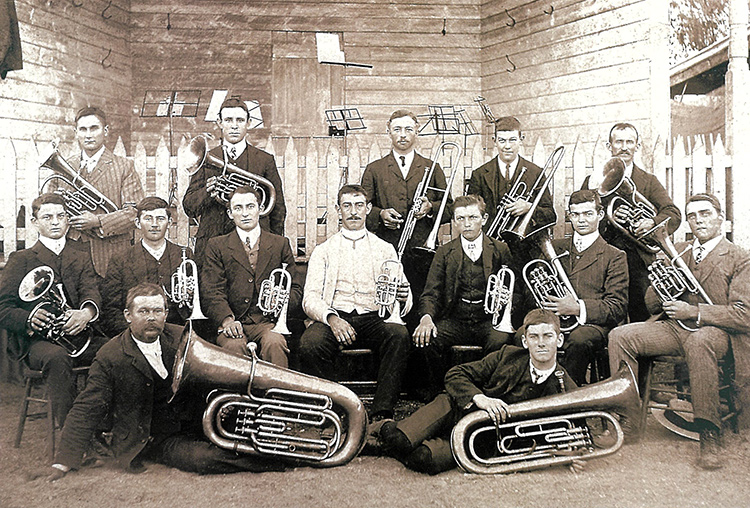
The Tanunda Brass Band in 1908
The Australasian Sketcher with Pen and Pencil was a monthly magazine published in Melbourne by The Argus between 1873 and 1889. In 1887 it published an illustration of 'seaside pleasures' - typical experiences at Melbourne's beaches, which included music played by "That leedle German Band!" You can view the full illustration at the website of the State Library of Victoria.
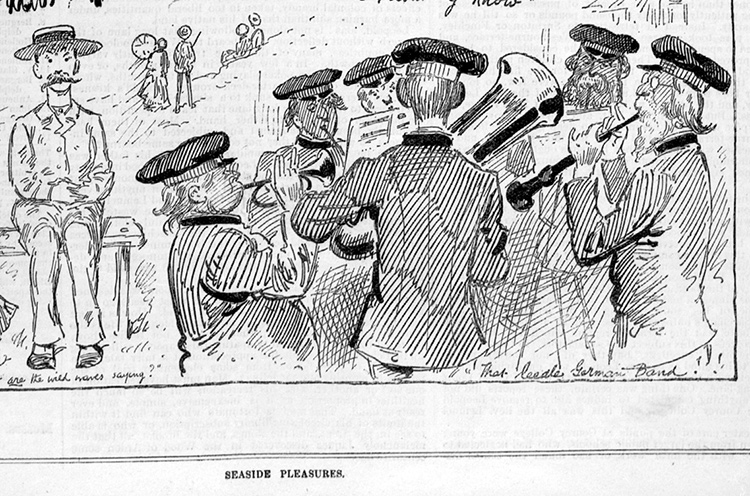
"Seaside pleasures". [Detail from a print published in The Australasian Sketcher with Pen and Pencil, Feb. 24, 1887]
Melbourne : Alfred Martin Ebsworth 1887.
Source: State Library Victoria (A/S24/02/87/25).
According to researcher Veronica Boulton: “Until radio broadcasting appeared in the 1920s, the brass band was for many people the only opportunity to hear live music in concert."[10] In an era before modern loudspeakers, the loud sound of outdoor brass music was also very useful for business. Bands were often hired to play loudly so they could attract crowds to circuses, plays, and land auctions.[11] When busking, the band members wore distinct uniforms and often used their volume deliberately. They would set up outside private homes or businesses and play loudly until the owners paid them to go away. At times some people considered them a public nuisance.[12] "Merchant", who wrote a letter to the newspaper The Argus, certainly thought so:
The German Band is no doubt appreciated in its proper place, but when they play outside offices they are most distracting, and in fact become a positive nuisance to all who have serious work to do.[13]
"Merchant", in The Argus newspaper
An unidentified photograph captioned ‘A Typical German Band from the 1880s’ was reproduced in the Australian Bicentennial publication Two Hundred Dancing Years and shows a band consisting of clarinet, cornet, flugel horn, alto and tenor horns, E-flat tuba and a boy bass-drummer (which was not uncommon in German bands).[14]
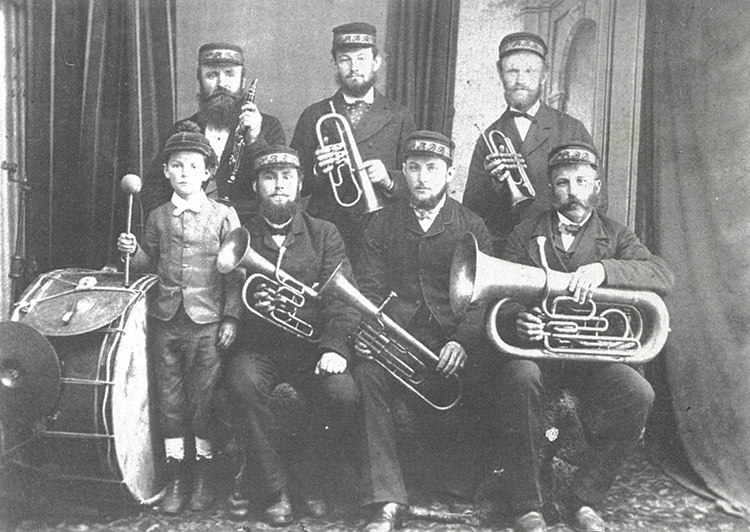
An unidentified photograph captioned 'A Typical German Band from the 1880s'
Reproduced in the Australian Bicentennial publication, Two Hundred Dancing Years.
Despite their commercial success, the bandsmen faced a difficult and hazardous lifestyle. They worked outdoors in all kinds of weather and frequently encountered hostility. Court records from the era show that bandsmen were sometimes verbally abused or physically attacked by street thugs and drunks, for example on Circular Quay in Sydney in 1909.[15]
In the end, German brass bands added a lot to Australia's early musical landscape and popular entertainment. However, this lively tradition met a sudden and tragic end. When World War I broke out, a strong anti-German atmosphere spread through Australia, causing these iconic street bands and their musical influence to disappear completely. According to the researcher John Whiteoak, "The declaration of war in late July 1914 brought fierce and sometimes violent hostility towards the bands and their now detested German music."[16]
However, as years passed after the First World War, some German-descended communities started up their brass bands again, for example the Marananga Brass Band in the Barossa Valley. This German band was established as the Gnadenfrei Brass Band in 1907, but ceased during the First World War. The village of Gnadenfrei was renamed Marananga by the South Australian government in 1918. The brass band was re-established as the Marananga Brass Band at a meeting chaired by Mr August Heinze in the Gnadenfrei Church Hall on 22 October 1924, and this brass band still exists today.
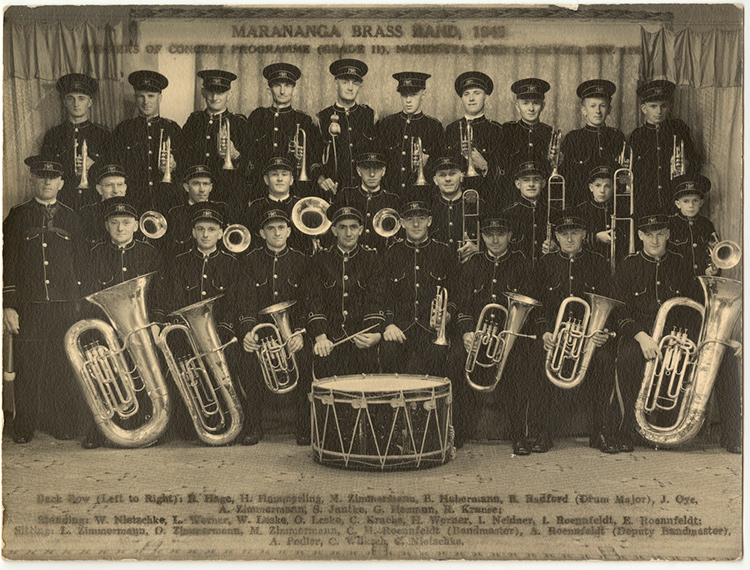
Members of the Marananga Brass Band with their instruments in 1945. All but one of the musicians listed underneath the photo have a German surname.
Source: State Library of South Australia, image B72987.
♦ Notes:
1. Whiteoak (2018), p.51
2. Whiteoak (2018), p.52
3. Voigt, Johannes H. (1987). Australia-Germany. Two Hundred Years of Contacts, Relations and Connections. Bonn (Germany): Inter Nationes. pp.41-44
4. Whiteoak (2018), p.60
5. ‘Music in the Streets: Melbourne’s German Bands’. (1907, July 3). The Argus (Melbourne, Vic. : 1848 - 1957), p. 8. Retrieved July 2, 2026, from <http://nla.gov.au/nla.news-article10144080>
6. Blake, Gregory. (2009). To pierce the tyrant's heart : a military history of the battle for the Eureka Stockade : 3 December 1854. Loftus (N.S.W.): Australian Military History Publications [in association with the Australian Army History Unit] p.25
7. Whiteoak (2018), p.56
8. Tampke, Jürgen. (2006). The Germans in Australia. Port Melbourne (Victoria): Cambridge University Press. p.103
9. Whiteoak (2018), p.62
10. Boulton, Veronica. Quoted in: Krasnostein, Sarah. (2025). The clarion call. Inside a community band’s benevolent quest for perfection. The Monthly. June 2025. p.31
11. Whiteoak (2018), p.63
12. Whiteoak (2018), p.58 / THE GERMAN BAND. (1905, September 1). The Argus (Melbourne, Vic. : 1848 - 1957), p. 9. Retrieved July 5, 2026, from <http://nla.gov.au/nla.news-article9901599>
13. THE GERMAN BAND. (1905, September 1). The Argus (Melbourne, Vic. : 1848 - 1957), p.9.
14. Whiteoak (2018), p.59-60
15. POLICE COURTS. JOSTLING THE GERMAN BAND. (1909, May 22). The Sydney Morning Herald (NSW : 1842 - 1954), p. 6. Retrieved July 5, 2026, from <http://nla.gov.au/nla.news-article15060218> / Whiteoak (2018), p.59
16. Whiteoak (2018), p.64
♦ Reference:
Andrews, S., Ellis, P., & Australian Bicentennial Authority. (1988). Two hundred dancing years and how to celebrate them with a colonial ball / Shirley Andrews and Peter Ellis. Australian Bicentennial Authority. p.11
Whiteoak, J. (2018). What Were the So-Called ‘German Bands’ of Pre-World War I Australian Street Life? Nineteenth-Century Music Review, 15(1), pp.51–65.