Gold in Victoria
German Rebels at the Eureka Stockade
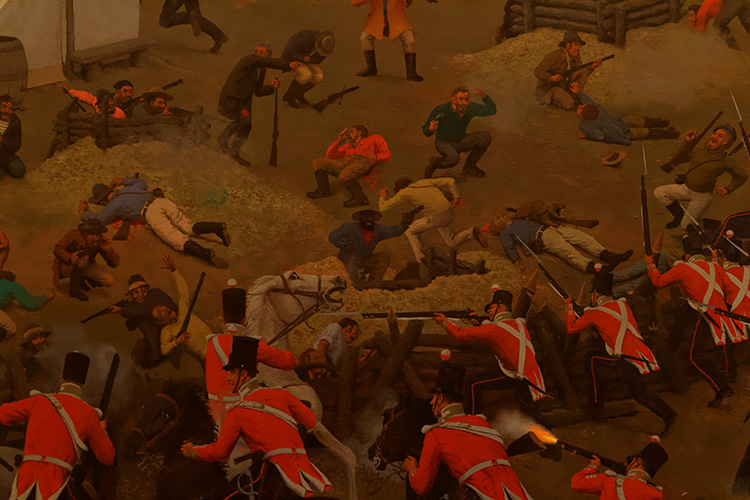
Eureka December 3 1854, (painted 1985-89) - detail / oil on canvas / George Browning (Australia, 1918-2000) / Eureka Centre, Ballarat
Germans were among the rebel miners who took part in the Eureka Stockade rebellion on the Ballarat goldfields on 3rd December, the closest Australia has come to a civil revolution. The miners were protesting against the cost of the miners licence and the arrogant and poor administration of the goldfields by the conservative government authorities. One of the rebel leaders was Friedrich Wern from Hannover, who had moved a successful motion at a mass meeting on 29th November that licences be burned. When the troopers stormed the Stockade with overwhelming numbers, among the 30 dead diggers were three Germans: Wilhelm Emmermann from Petersberg, Johann Hafele, a blacksmith from Württemberg, and Eduard Thönen, a Prussian from Elberfeld (the "lemonade man").
The Victorian government mistakenly believed that Friedrich Wern (Vern) was the leader of the uprising and offered £500 reward for his capture.
➜ More about Vern... (including the 'Wanted' poster).
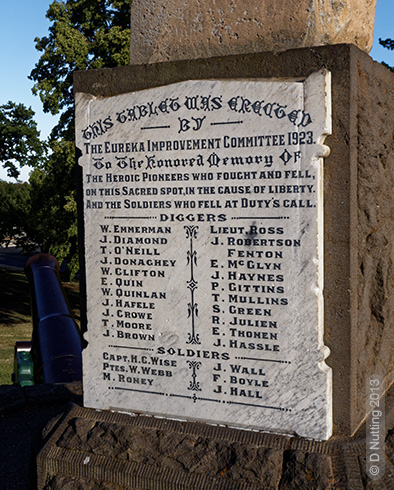
Memorial plaque with the names of the dead, Eureka Stockade Monument, Eureka St, Ballarat
Edward Thonen (Eduard Thönen)
Thönen was born on 26th May 1827 in Elberfeld, Prussia (Elberfeld is now part of Wuppertal - on 1st August 1929 Elberfeld was merged with four other towns to form today's city of Wuppertal in the eastern Rhineland). He trained to be a merchant, and at the age of 23 travelled to England on the ferry from Ostend in Belgium to Dover. He arrived in England on 10th December 1850. Almost all British and Australian newspaper reports about him spelled his name 'Thonen', without the German Umlaut over the letter 'o'. Thonen excelled at languages. He demonstrated fluency in several foreign languages, including French, Dutch, English, and Spanish, with the possibility of his linguistic repertoire extending beyond this list. Thonen was one of 9,566 residents of London in the 1851 census who were recorded as having been born in Germany. Shortly after arriving in London he was robbed of most of his valuables, but he found a job as a clerk, working for a diamond merchant, however, it was difficult for him to make ends meet, as his salary was low. Thonen decided to steal from his employers and use the money to escape to America.
He nearly made it to America, but the British police chased his ship and he was caught 60-80 miles off the Welsh coast and brought back to London. A large number of newspapers in Britain and Ireland reported on Thonen's diamond robbery.
It's surprising that Thonen was sentenced to only one year in prison for the diamond robbery. He returned to his family in Germany in the summer of 1852 and must have heard about the gold discoveries in south-eastern Australia. He decided to go to Australia, and as he was a reservist in a unit of the Prussian army (the 'Landwehr-Bataillon Essen'), he needed to get permission from his military unit to emigrate. He received this permission, however it is not known exactly when he arrived in Australia. The researchers Bamberger and Young have concluded that Thonen probably arrived in Victoria in the second half of 1853, and then moved to Ballarat shortly after his arrival.[1]
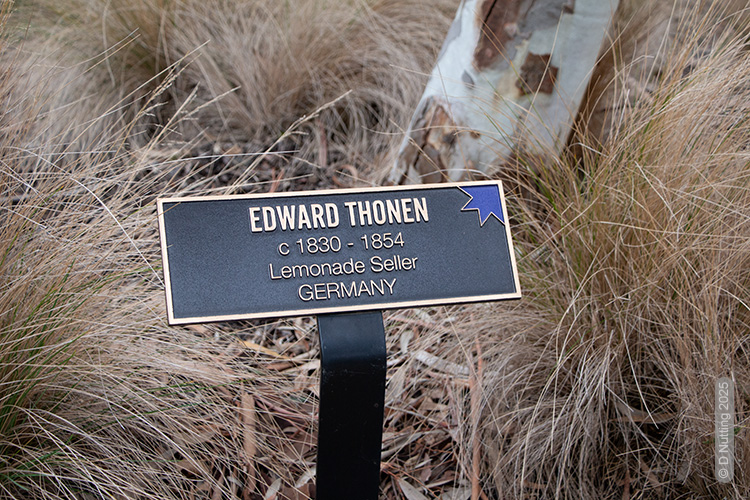
Thonen is included in the Pathway of Remembrance, a memorial located in Eureka Stockade Memorial Park honouring those who died in the 1854 Eureka Stockade.
Thonen had received basic military training in the Prussian army. He had the respect of other diggers in the stockade and was allocated one of the leadership roles in the defence of the stockade. The Italian revolutionary Raffaelo Carboni, who was among the rebel diggers before the battle, and who wrote a book about these events at Ballarat, described how Thonen died from being hit in the mouth by bullets. According to Carboni, Thonen commanded a division of the stockade defenders at the southern side of the stockade.[2] Carboni wrote that a “shot struck Thonen exactly in the mouth, and felled him on the spot".[3]
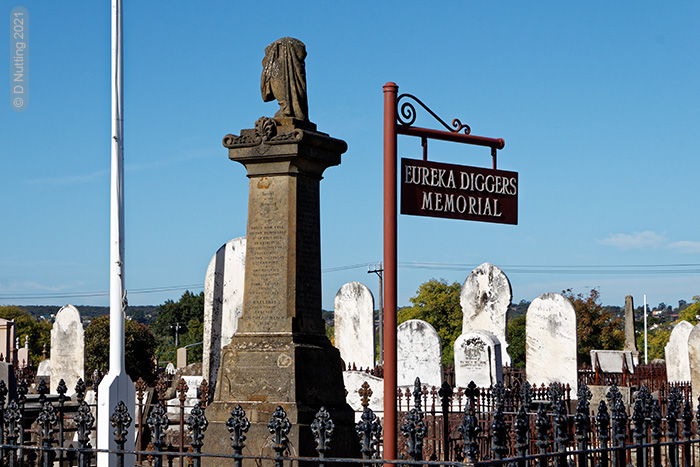
Eureka memorial in the Ballarat Old Cemetery
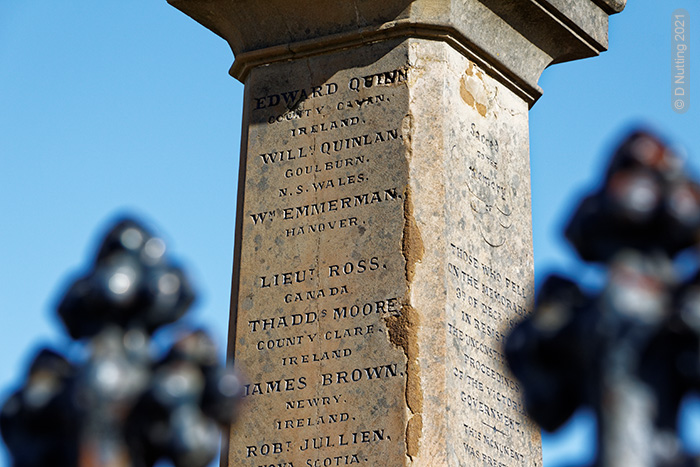
Eureka memorial in the Ballarat Old Cemetery
At the time of the Eureka Stockade there was not yet a unified single German nation (the German Empire was formed in 1871); the area of present-day Germany consisted of many kingdoms, duchies, principalities and free cities. This is why the memorial to the rebels of the Eureka Stockade gives after their name the specific region or kingdom that they were from (e.g. Hanover), not ‘Germany’.
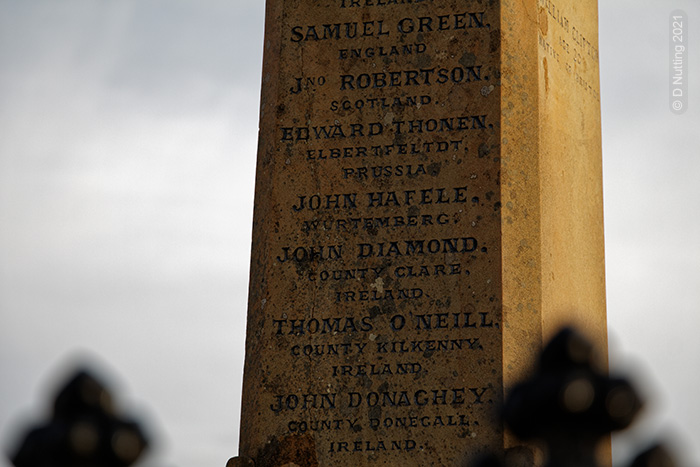
Eureka memorial in the Ballarat Old Cemetery, view from another side
John Hafele
A German blacksmith is also mentioned by Rafaello Carboni - this blacksmith worked hard making pikes for the rebels in the days leading up to the government attack on the stockade. The use of improvised pikes by civilian rebels was common during the eighteenth and nineteenth centuries.[4] Some researchers consider this blacksmith to be Johann Hafele, after whom one of the footpaths in the old cemetery at Ballarat is named (Hafele Drive). He was a large strong man[5], and the military historian and author Gregory Blake believes it is very possible that Johann Hafele already had some experience of war, that he was one of the foreigners who fought in the Mexican-American War (1846-48), based on comments made by Raffaello Carboni about Hafele, written after the Eureka battle (Carboni wrote of Hafele: "praising the while his past valour in the wars of Mexico".)[6]. The United States Army of that time included many Germans.[7]
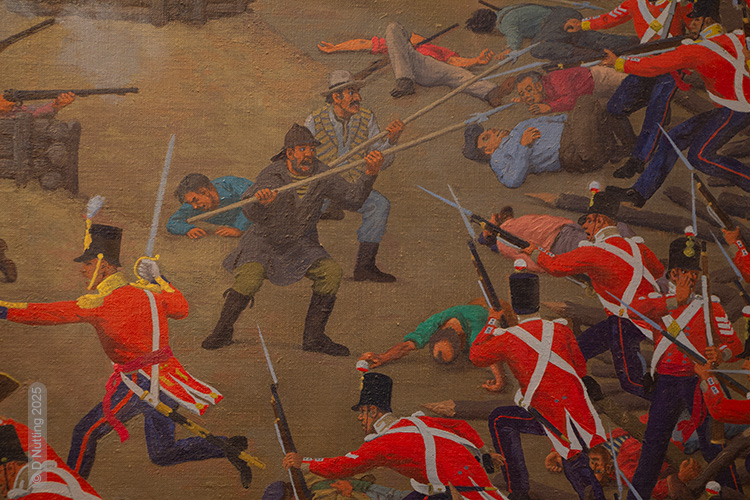
George Browning's painting of the battle in the Eureka Stockade also shows rebels wielding pikes to defend the stockade.
Eureka December 3 1854, (painted 1985-89) - detail / oil on canvas / George Browning (Australia, 1918-2000) / Eureka Centre, Ballarat
Hafele was killed in the stockade; researchers believe it is likely that it was his body that some eye-witnesses described as being pierced by many bullet holes and bayonet wounds, some of which happened when he was already dead. One eye-witness described how the top of the blacksmith's skull was practically sliced off by a blow from a soldier's sword.[8]
There are several descriptions of Hafele’s corpse by journalists after the battle for the stockade, but the only eyewitness to his death was Private John Neill of the 40th Regiment, one of the soldiers attacking the stockade. He reported later that Hafele was killed by Lieut. Richards of the 40th Regiment, and that Hafele “fought well and died gloriously”. Private Neill did not mention what sort of wounds Hafele sustained.[9]
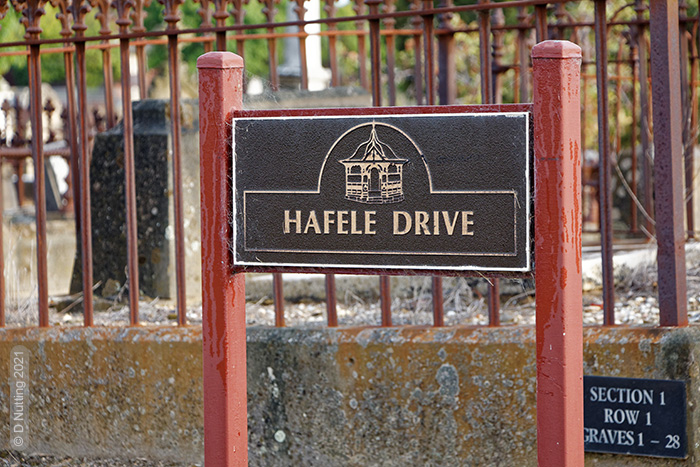
A pathway sign in the Ballarat Old Cemetery (Hafele Drive)
As the bodies of dead rebels were being transported away for temporary burial, eye-witnesses reported how a small dog, presumably belonging to the German blacksmith, cried piteously and stood on its dead owner's bloodied chest and refused to leave him.[10] Some researchers think it may be possible that this German blacksmith was in fact one of the other dead Germans whose name is on the Eureka memorials, namely Wilhelm Emmermann. Johann Hafele's name is also listed on the memorials for the dead rebels. His name was originally very probably spelled Häfele, with the German Umlaut on the first vowel; that spelling is far more common in Germany than ‘Hafele’).
The Ballarat Star reported in 1888 on the reunion of three old friends in Armstrong Street, Ballarat, who had been in Ballarat when the Eureka battle occurred. These three men, Charley, Mick and Bill, told the newspaper what they remembered, as follows:
Little Thoneman, the lemonade man, was shot, bayonetted, and sabred here on the right of the gully, and over there on the left lay the German blacksmith who made the pikes, with the top of his skull hanging by the scalp, and still living, his little terrier dog lying on his breast and refusing to leave his master.
The Ballarat Star, 22/09/1888

The rebel diggers who were tried in court were defended free-of-charge by Melbourne's best lawyers and were all acquitted. Improvements in the administration of the goldfields and in the political life of the colony followed. Pictured is the famous flag of the Eureka Stockade, thought to have been designed by a Canadian digger called "Lieutenant" Ross (who died defending the Stockade) and made, according to Frederick Vern, by "two English ladies".
The Pictures Collection of the State Library of Victoria possesses a photographic print (photographer unknown) from a photo taken of a painted canvas titled Eureka Stockade by Izett Watson and Thaddeus Welch, circa 1890. The print was hand-painted in colour by Beryl Ireland, circa 1891. You can see the picture in the State Library of Victoria's Pictures Collection [➽ H141890].
The Eureka movie and Vern on-screen
In the late 1940s a movie was made in Australia based on the Eureka Stockade events and Frederick Vern was played by a German actor who had been brought to Australia by force. Sigurd Lohde (1899-1977), a German actor of Jewish descent, played the role of Vern on-screen. Lohde had trained as an actor and director in Germany and had his first professional role on the stage of the Staatstheater in Berlin in 1919. Later he acted in various theatres in Frankfurt am Main, Breslau and Berlin, and appeared in several German films. In the 1930s, the time of Nazi dictatorship in Germany, Lohde first moved to Austria and later to Czechoslovakia, appearing in theatrical productions in Vienna and in Prague. Later still he fled to London and worked at the Deutsches Theater there. In Britain he appeared in movies like Night Train to Munich (1939) and Neutral Port, a wartime film made in 1940, where he played the German consul.[11]
On 10th July 1940 he was at the docks in Liverpool, intending to catch the ferry to the Isle of Man, where he was to begin a job as an official interpreter in an internment camp there (those camps held "enemy aliens" - political detainees, suspected spies, refugees, and Jewish refugees). However, the ship HMT (Hired Military Transport) Dunera was at the docks too and would soon depart with more 'enemy aliens' who had been living in Britain at the start of the war and whom the British government wanted to deport to internment in Australia. Although Lohde had official documents confirming his job on the Isle of Man, the British soldiers on the docks mistakenly forced Lohde to board the Dunera and he was also sent to Australia, enduring the abuse and maltreatment by the British guards on board that ship.[12]
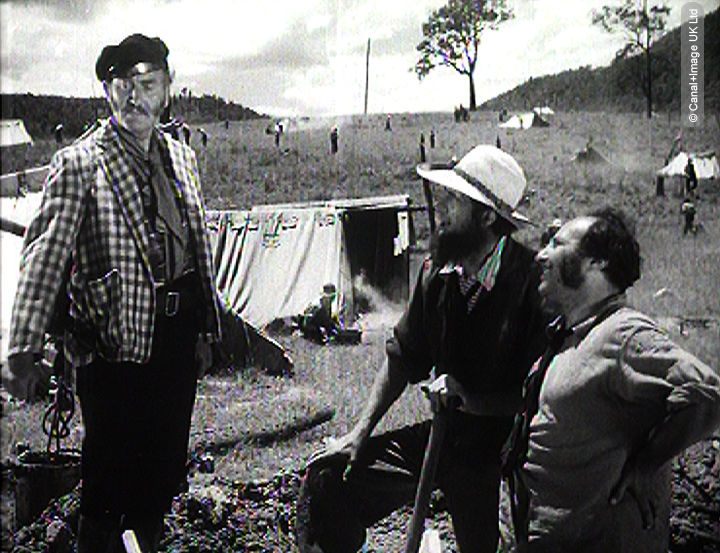
Scene from the Ealing Studios movie Eureka Stockade (1949). Frederick Vern (Sydney Loder) is the man on the left.
Photo source: provided by the (Australian) National Film and Sound Archive. The photo appears here with the permission of and under licence from Canal+Image UK Ltd, who own the copyright.
In Australia Lohde and the other Dunera passengers were put into internment camps. After the war Lohde tried to get work in radio and theatre in Australia, but not many opportunities existed. In Australia as earlier in England his show business name was Sydney Loder. His main acting achievement in Australia was playing the part of Frederick Vern in the 1949 movie Eureka Stockade, which was made in Australia by the British film production company Ealing Studios. In the scene where Vern meets Peter Lalor and Raffaello Carboni for the first time on the Ballarat goldfield, Vern introduces himself in a formal manner and clicks his heels together loudly in a military manner. This was unrealistic and Lohde the actor was most likely asked to do this by the British director, who wished to exploit the cliche common in British and American war films that clicking the heels together loudly is stereotypical behaviour of a German officer. The click of boots at the command "Stillgestanden" ('Stand to attention!') was no louder in German armies than in other armies.[13]
In this scene from the film (see the photo above) Vern introduces himself to Lalor and Carboni, saying that he used to be a member of the 'Royal Hanoverian Guards' (it is known that Vern was from Hannover, which makes it more possible that he was influenced by British military traditions, given the many years of close union between the Kingdom of Hannover and the United Kingdom). Lalor and Carboni then introduce themselves, and Vern/Lohde replies in German: "Sehr erfreut" [= "Pleased to meet you"].
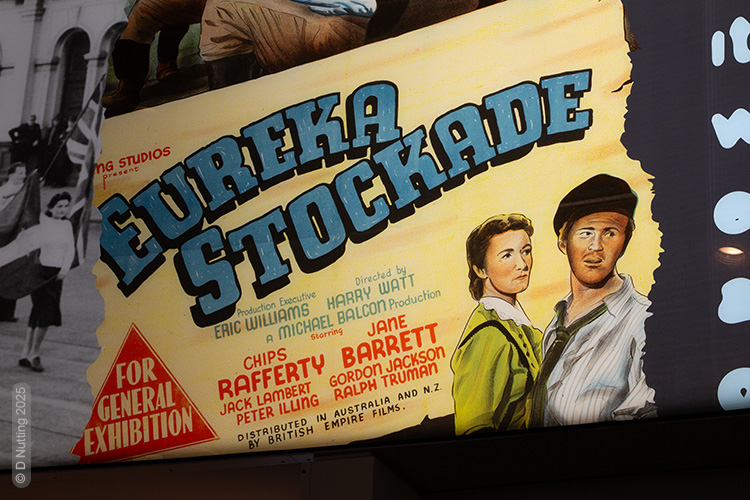
The Eureka Centre at Ballarat displays a collage that includes the promotional poster for the movie Eureka Stockade (1949).
There weren't many openings for Lohde in show business in Australia and he returned to Germany in 1955 and opened a bar in western Berlin that he named 'Das Känguruh'. Lohde found work again on the stage in Germany and appeared also in several German movies over the next couple of decades before his death in 1977.[14]
♦ Notes:
1. Bamberger & Young (2023)
2. Carboni (1855), p.71
3. Carboni (1855), p.72
4. Blake, Gregory (2012), p.226
5. Carboni (1855), p.58
6. Carboni (1855), p.57
7. Blake, Gregory (2012), p.135
8. GOLD-SEEKERS OF THE FIFTIES. (1899, June 24). The Argus (Melbourne, Vic. : 1848 - 1957), p. 4. Retrieved March 13, 2021, from <http://nla.gov.au/nla.news-article9520758>
9. Blake, Gregory (2012), pp.173, 245 / Withers, William Bramwell. (1887). The History of Ballarat : from the first pastoral settlement to the present time. Ballarat (Vic.) : F.W. Niven & Co. p.124
10. Kieza, Grantlee. Personal communication (email) 30/06/2014. / GOLD-SEEKERS OF THE FIFTIES. (1899, June 24). The Argus (Melbourne, Vic. : 1848 - 1957), p. 4. Retrieved March 13, 2021, from <http://nla.gov.au/nla.news-article9520758>
11. Staedeli, Thomas. (n.d.). Porträt des Schauspieler Sigurd Lohde. <https://www.cyranos.ch/smlohd-d.htm>. Accessed 06/04/2025.
12. Pearl, C. (1983). The Dunera scandal: deported by mistake. London & Sydney: Angus & Robertson. p.22
13. Füssel, Marian. (University of Göttingen). Personal communication, email 25/07/2023.
14. Pearl, C. (1983), p.195
♦ References:
Bamberger, D. & Young, A. (2023). Edward Thonen: a forgotten Eureka rebel. WikiTree Germany Connector's Challenge. Zeitgeschichtliche Sammlung, Zentrum für Stadtgeschichte und Industriekultur Wuppertal. Available here as PDF-file  .
.
Blake, Gregory. (2012). Eureka Stockade : a ferocious and bloody battle. Newport, N.S.W. : Big Sky Publishing
Carboni, Raffaello. (1855). The Eureka Stockade. Melbourne : J P Atkinson and Co.
RENEWING THEIR YOUTH. (1888, September 22). The Ballarat Star (Vic. : 1865 - 1924), p.5 (Ballarat Star (Vic. : 1865 - 1924)). Retrieved March 7, 2024, from <http://nla.gov.au/nla.news-article209448532>
Kieza, Grantlee. (2013). Sons Of The Southern Cross: rebels, revolutions, Anzacs and the spirit of Australia's fighting flag. HarperCollins, Sydney. ISBN: 9780733331565 p.165 & p.177
Lodewyckx, Prof. Dr. A. (1932). Die Deutschen in Australien. Stuttgart: Ausland und Heimat Verlagsaktiengesellschaft. pp.78-79
Voigt, Johannes H. (1988). Australien und Deutschland. 200 Jahre Begegnungen, Beziehungen und Verbindungen. Hamburg (Germany): Institut für Asienkunde. p.23