The 'First Shot'
The British Empire's first shot at Germans in 1914
Before the First World War broke out in August 1914, the trading needs of the German colonies in the South Pacific and in Papua New Guinea meant that German cargo ships often called at Australian ports. The freighter S.S. Pfalz, 6,557 tons, was a fairly new ship, one of a series of ships that was built at the well-known shipyards of Bremer Vulkan in Bremen-Vegesack for the shipping line Norddeutscher Lloyd. The Pfalz was launched in 1913, and in August 1914 the ship, under the command of Captain Wilhelm Külken, was at Victoria Dock in Melbourne.
Tensions were high in Europe at the start of August and the Australian government was wondering when the British Empire would be at war with Germany. The government (which in those days was based in Melbourne; the federal capital Canberra was not yet developed) sent instructions to all the major ports in Australia about action to take in the event of war; the government knew that German ships would try to get out to the open seas as soon as a war started, in order to avoid being seized.
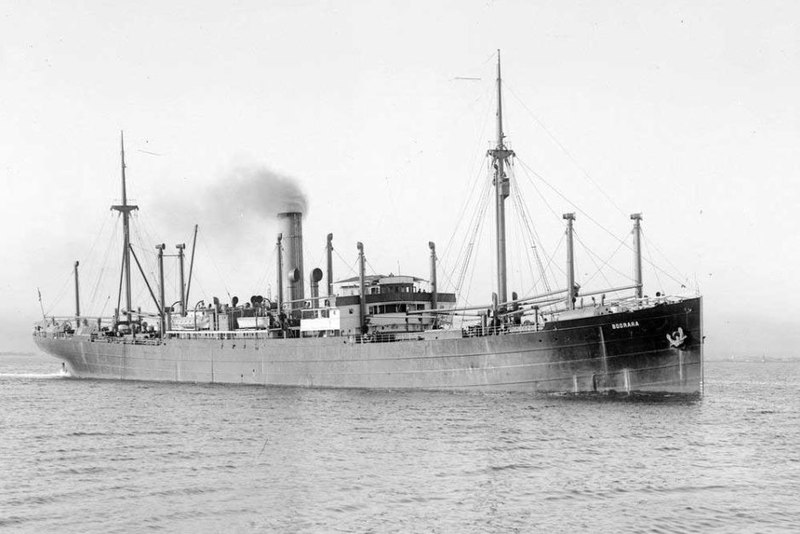
HMT Boorara, formerly the SS Pfalz
Photo source: National Library of Australia, via Wikimedia Commons
Captain Külken was aware that a war could start very soon, and he ordered that his ship load up on coal in order to leave port. At around 7.45 a.m. on the 5th August the Pfalz steamed out of the Yarra River and headed off down Port Phillip Bay, at a relatively slow speed in order to avoid burning up coal too fast; the ship probably aimed to reach South America, to ports there that would be neutral in the event of war. The Australian pilot Captain Robinson of the Port Phillip Pilot Service was on board – the pilot’s job was to guide big ships through the narrow opening of Port Phillip Heads, through which ships travel out into the open waters of Bass Strait.
Off Portsea at the southern end of Port Phillip Bay, on the eastern shore, a Royal Australian Navy examination steamer named Alvina met the Pfalz in order to carry out an inspection. The ship’s papers were in order and there was no news about war, so the Pfalz was permitted to continue to the Heads. The crew of the Pfalz were no doubt pleased and excited that they were about to leave Australia. By the time the inspection launch returned to the pier at Portsea, the Australian government in Melbourne had received a telegram from London announcing that war had been declared – this meant that Australia was automatically at war on Britain’s side, as Australia had no independent foreign policy in those days. Melbourne immediately notified Fort Queenscliff, on the western side of the southern end of the bay. Fort Queenscliff controlled the operations of the defence installations at the opening to Port Phillip Bay, and these included Fort Nepean, close to the end of the Mornington Peninsula on the eastern shore near the Heads.
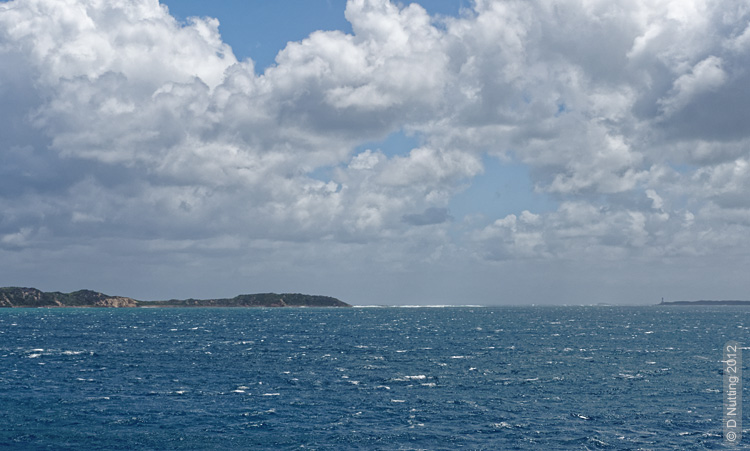
This view down Port Phillip Bay, looking towards the Heads, is probably similar to the view the captain of the Pfalz had when he tried to escape from Port Phillip Bay.
Fort Nepean displayed signal flags that indicated that the ship had to stop and turn around. It seems that noone on the ship noticed these visual signals – the Australian pilot was concentrating on approaching the narrow opening of the Heads. By telephone Fort Queenscliff ordered the large, long-range 6-inch Mark VII guns at Fort Nepean to ‘stop the Pfalz or sink her’. At about 12.45 pm one of these guns at Fort Nepean fired a shot that landed just behind the stern of the ship with a large splash, and the Australian pilot realised the danger. Captain Külken, who at that point could see the Heads very close by, probably thought he could race for the Heads and avoid being hit, and there was a brief struggle between him and the Australian pilot for the helm of the ship. The pilot managed to convince the captain that the next shot would hit the ship, and the captain turned the Pfalz around.
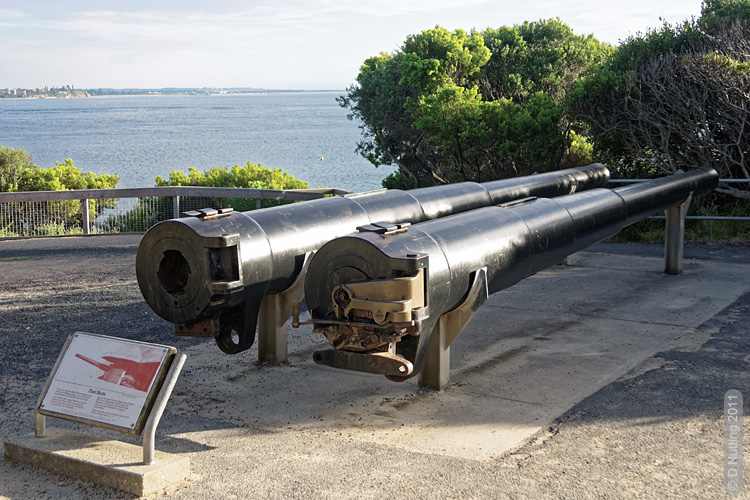
The long-range Mark VII gun barrels of 1914 on display at Fort Nepean. The right-hand barrel fired the warning shot.
This shot from Fort Nepean was the first shot fired in the First World War by the British Empire. It is at first glance surprising that this occurred so far away from Europe, on the other side of the world. Some people in the United Kingdom believe that the first shot was fired by the Royal Navy destroyer HMS Lance in an attack on the German minelayer and former excursion steamer Königin Luise in the North Sea. However, when you take into account the different clock times between Melbourne and London, it is clear that the shot from Fort Nepean occurred a few hours before HMS Lance opened fire on the Königin Luise in the North Sea.[1]
The Pfalz was taken back to Williamstown, was renamed the HMAT Boorara and converted into a troop carrier for Australia. The ship took Australian soldiers to the battles at Gallipoli.
The crew of the Pfalz was sent to an internment camp at Holsworthy in Sydney, where many of the internees were crews from German merchant ships captured in Australian ports at the outbreak of war such as the Pfalz, the Oberhausen in Tasmania, the Elsass, the Berlin, the Prinz Sigismund, the Hobart, the Tiberius, the Turul and the Germania. Captain Kühlken was sent to an internment camp at Berrima in NSW, where officers were accommodated. The internees enjoyed considerable freedom at Berrima and the local people generally treated them with courtesy and sometimes affection. At the end of the war after the four years of internment Kühlken returned to Germany and eventually captained other merchant ships. In 1930 a merchant ship’s voyage took him to Australia, where he enjoyed revisiting Berrima, and thought wistfully of living in Australia.[2]
Fort Nepean is also associated with Australia’s most famous soldier, the German-Australian John Monash. On 3 March 1887 he joined the North Melbourne Battery (Metropolitan Brigade) of the Garrison Artillery, whose fixed guns defended the Victorian ports. Monash rose through the ranks to become commanding officer of this artillery unit in 1897, a position he held until 1908. The coastal artillery of Fort Nepean was the active service location of the North Melbourne Battery.[3]
♦ Notes:
1. Naval Staff, Training and Staff Duties Division, Naval Staff Monograph (Historical) Volume X, Home Waters - Part I - From the Outbreak of War to 27 August 1914. Admiralty (UK), April 1924, page 50.
2. Craigie, Jim. (2014). The Shot that Stopped Pfalz. Naval Historical Review (September 2014 edition). Online at: <https://navyhistory.au/the-shot-that-stopped-pfalz/>
3. Pedersen, Peter Andreas. (1982). The development of Sir John Monash as a military commander. [PhD, University of NSW]. <https://doi.org/10.26190/unsworks/9584>. p.28
♦ References:
History Recalled. (1937, August 5). The Maitland Daily Mercury (NSW : 1894 - 1939), p. 6. Retrieved November 18, 2013, from <http://nla.gov.au/nla.news-article126521718>
Robertson, A.M. (1986). War in Port Phillip. Nepean Historical Society. Originally published in 1968, reprinted in 1986 by The Craftsman Press, Melbourne.
Royal Museums Greenwich. (n.d.) The sinking of the German minelayer 'Königin Luise', 5 August 1914. Accessed on 20/03/2025 at <www.rmg.co.uk/collections/objects/rmgc-object-125048>