The First World War
Sir John Monash
John Monash (1865-1931) was born in West Melbourne of Jewish parents who had migrated from a German-speaking region of Poland.[1] His father pronounced the family name as ‘MOH-NAASH’ (i.e. in the German way).[2] German was the language spoken in the family while John was growing up.[3] Although John Monash grew up bilingually, he spoke English with a light German accent up until early adulthood. He worked hard to remove this from his speech patterns.[4] After arriving in Australia in 1854 Monash’s father Louis changed the spelling of the family name from the Germanic ‘Monasch’ to a more English-looking ‘Monash’.
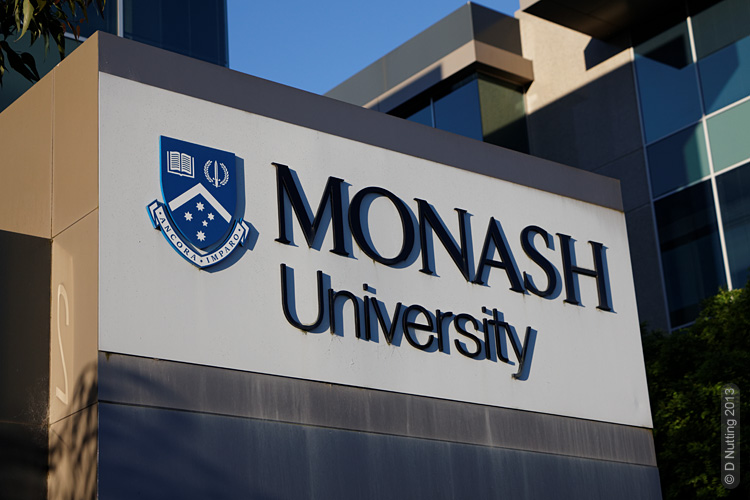
A sign at the university named after John Monash
Monash’s father experienced business problems in Melbourne in the 1870s and he moved the family to the small town of Jerilderie (in the Riverina in southern NSW) where he ran a store. From 1875-77 Monash attended the local school there, but the teacher recognised Monash’s high intelligence and encouraged the family to further Monash’s education in Melbourne. John’s mother moved back to Melbourne with him, though John returned to Jerilderie for visits on school holidays. In later years Monash claimed to have witnessed the Kelly Gang in Jerilderie when they robbed the bank there in 1879.[5]
At university Monash studied Arts and Engineering and became a part-time soldier, joining the university company of the 4th Battalion, Victorian Rifles. German culture continued to be part of his identity - he wrote letters to his father Louis in German and participated in German club life in Melbourne. In his work life he experienced ups and downs, but eventually became a successful civil engineer, taking a leading role in the construction of bridges and railways, and was known for hard work and meticulous planning. In his soldier-life for the militia he joined an artillery unit, the North Melbourne Battery of the Metropolitan Brigade of the Garrison Artillery and rose through the ranks. In 1897 he became commander of this artillery unit, whose training ground and fighting station was Fort Nepean at the remote southern end of the Mornington Peninsula - one of the forts that defended the entrance to Port Phillip Bay.
Although work in coastal artillery was highly specialized and isolated from the main stream of military activities and influence, it was there that Monash developed his gift for administration and learned to command men with fatherly authority.[6] It was at Fort Nepean and in the North Melbourne Battery that Monash “learned to know and understand Australian volunteer soldiers.”[7] He remained the Commanding Officer at Fort Nepean from 1897-1908.[8]
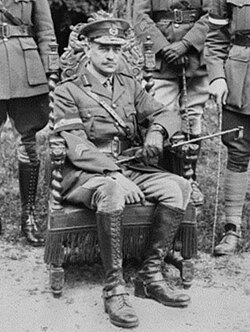
Lieutenant General John Monash, Commander Australian Corps in 1918, at the Australian Corps Headquarters in France.
Photo source: Australian War Memorial, Public domain, via Wikimedia Commons

Before the First World War Monash was president of the Victorian Institute of Engineers. He played a major role in popularising the use of reinforced concrete to Australian engineering projects – one biographer claims that Monash’s fluency in German gave him a distinct edge over his rivals as most of the relevant technical publications were written in German.[9] Monash was a consultant on the use of reinforced concrete in the great dome of the State Library of Victoria in 1911. This dome, of ribbed reinforced concrete was the largest such dome in the world at that time.
At the start of the First World War, he commanded the 4th Infantry Brigade, Australian Imperial Force and was initially sent to Gallipoli. In 1916 he was promoted major general in command of the new Australian 3rd Division and sent to the battlefields of France. In Europe the army censors read Monash's letters, and he had to beg his family back home in Melbourne to stop writing to him in German.[10] On the battlefields of France he soon became known for innovative tactics involving precise planning of the timing and movements of masses of men and different types of military hardware, and he became popular with his soldiers. In 1918 Monash was appointed commander of the Australian Army Corps, which was created by the amalgamation of all five Australian divisions in France. The Battle of Hamel in July 1918 was perhaps his most famous victory.
The most famous British General in the Second World War, Montgomery, wrote of John Monash[11]:
I would name Sir John Monash as the best general on the Western Front in Europe; he possessed real creative originality, and the war might well have been over sooner, and certainly with fewer casualties, had Haig been relieved of his command and Monash appointed to command the British armies in his place.
Field Marshal Sir Bernard Law Montgomery
In a documentary about John Monash, Dr Matthias Strohn, a military historian and Lieutenant Colonel in the Bundeswehr (the German Army) said the following about Monash: "Monash was in a unique position. He had the German nature in his blood. He intrinsically understands how Germans think, he understands the German culture, the German language, so you could have actually put him in the German uniform."[12]

Monash Medical Centre, a hospital in Clayton named after John Monash
At the end of the war Monash, "the son of a German-Jewish shopkeeper is, at this moment, simply the most celebrated Australian to have lived."[13] At the end of 1918 Monash was a nationally respected and famous person. John Latham was an Australian lawyer who served on the Australian delegation to the 1919 Paris Peace Conference and later was the Chief Justice of Australia from 1935 to 1952. At the end of the First World War he wrote to John Monash with “a hearty welcome home to you - who are, in the more real sense, the leader of Australia”.[14] After the war Monash was initially in charge of planning operations to bring Australian soldiers back home, but in 1920 he was offered the job of starting up the new State Electricity Commission of Victoria. This job and role, ensuring the provision of cheap electricity to support Victoria’s manufacturing industries “suited Monash’s engineering skills, his leadership strengths and his strategic vision”.[15] His work with the SEC was important for the development of Victoria’s economy.
Monash continued to advocate for the interests and needs of returned soldiers and he was also Vice-Chancellor of the University of Melbourne from 1923 until his death eight years later. He also played a key role in advocating for a significant war memorial in Melbourne and was subsequently in charge of the building works for Victoria’s monumental Shrine of Remembrance, to honour Australia's many war dead.[16] However, he died before construction of the Shrine was completed.
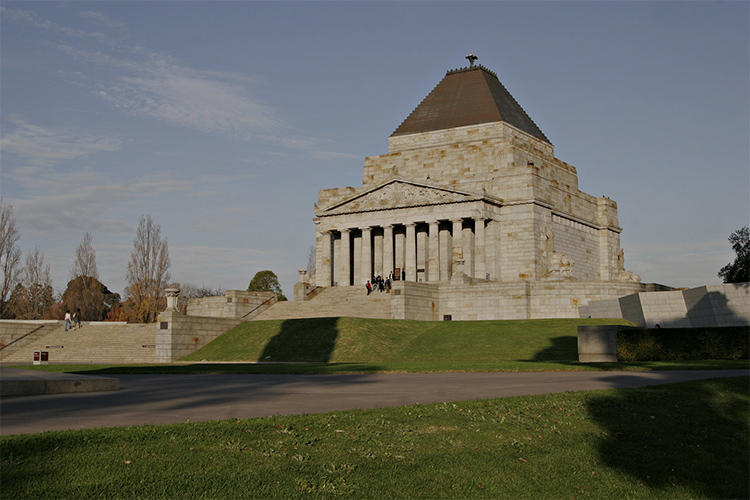
The Shrine of Remembrance in Melbourne - a project that was important to John Monash.
Photo source: fir0002 :: flagstaffotos [at] gmail.com :: Canon 20D + Tamron 28-75mm f/2.8, GFDL 1.2, via Wikimedia Commons
![fir0002 :: flagstaffotos [at] gmail.com :: Canon 20D + Tamron 28-75mm f/2.8](https://commons.wikimedia.org/wiki/File:Melbourne_war_memorial04.jpg)
When Monash died in 1931 a short funeral service was conducted according to Jewish customs. More than 300,000 people attended the memorial service for John Monash, and thousands lined the streets and roads along the route that took his coffin to the Brighton General Cemetery in North Road.[17] The gravestone in the cemetery is inscribed in the Hebrew language as well as in English.
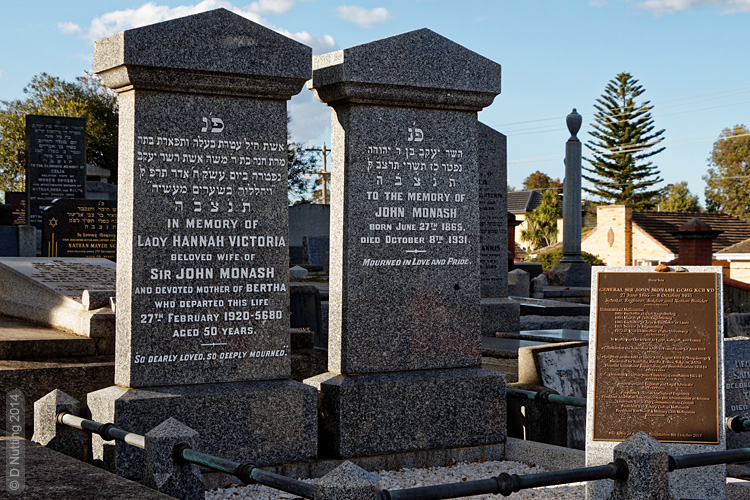
The graves of John Monash and his wife Hannah at Brighton General Cemetery
Named after John Monash
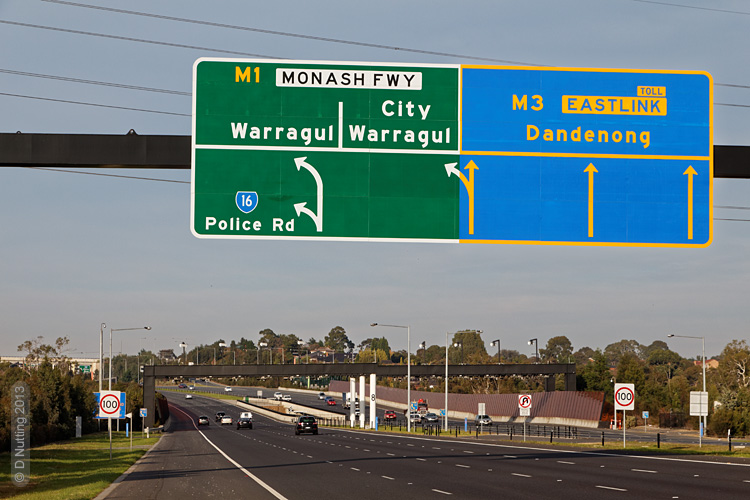
A freeway interchange: a freeway sign in the east of Melbourne announces the connecting ramp that leads to the freeway named after John Monash.
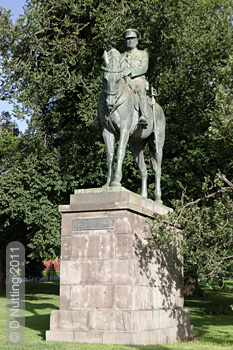
A bronze equestrian statue of John Monash in Kings Domain, Melbourne. It was unveiled in 1950.
John Monash received awards from several other countries, and many institutions and places (particularly in Victoria) have been named after him – the best known being Monash University, but other examples are:
- the Monash Freeway in Melbourne,
- the Monash Medical Centre,
- the John Monash Science School (a high school in Clayton, Victoria, that specialises in the Sciences, Mathematics and Associated Technologies),
- the road named Sir John Monash Drive in Caulfield,
- the Canberra suburb of Monash,
- the Sir John Monash Centre (opened in 2018 at the Villers-Bretonneux Military Cemetery, France),
- Monash Gully (a valley at Anzac Cove on the Gallipoli Peninsula in Türkiye),
- Monash Gully five kilometers west of Wye River on the Great Ocean Road in Victoria (a scenic coastal road built by returned soldiers between 1919 and 1932, and dedicated to Victorians who served in the First World War)
- a new village named Monash that was established in the Riverland area of South Australia in 1921 for repatriated soldiers returned from World War I as part of the State Government Soldier Settler Scheme,
- the federal electorate of 'Monash' - it lies east of Melbourne and runs from the Great Dividing Range to Bass Strait.
John Monash is depicted on the Australian $100 bank note.

An advertisement in a newspaper shows the Australian $100 bank note with John Monash.
See also: Effects of the First World War on German Australians
♦ Notes:
1. Serle (1982), p.1
2. Kieza (2015), p.14
3. Serle (1982), pp.7-8, 193
4. Kieza (2015), p.20
5. Kieza (2015), pp.31-37
6. Serle (1986)
7. Serle (1982), p.169
8. Pedersen (1982), p.28 / Nepean Historical Society. (n.d.) Sir John Monash and Fort Nepean. <nepeanhistoricalsociety.asn.au/history/defence/the-fortifications/>
9. Pedersen (1982), p.12
10. Pitt & Greste (2018)
11. Pedersen (1982), p.533 (quotes Montgomery)
12. Pitt & Greste (2018)
13. Pitt & Greste (2018)
14. cited in Serle (1982), p.423
15. McKernan, Michael. (2014). Victoria at war : 1914-1918. Sydney, NSW: NewSouth Publishing. p.209
16. Inglis, Kenneth & Brazier, Jan. (2008). Sacred Places: War Memorials in the Australian Landscape (3rd ed.). Melbourne (Australia): Melbourne University Press. p. 307
17. SIR JOHN MONASH (1931, October 12). The Argus (Melbourne, Vic. : 1848 - 1957), p. 7. Retrieved March 27, 2025, from <http://nla.gov.au/nla.news-article4431571>
♦ References:
Kieza, Grantlee. (2015). Monash / Grantlee Kieza. Sydney, New South Wales : HarperCollins Publishers
Pedersen, P. A. (1981). Some Thoughts on the Prewar Military Career of John Monash. Journal of the Royal Australian Historical Society, Vol. 67. Sydney. p.212
Pedersen, Peter Andreas. (1982). The development of Sir John Monash as a military commander. [PhD Doctorate thesis, University of NSW]. <https://doi.org/10.26190/unsworks/9584>.
Pitt, Victoria Midwinter. (Director). (2018). Monash And Me. (Presented by Peter Greste). Artemis International Pty Ltd (in association with the ABC).
Serle, Geoffrey. (1982). John Monash. Melbourne: Melbourne University Press.
Serle, Geoffrey. (1986). 'Monash, Sir John (1865–1931)'. Australian Dictionary of Biography, National Centre of Biography, Australian National University. <https://adb.anu.edu.au/biography/monash-sir-john-7618/text13313>. Published first in hardcopy 1986, accessed online 12 March 2011.