First World War
Effect of the Bryce Report
For Germans in Australia and for Australians of German descent, life became more difficult after the publication and distribution in May 1915 of an influential piece of British propaganda entitled Report of the Committee on Alleged German Outrages.[1] This pamphlet described in lurid detail brutality allegedly inflicted by German soldiers on civilians in occupied parts of Belgium. This pamphlet, produced by the British War Propaganda Bureau, is commonly known as the Bryce Report – Viscount James Bryce was a historian and former British ambassador to the USA who led the committee that produced the report. Viscount Bryce was well known in the USA and the British Government hoped that the report with his name on it would solidify support in the USA for Britain’s war effort.[2]
At least two occasions are known where German soldiers reacted savagely towards Belgian civilians in the towns of Dinant and Louvain – the soldiers claimed that they had been fired upon by snipers.[3] The Bryce Report was criticised for the way its information was collected – it seems that specific evidence of atrocities was not a priority – and the Report was largely discredited after the war.[4]
An American reporter named Irving Cobb was in occupied Belgium in 1914 and sent reports from the front line back to his newspaper bosses. He wrote: “Every Belgian refugee had a tale to tell of German atrocities on non-combatants; but not once did we find an avowed eye-witness to such things.” Every refugee with whom Cobb spoke told of torture and other brutality, but the refugees had never seen it themselves – they had heard of it happening in another town.[5]
Robert Graves was a British poet and writer who served as an officer in the Royal Welch Fusiliers during World War I. He joined the British Army at the start of the war and fought on the Western Front. In his book Goodbye to All That (1929) he wrote: “Propaganda reports of atrocities were, it was agreed, ridiculous. We no longer believed the highly-coloured accounts of German atrocities in Belgium.”[6]
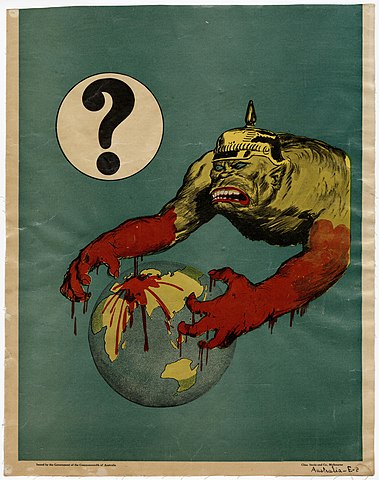
"?" - an Australian anti-German propaganda poster issued by the Australian government (artist: Norman Lindsay).
Picture source: Norman Lindsay, Public domain, via Wikimedia Commons
_Australian_WWI_Poster_-_Norman_Lindsay.jpg)
Britain published the Report simultaneously in 30 languages, and it arrived in Australia soon after its publication in Britain and America and was widely distributed around Australia also, where war service was voluntary. Governments in the Australian states hoped that the report would increase the number of people volunteering to fight in the war. The original Bryce Report was 430 pages long, but the government of New South Wales printed thousands of copies of a shortened version of the Bryce Report titled ‘The Truth About German Atrocities’ and sold them at a very cheap subsidised price. The Bryce Report (according to the NSW State Archives in the year 2014) "greatly influenced the Australian public’s view of the war, and of Germany in particular. This was most acutely felt by persons of German birth living in Australia, many of whom were peaceful, long-term residents of NSW."[7] The atmosphere for Germans in Australia and for Australians of German descent worsened, as the Bryce Report "sharpened Australian anti-German fury".[8] According to Australian historian John Williams, the Report "marked the point at which Anglo-Australia progressively turned against citizens of German descent and began to distrust them, to discriminate against them and then hate them."[9]
The anti-German propaganda poster on this page was described by Professor Peter Stanley in 2017 as "the most monstrous of the hundreds of posters" that Australians had seen during the war. The drips of blood are falling in the direction of Australia also. The Australian government commissioned the Australian artist Norman Lindsay to produce this picture in October 1918, and Lindsay did so at the same time that he was drawing and writing his famous book for children The Magic Pudding.[10] The poster depicts an ape monster in a German helmet with bloody hands reaching around the globe. This poster, like the Bryce Report, aimed to heighten negative public attitudes to Germany and Germans in general.
Note: the Australian War Memorial acknowledges that the behaviour of some Australian soldiers in the war was poor: “As for their [Germans] brutality, there are several examples of Australians and other Allied troops committing their own atrocities.”[11]
➜ The effects of the First World War on Australia's German-speakers
♦ Notes:
1. Keneally (2011), p.289
2. Milton (2007), p.55
3. Milton (2007), p.48
4. Milton (2007), p.56
5. Milton (2007), p.59
6. cited in Milton (2007), p.59
7. 'The Truth About German Atrocities', 1915. An abbreviated form of the ‘Report of the Committee on Alleged German Outrages’. NSW Anzac Centenary. An online exhibition by the State Archives. Accessed on 02/10/2025.
8. Keneally (2011), p.289
9. Williams (2003), p.56
10. Stanley, Peter, & National Library of Australia. (2017). The crying years : Australia's Great War / Peter Stanley. Canberra, ACT : NLA Publishing. p.201
11. Australian War Memorial. Exhibitions. 1918: Fritz - Australian soldiers' relations with Germans. Available online here.
♦ References:
Keneally, Thomas (2011). Australians, Volume 2, Eureka to the Diggers. Crows Nest, N.S.W.: Allen & Unwin. p.289
Milton, Richard. (2007). Best of Enemies: Britain and Germany - 100 Years of Truth and Lies. Cambridge: Icon Books.
Williams, John F. (2003). German Anzacs and the First World War. Sydney: University of New South Wales Press