Australia - loyal to the British Empire in 1914
Why did Australia automatically join Britain in the war in 1914?
When the First World War broke out many Australians of German descent faced antagonism and discrimination in their own communities and in their workplaces. The Australian states had stopped being colonies of the United Kingdom nearly 15 years earlier. Why did Australians not have a more independent or neutral reaction to the war in Europe?
Australia in the 21st century has a multicultural society – the family backgrounds of many Australians originate in many different countries. Many young Australians may find it surprising that Australia immediately joined Britain in the fighting of World War I. The Australian historian Geoffrey Serle wrote as early as 1968 that young Australians no longer understood the immense weight of the British Empire in Australian life in the past.[1] Australia did not send troops to fight alongside British forces in the Falklands War of 1982. So what was the situation in 1914?
In 1914 most Australians were proud of being part of the British Empire. At that time Australia had no embassies, no foreign minister and no national anthem.[2] Australian citizenship did not exist until it was created under the Nationality and Citizenship Act of 1949.[3] In 1914 most Australians were British subjects. Australia looked to Britain’s Royal Navy to provide defence. Schoolteachers made the war a central part of school life. Schools and their students played a part in patriotic festivals and in fund-raising for the Australian troops. Schools focused on the Empire rather than on the nation of Australia. In the north-east of Victoria “in lessons and in lectures on special occasions like Empire Day or Waterloo Day students were constantly reminded of the advantages of belonging to the British Empire."[4] Many Australians referred to Britain as “the Mother Country”, even if they were born in Australia. George Brammall, the Anglican church minister in Bright in north-eastern Victoria summed up the mood in the region when he said in September 1914: "We are British first, and Australian second."[5] The Australian historian Benjamin Jones described Australians' loyalty as follows: "Arguably Britishness meant even more to Australians than it did to the inhabitants of the United Kingdom. Prime Minister Billy Hughes would claim: 'We are more British than the people of Great Britain.'"[6]
'When Britain declared war on Germany in August 1914, the Empire was at war, and no political leader in Australia doubted the fact.'[7]
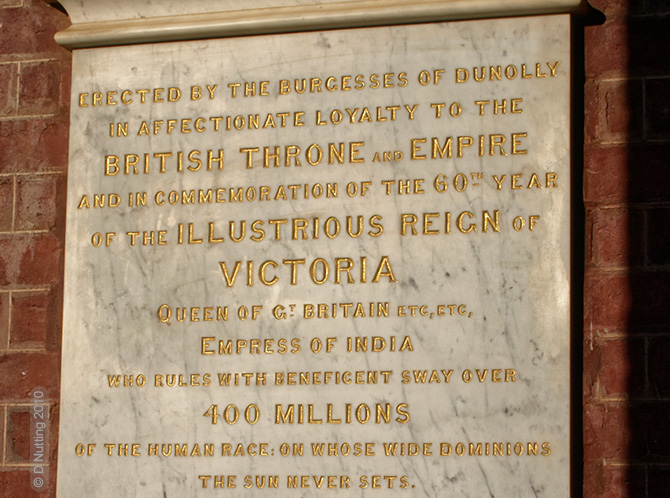
Large tablet at the Dunolly Town Hall commemorating 60 years of Queen Victoria's rule over the British Empire.
The grandiose wording on this tablet in the small central Victorian town of Dunolly shows how much Queen Victoria was admired as leader of a vast empire.
The text on the tablet reads: “Erected by the burgesses of Dunolly in affectionate loyalty to the British throne and empire and in commemoration of the 60th year of the illustrious reign of Victoria, Queen of Great Britain etc, etc, Empress of India, who rules with beneficent sway over 400 millions of the human race: on whose wide dominions the sun never sets.”
In the years leading up to the outbreak of the First World War most Australians were proud to be members of the British Empire, and the British government gave overseas ‘dominion’ countries more recognition. When King George the Fifth and Queen Mary were crowned in 1911 there was a huge military parade, and compared to the last coronation (1902) there was quite a difference in the status given to the standard-bearers of ‘dominion’ countries such as Australia, Canada, South Africa, New Zealand and India. For the first time at a coronation the overseas dominions were given the same prominence in the parade as the four home countries of the United Kingdom (= England, Scotland, Wales and Ireland).[8] This no doubt strengthened Australians’ feelings of a close bond to the “mother country”.
In one sense it is ironic that Britain and Germany were at war: Wilhelm II, Emperor of Germany, was a grandchild of Britain’s Queen Victoria, who died 12 years before World War I started. Victoria, who was "more German than British"[9], had been married to a German, Prince Albert of the duchy of Saxe-Coburg and Gotha. Read more here about how British Australians honoured the German Prince Albert in the naming of several towns, suburbs and parks. In fact, every single British king or queen between 1714 and 1901 was married to a German spouse.[10]
The outbreak of World War I in 1914 changed the lives of more than 100,000 Germans living in Australia, and started a very difficult time for them and for many Australians of German descent.
♦ Notes:
1. Schreuder & Ward (2008), p.2
2. Jones (2018), pp.50-51
3. National Archives of Australia: A1861, Photograph. Souvenir of the Declaration of War, August, 1914. Registration and Exhibit. 3250. Available online here: <www.naa.gov.au/learn/learning-resources/learning-resource-themes/war/world-war-i/souvenir-poster-declaration-war-1914>.
4. McQuilton (2001), p.141
5. McQuilton (2001), p.19
6. Jones (2018), p.20
7. Millar, T. B. (1991). Australia in peace and war : external relations since 1788. Botany, N.S.W : Australian National University Press. p.28
8. Davies (2000), p.737
9. English biographer and journalist A.N. Wilson, in Real Royalty. (2020, January 20). The secrets inside Queen Victoria's diaries. [Video] YouTube <www.youtube.com/watch?v=9rXmC2j3rS8>
10. Davies (2000), p.631
♦ References:
Davies, Norman. (2000). The Isles: A History. Revised edition. London: Papermac.
Jones, Benjamin T. (2018). This time : Australia's Republican past and future. Carlton (Victoria): Redback.
McQuilton, John. (2001). Rural Australia and the Great War : from Tarrawingee to Tangambalanga. Carlton, Vic : Melbourne University Press.
Schreuder, D. M. & Ward, Stuart. (2008). Australia's empire. Oxford : Oxford University Press.