Victoria
Tatura Internment & P.O.W. Camps
Part 1 - why Tatura?; the structure of the camps
Part 2 - daily routine, entertainment and leisure for interned families
Part 3 - the German War Cemetery
Most of the internees and prisoners-of-war aimed to make the best of their situation by maintaining their traditions, by maintaining a daily routine, and by staying busy making necessities, studying, creating art, entertaining each other and recording their experiences in art and writing - all with the limited material available to them in the camps. In Camp #3 at Tatura the internees established a brass band, a chamber music orchestra, choirs and a theatre company.[1] In the Tatura Irrigation & Wartime Camps Museum many examples are on display of the ingenuity and creativity of the internees.
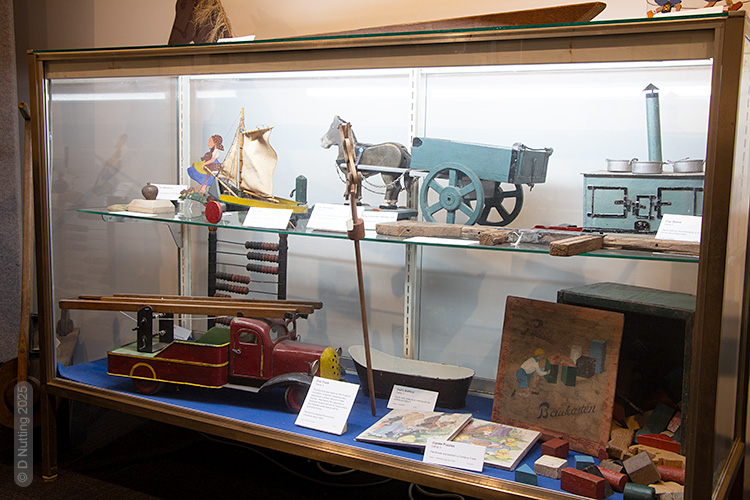
Toys made by internees for the children in the camp. The fire engine was made in Camp #3 by Friedrich Schöttler, a Lutheran missionary in New Guinea. He fled from the Japanese to Australia, where he was interned at Tatura. Don Kühne received this fire engine for Christmas around 1944. (Displayed at the Tatura Irrigation & Wartime Camps Museum)
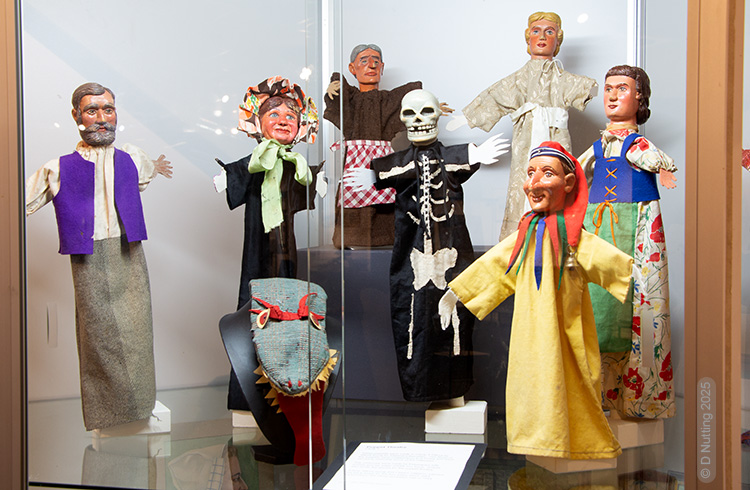
Puppet Theatre, Camp #3: The puppets in the photo were made in Camp #3 Tatura by Alfons König for Ekkehard Beinssen. The faces of the puppets were created from fruit boxes and were carved to resemble some of the Internees. The costumes were made by Ekkehard's wife Irmhild and her sister Gisela von Koch. Irmhild also wrote the stories for the puppet theatre - the four plays were performed in the camp recreation hall in 1944. (Displayed at the Tatura Irrigation & Wartime Camps Museum)
Dr. Gerhard Neumann came from Germany to take up a position as lecturer in German language and literature at Sydney University around 1937 but was arrested as a possible security risk in September 1939. He married Peggy McIntyre, a well-connected art gallery curator at Liverpool Internment Camp in February 1940. Peggy tried to obtain her husband's release; she was only allowed to see him for half an hour on each of her visits to Tatura Camp #1. Dr Neumann was greatly respected by his internee students in Camp 1 as he prepared them for their Abitur (matriculation) exams. The results were sent via the Red Cross to Germany. In Camp #1 he wrote a comedy in eight scenes (Lustspiel in acht Szenen) entitled Die Klosterbrüder - oder die gestörte Liebesstunde. The cover of the program for the performance states that it was written in the internment camp at Tatura in March 1940.
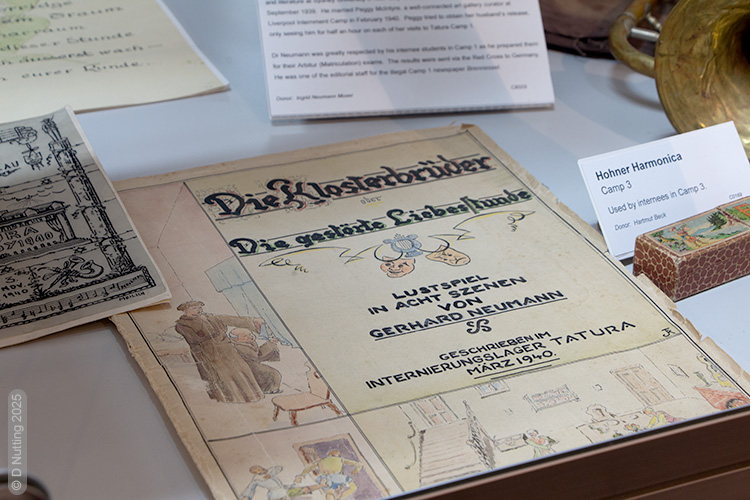
Program for the play written by Dr Neumann. (Displayed at the Tatura Irrigation & Wartime Camps Museum)
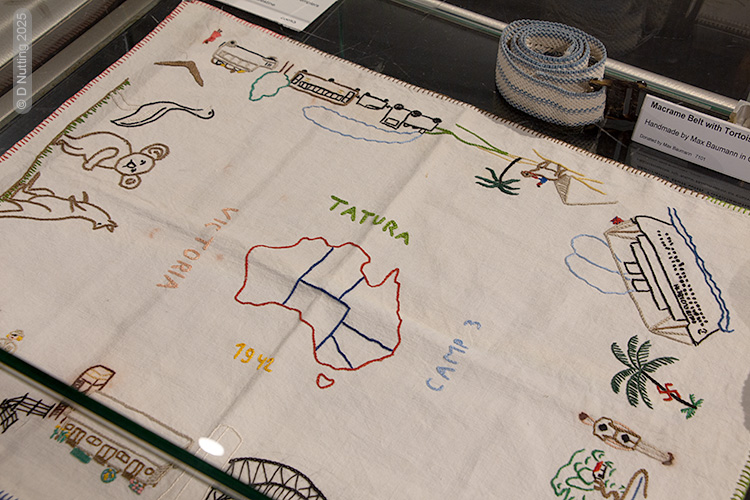
This tray cloth was embroidered by 14-year-old Anna Maria Treftz. It shows scenes of the changes in life experienced by the Templer families when they were expelled by the British from their communities in Palestine and interned in Tatura. The calico cloth came with them from Palestine. (Displayed at the Tatura Irrigation & Wartime Camps Museum)
Education was available for all ages, provided by teachers among the internees.
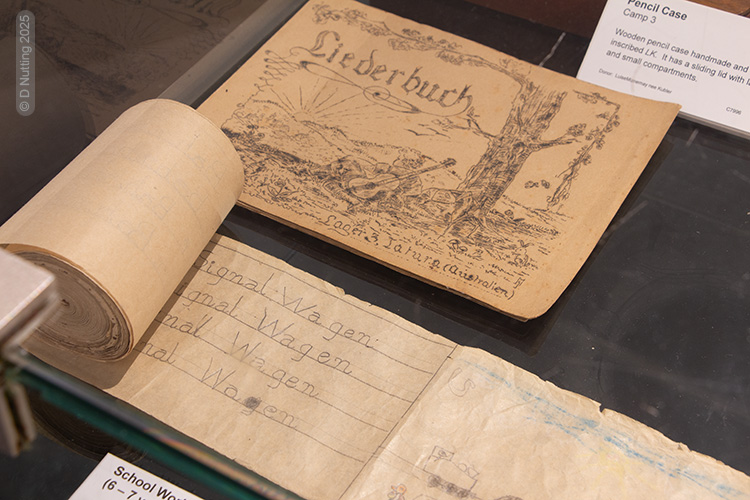
School work of Gretl Frank, who was 6-7 years old at the time. She drew it on standard-issue toilet paper in Camp #3. (Displayed at the Tatura Irrigation & Wartime Camps Museum)
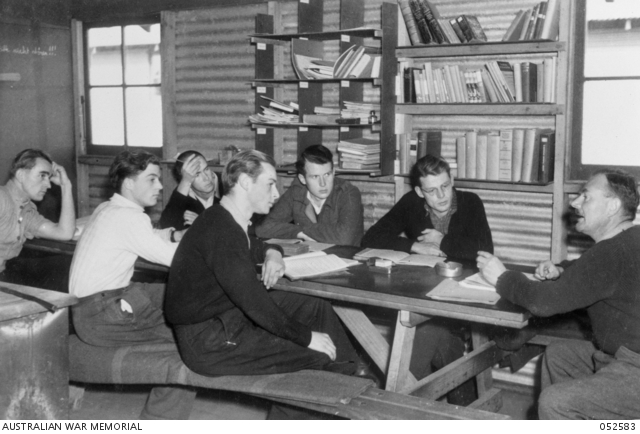
Tatura, Victoria. 19/06/1943. Abitur (matriculation / school-leaving qualification) and university-entrance students attend a coaching class at Camp #1, Tatura internment group. Left to right: Q137 R. Neumann; Q153 F. K. Mayer; E3516 H. Jansen; N1431 H. H. Hennig; E35134 J. Friedrich; N1125 W. Eckels; N1011 J. Vd. Schulenberg.
Photo source: Australian War Memorial (public domain).
One of the ways in which the German officers imprisoned at the Dhurringile mansion tried to avoid boredom was to plan escapes. They considered it their duty to try to escape from captivity. There were several escape attempts, and in January 1945 17 German officers escaped from Dhurringile through a tunnel that they had dug, however they were recaptured soon in the nearby countryside and villages.
The tunnel began under the floor of the mansion (the entrance was hidden under a cupboard) and was more than 100 metres long. The story goes that Captain Theodor Detmers of the ship Kormoran and a Luftwaffe pilot Major Hellmut Bertram reached the township of Tallygaroopna, more than 40 km from the Dhurringile mansion, about a week after their escape and tried to buy bread and cheese from a shop. When they left the shop, the shop-owner phoned the police to let them know that ‘there was a chap in here looking for food. He spoke English too good to be an Australian.’ Detmers, Bertam and the other escapees were all captured and returned to Dhurringile.[2]
♦ Notes:
1. Monteath (2018), p.163
2. Monteath (2018), p.205
♦ References:
Association of German Teachers of Victoria, Inc. (1999). Tatura Heritage Trail.
Bossence, William Henry. (1969). Tatura and the Shire of Rodney / by William Henry Bossence. Melbourne : Hawthorn Press. pp.265-284
Exhibition notes displayed at the Tatura Irrigation & Wartime Camps Museum.
Monteath, Peter. (2018). Captured lives : Australia's wartime internment camps / Peter Monteath. Canberra, ACT : NLA Publishing