Ski Resorts in Australia
The influence of German-speaking immigrants
Immigrants from the German-speaking countries, particularly from Austria, played a significant role in the development and popularising of skiing as a recreational activity and of ski resorts in Australia. A considerable number of them had done skiing as a leisure activity in their former homelands and brought with them ideas, trends, and knowledge about skiing as a leisure sport.
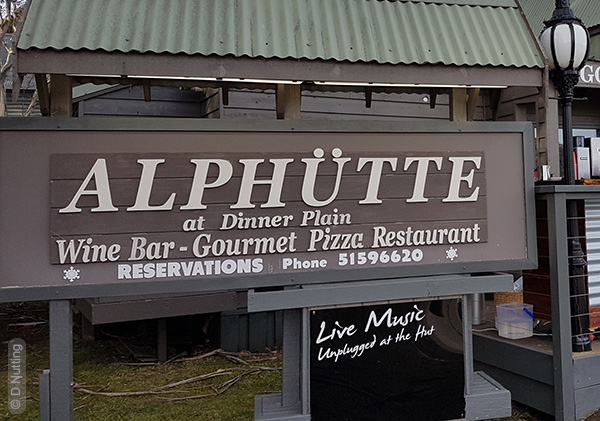
The Alphütte restaurant at Dinner Plain, Victoria.
The three active skiing states in Australia are New South Wales, Victoria, and Tasmania, as well as the Australian Capital Territory. Skiing was introduced to Australia by migrant miners in New South Wales and Victoria in the second half of the nineteenth century, and the Austrian immigrant Gustav Weindorfer introduced skiing to Tasmania in the 1920s.[1]
Gustav Weindorfer and skiing
Weindorfer is well known for popularising tourism in the Cradle Mountain area in northwest-central Tasmania. The area is a part of the Tasmanian Wilderness UNESCO World Heritage site. In 1912 Weindorfer and his wife Kate built a chalet in the Cradle Valley in order to encourage visitors to the Cradle Mountain area, and named the chalet Waldheim (‘home in the forest’).
In July 1914 during a winter with much snow Weindorfer made his own pair of skis, which are considered to be the first ever hand-crafted skis in Tasmania, where skiing was a practically unknown sport at that time. On the 17th July he skied for the first time down the slopes of the valley opposite his lodge Waldheim, and was very happy with the performance of his skis.[2] In the 1920s Weindorfer introduced several friends of his to the fairly new sport of skiing – none of them had ever seen a pair of skis before. This group of friends later made a visit to Waldheim every year for a fortnight of skiing from about 1929 until a few years after Weindorfer died.[3]
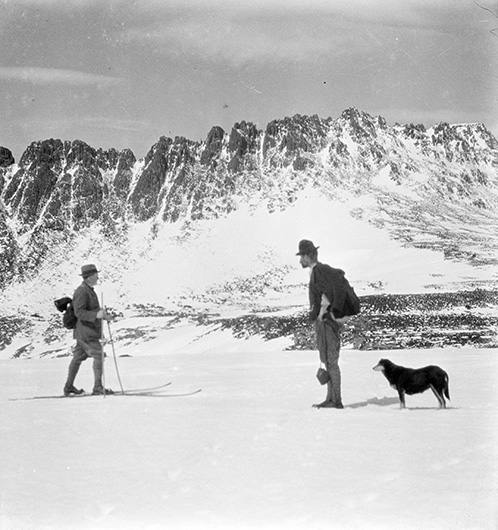
Gustav Weindorfer (at right) and F. Smithies on skis at Cradle Mountain - September 1925
Photograph source: Item Number NS573/4/10/1/6, series 'Photographs of Gustav Weindorfer and Waldheim Chalet, Cradle Mountain' (NS573/4/10). F. Smithies Collection, Tasmanian Archives, used here with permission.
<https://libraries.tas.gov.au/Record/Archives/NS573-4-10-1-6>
You can read more about Gustav Weindorfer's adventuous life...
'Mamma' Otter-Strolz
At the Mount Baw Baw Alpine Resort there is a plaque honouring the life of an Austrian woman who contributed to the development of recreational skiing in Victoria. The text on the plaque reads: "In memory of 'Mamma' Otter-Strolz, born 1.4.1902 at Innsbruck (Austria), died 6.1.1988 at Mount Baw Baw. A pioneer of Victorian snow fields. Alpine Resort Commission."
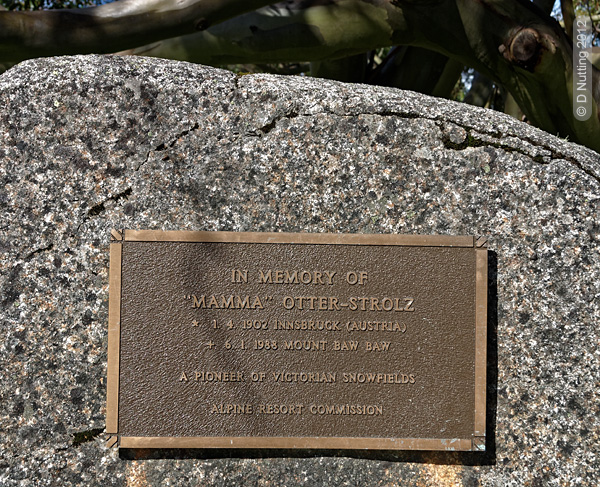
Plaque at Mount Baw Baw Alpine Resort.
Karl Anton Schwarz
Karl Anton Schwarz (known in Australia as Charles William Anton) was an Austrian from Vienna who had a long-lasting impact on Australian snow field developments after World War II. He grew up in the Viennese suburb of Grinzing and finished his schooling in 1935. He then got a job with the Austrian branch of the British Sun Insurance Company and became a good speaker of English. In his spare time he spent a lot of time touring the alps on skis. He was a member of the Austrian Alpenverein (alpine club) and used its alpine huts and other facilities and gained knowledge of the organization’s structures and the value of shelter huts in alpine areas.
Karl’s family considered themselves Catholic, but when the National Socialists seized power in Austria in 1938 they considered the family to be Jewish due to the family’s background. Karl and his parents were lucky to be able to get out of Austria when he gained a job with an Australian insurance company, and they arrived in Sydney in December 1938. Only two months after arriving in Australia, he officially changed his name to Charles William Anton.
By the 1940s there were some ski clubs in Australia but the infrastructure in the mountains was underdeveloped. Karl Anton Schwarz developed plans to establish an alpine organization similar to the Austrian Alpenverein. He was good at organising people and creating business networks, and had a flair for publicity, which was useful when he founded the Ski Tourers Association at the start of the 1950s. When the Kunama Hütte was built in the early 1950s Anton ensured that Austrian influences were visible inside and outside; he wanted it to look like the alpine huts he knew from Austria.
[In the 1950s] Austria was very fashionable among Australian skiers at that time given the fact that much of Australia’s ski know-how derived from Austria. (…) The first Austrian skiing instructors arrived as early as the 1930s.
Philipp Strobl
Anton and his wife decorated their apartment in the Sydney suburb of Randwick with lots of Austrian paraphernalia, including Tyrolean-style furniture which they made themselves. This was unusual in Sydney and the magazine Australian Women’s Weekly reported on it. The first paragraph of the article states:[4] "Keen skiers, Mr. and Mrs. Charles Anton have reproduced the gaiety and comfort of peasant homes they admired in the Austrian Alps in their flat at Randwick, Sydney. They designed and made furniture, and painted the walls in peasant style with very charming results."
Anton was a key figure in the development of the Thredbo ski resort, and for the Kareela Hütte there Anton hired an Austrian architect, Otto Ernegg.
In late 1962, Anton decided that the name ‘Ski Tourers Association’ no longer reflected the broad popularity that skiing was gaining in Australia, and changed the “STA” into the “Australian Alpine Club”.
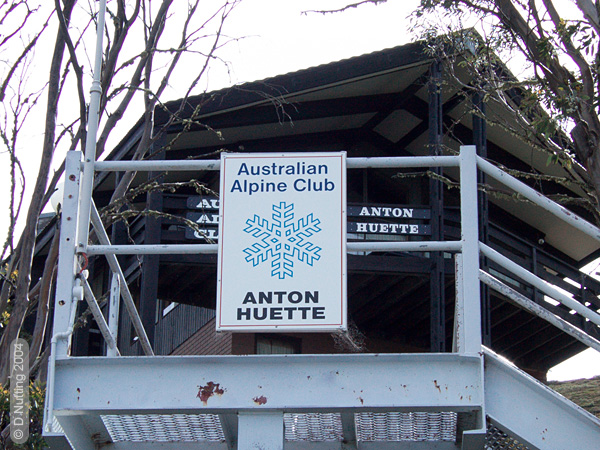
Anton Huette, a lodge opened by the AAC at Mt Hotham in 1972, was named after Charles Anton. Anton Huette sits at 1,753m altitude.
German names and phrases at ski resorts
The influence and fashionableness of skiing culture from Germany, Switzerland and particularly Austria are evident in the German names of many businesses, lodges, hotels and restaurants in Australian ski resorts. For example:
▶ Patscherkofel Lodge (named after a mountain near Innsbruck in Austria), officially opened in May 1966, by Charles Anton, at Mt Buller in Victoria.
▶ Tirol Lodge is a café & restaurant at the Mt Buller ski resort in Victoria. Tyrol is a western state of Austria well-known for its mountains and ski resorts. The name of the lodge is spelled the German way, with the letter "i".
▶ Koflers Restaurant carries the name of Helmut Kofler, the Austrian who ran the Mt Buller chalet in the 1930s. The restaurant is part of the same building (Helmut Kofler Hütte) that the Victorian Government erected in 1959 ‘as a symbol of faith in the development of tourism and snowsports on Mt Buller’.
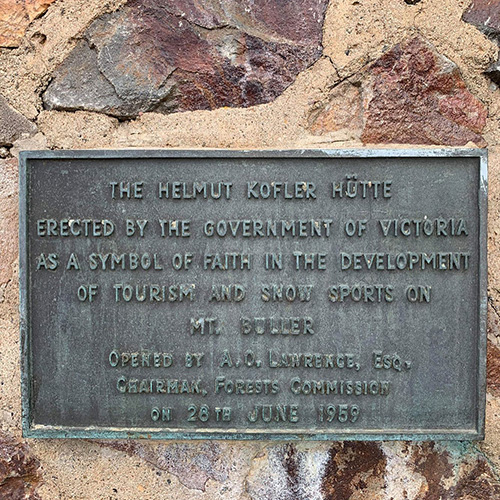
Memorial plaque at the Kofler-Hütte in Mt Buller.
Photo credit: Mt Buller. Displayed here by kind permission of Mt Buller and according to the Terms of Use of the Mt Buller Digital Media Gallery.
▶ Burger Haus (at Mt Buller) uses a German spelling.
▶ Enzian Hotel (at Mt Buller) - Enzian is the German name of a blue alpine flower (the flower is referred to as the gentian flower in English), and also of an alcoholic drink that is distilled from the root of the Enzian plant. Enzian is also the name of a mountain in the Bavarian Forest in south-eastern Germany. Enzian Lodge in Jindabyne in New South Wales was modelled on the style of an Austrian chalet. / Pflanzengattung aus der Familie der Enziangewächse / Spirituose aus Enzianwurzeln / Berg (1285 m) im Bayerischen Wald / The gentian flower
▶ Arlberg Hotel (at Mt Buller) - the Arlberg is a mountain range with many ski resorts in the west of Austria.
▶ Watzmann Haus / Alpine Hotel (at Mt Baw Baw Alpine Resort in Victoria) - the building is no longer there, but the name Watzmann came from the third highest mountain in Germany, in the Berchtesgaden Alps.
▶ Schnapps apartments is an accommodation complex in Mount Hotham in Victoria. Schnaps (spelled with one "p" in German) is an umbrella name for various distilled alcoholic drinks that are sometimes based on fruits.
An article in the Sunday Age in 2018, entitled 'Check into the snow trip clinic', gave readers advice on how to enjoy a ski holiday on the snow fields of Australia. The writers pointed out the influence of German-speaking immigrants on the atmosphere of ski resorts in Australia: "If you’re chasing a European apres-ski feel, there are two resorts you must visit: Thredbo and Mount Buller. These were both heavily influenced by Austrian and other European immigrants in their first two decades, the 1950s and ‘60s and you can feel it everywhere – from the names of the streets and ski runs, to the Tyrolean-style bars and restaurants where schnapps rule the roost."[5]
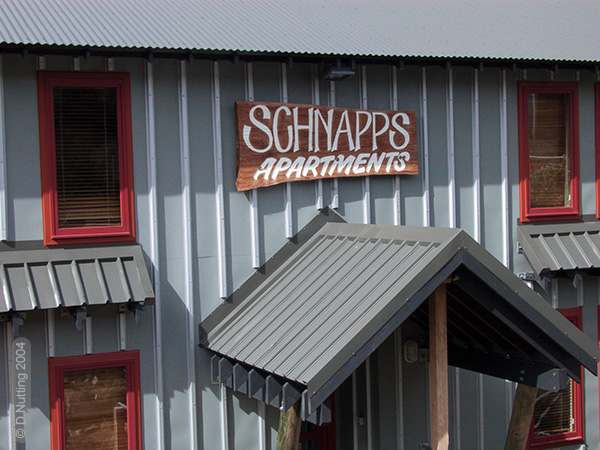
The 'Schnapps' apartments at Mount Hotham ski resort, Victoria.
Some German skiing expressions have been used at Australia’s ski resorts. The 2018 article in the Sunday Age included a section on how to understand expressions that you can hear in those ski resorts, including German expressions, as follows:
♦ Notes:
1. Strobl (2016)
2. Giordano, Margaret. (1987). A Man and a Mountain. The Story of Gustav Weindorfer. Launceston (Tasmania): Regal Publications. p.44
3. Giordano, Margaret. (1987). A Man and a Mountain. The Story of Gustav Weindorfer. Launceston (Tasmania): Regal Publications. p.88
4. YOUNG COUPLE FURNISH FLAT AS CHALET (1950, September 23). The Australian Women's Weekly (1933 - 1982), p. 44. Retrieved June 30, 2023, from <http://nla.gov.au/nla.news-article43597184>
5. Darby, Jim & Craig Tansley (2018). “Check into the snow trip clinic”. Traveller on Sunday, The Sunday Age, 20/05/2018. p.16
♦ Reference:
Strobl, Philipp. (2016). Migration, Knowledge Transfer, and the Emergence of Australian Post-War Skiing: The Story of Charles William Anton. The International journal of the history of sport, 33(16), pp.2006–2025. <https://doi.org/10.1080/09523367.2017.1313234>.