Tasmania
Gustav Weindorfer & Cradle Mountain
The pristine natural condition and the international fame and popularity of the Cradle Mountain area of Tasmania are largely due to the efforts of an Austrian immigrant.
Gustav Weindorfer (1874-1932), naturalist and conservationist, was born at Spittal an der Drau, in the Duchy of Kärnten, Austria (Kärnten is now a federal state of Austria). After his school years he did agricultural studies at Mödling, near Vienna. He migrated to Australia and arrived in Melbourne in 1900. In Melbourne he worked in an office but was very active in amateur botany circles. He became a member of the Victorian Field Naturalists’ Club and organised excursions in the Victorian Alps for members and he wrote articles in publications about plants and held public lectures.[1]
Weindorfer married Kate Cowle in 1906, who was also a member of the Victorian Field Naturalists’ Club but originally from Tasmania. They moved to Tasmania and farmed in the north of the state. Weindorfer was very impressed by the mountain scenery of Tasmania, the rolling green fields and rivers and waterfalls - it probably reminded him of the alpine areas of his home state of Carinthia in Austria.[2] Gustav and Kate were very enthusiastic about the natural beauty of the area around Cradle Mountain, which they climbed together, and were determined to make it a national park. They lobbied government and public authorities to build a road to Cradle Mountain, and worked hard to publicise the area to bushwalkers, mountaineers and nature lovers.
In 1912 Gustav began building a chalet called Waldheim (‘home in the forest’) at which he could welcome visitors to the area. The Tasmanian government was slow to respond to Gustav’s lobbying for a road into the area and he had to carry materials and equipment to Waldheim on his back.
Gustav and Kate Weindorfer's goals included publicising the beauty of the area to more and more nature lovers, making it easier for visitors to travel there, and persuading the Tasmanian government to declare the area a national park. Gustav enthusiastically guided many groups of visitors through the area and often climbed Cradle Mountain with adventurous nature lovers.
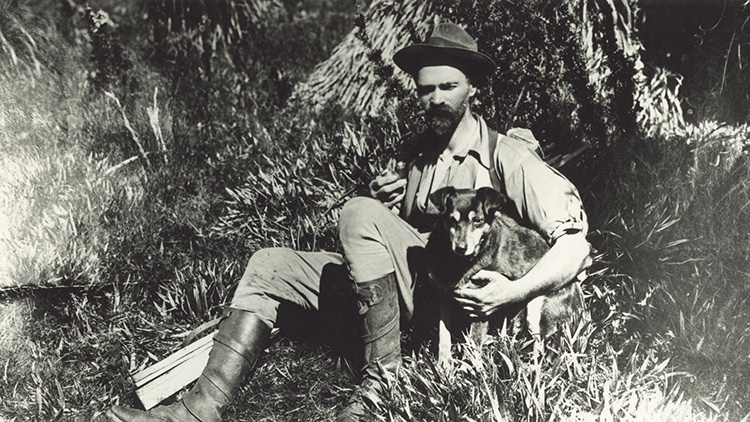
Gustav Weindorfer and his dog named Flock.
Photo source: 'F. Smithies Collection', Tasmanian Archive and Heritage Office, item number: NS573/4/10/1/1. Used here with permission.
In July 1914 during a winter with much snow Weindorfer made his own pair of skis, which are considered to be the first ever hand-crafted skis in Tasmania, where skiing was a practically unknown sport at that time. On the 17th July he skied for the first time down the slopes of the valley opposite his lodge Waldheim, and was very happy with the performance of his skis.[3] In the 1920s Weindorfer introduced several friends of his to the fairly new sport of skiing – none of them had ever seen a pair of skis before. This group of friends later made a visit to Waldheim every year for a fortnight of skiing from about 1929 until a few years after Weindorfer died.[4]
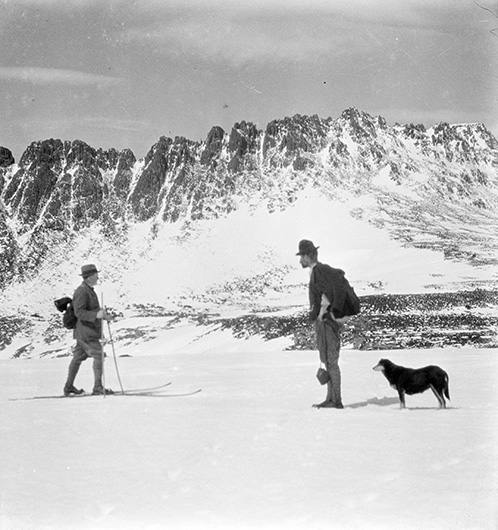
Gustav Weindorfer (on the right) and F. Smithies on skis at Cradle Mountain - September 1925.
Photo source: Article number NS573/4/10/1/6 Series 'Photographs of Gustav Weindorfer and Waldheim Chalet, Cradle Mountain' (NS573/4/10). F. Smithies Collection, Tasmanian Archives, used here with permission.
1916 was a tragic year for Weindorfer. In Austria his parents and his brother Lothar died, and in northern Tasmania his wife Kate died. Weindorfer increasingly experienced prejudice in the anti-German and anti-Austrian atmosphere of that time.[5] The journalist Kate Legge wrote in 2019 of Weindorfer’s life during the years of the First World War:[6]
Then, as Tasmanian sons, brothers and fathers died at the front, the antagonism towards anyone with a German accent or Austrian heritage intensified. One of Gustav’s dogs was poisoned with strychnine. He was ousted from a Launceston social club and kept under surveillance. Isolated by harsh winters and the brunt of wartime hostility he wrote prodigiously, publishing articles in serious journals and the popular press, describing and collecting native plants and fauna, testing seedlings in different habitats (...)
Kate Legge
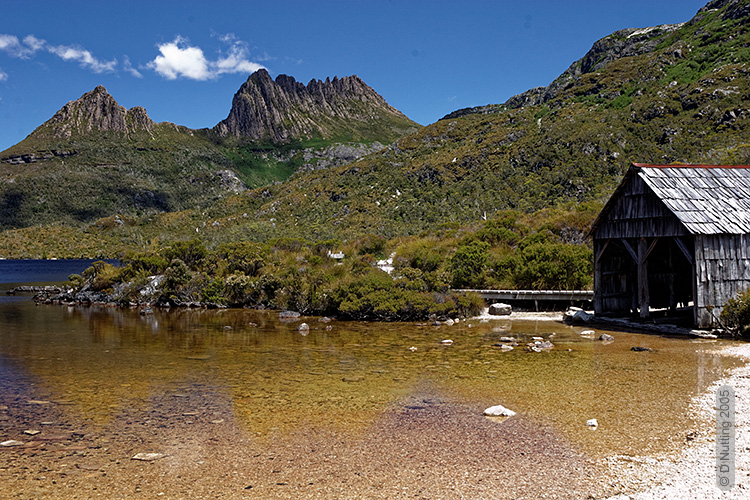
Dove Lake with Cradle Mountain in the background.
The jagged contours of Cradle Mountain frame the icy waters of Dove Lake – it’s perhaps the Tasmanian landscape seen most often in photos and on postcards.
The small boathouse on the shore of Dove Lake, which can be seen in many photos of the lake with Cradle Mountain in the background, was built in 1940 by the first official park ranger to house a few small boats that the park authority had there. Weindorfer himself owned a few punts on the lake.[7]
Waldheim became a popular resort and visitors found Weindorfer to be a cheerful, charming and witty host. In the 1920s "a stay at Waldheim and a meeting with the almost legendary Weindorfer was a "must" for many."[8] Charles Witham wrote in 1924 that Waldheim was the only tourist accommodation-house he had ever seen that was exactly suited to its surroundings.[9]
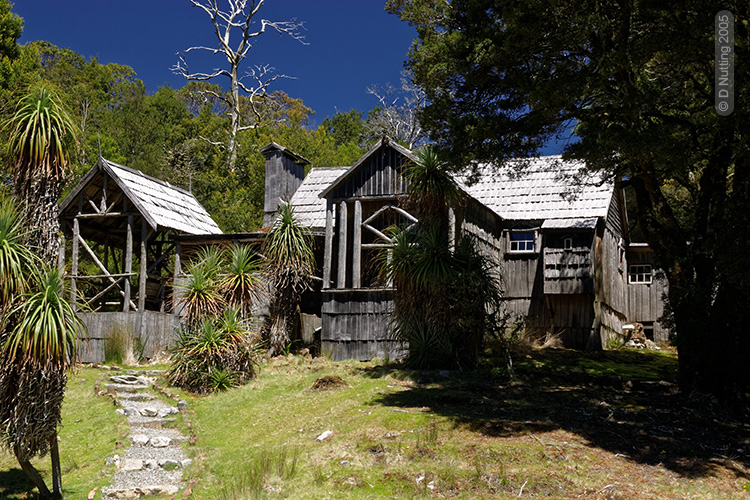
Waldheim
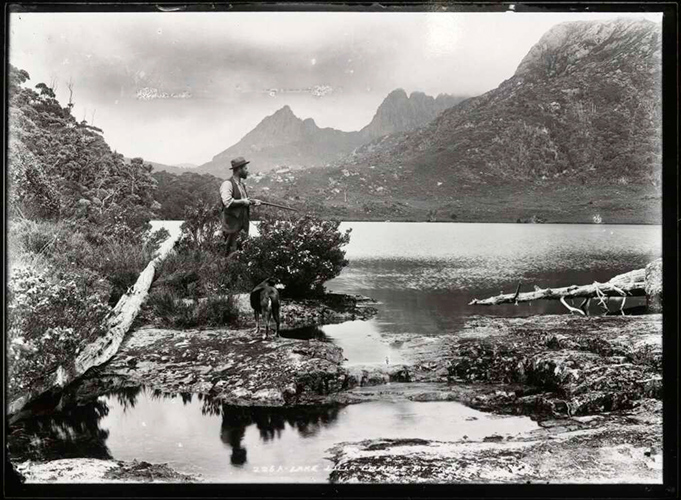
Gustav Weindorfer and his dog named Flock at Lake Lilla.
Photo source: Spurling, Stephen, III, 1876-1962. (1922). Cradle Mountain - Lake Lilla, Gustav Weindorfer and his dog, 1922 [picture] / Spurling. <http://nla.gov.au/nla.obj-145495378>
Weindorfer acted as an unofficial ranger and kept weather records for the Cradle Mountain area.[11] He died of heart disease in 1932 and was buried in the Cradle Valley.
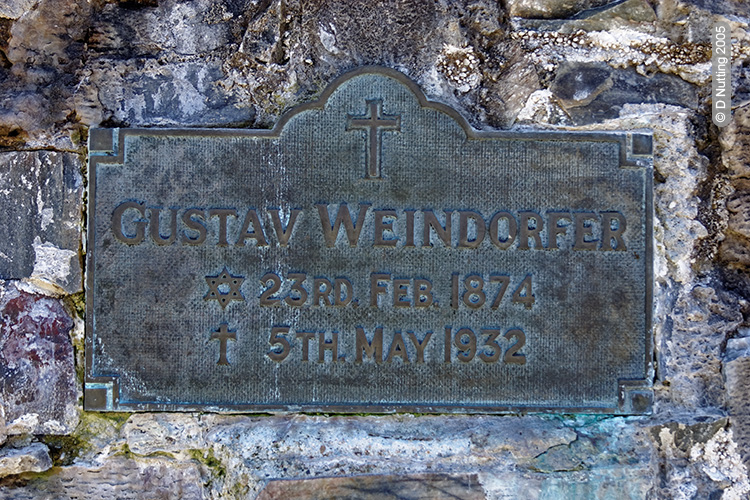
Plaque on a memorial cairn at Waldheim
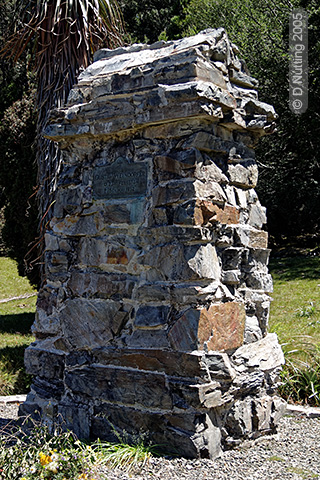
Memorial cairn at Waldheim
The Cradle Mountain-Lake-St. Clair National Park is part of the UNESCO World Heritage list: Tasmanian Wilderness.
In 2015 the Lonely Planet publishing house produced its "Ultimate Travelist: The 500 Best Places on the Planet ... Ranked", as voted on by the Lonely Planet community. Cradle Mountain was listed as #32/500.
♦ Notes:
1. Tilley (1990) / Giordano (1987), p.9
2. Giordano (1987), p.20
3. Giordano (1987), p.44
4. Giordano (1987), p.88
5. Giordano (1987), pp.51-53
6. Legge (2019)
7. Nash, Mike. (Historic Heritage, Parks and Wildlife Service of Tasmania). Personal communication via email on 14/09/2015.
8. Giordano (1987), p.98
9. Whitham, Charles & Mount Lyell Tourist Association. (1924). Western Tasmania : a land of riches and beauty. Queenstown, Tasmania : Mount Lyell Tourist Association. Chapter 2.
10. Displayed on an information board at Waldheim, near Dove Lake (2005).
11. Giordano (1987), p.57
♦ References:
Giordano, Margaret. (1987). A Man and a Mountain. The Story of Gustav Weindorfer. Launceston (Tasmania): Regal Publications
Legge, Kate. (2019, March 1). Kindred spirits. Their love story unfolded in the Tasmanian wilderness a century ago. What would this pioneering pair make of Cradle Mountain now? The Weekend Australian - Magazine. Sydney: News Corp Australia.
Tilley, Raymond F. 'Weindorfer, Gustav (1874–1932)', Australian Dictionary of Biography, National Centre of Biography, Australian National University, <http://adb.anu.edu.au/biography/weindorfer-gustav-9038/text15919>, published first in hardcopy 1990 [Volume 12], accessed online 10 September 2015.