Architects
Harry Seidler
Part 1 - childhood in Vienna :: escape to England :: internment :: studies in North America :: the Rose Seidler House in Sydney
Part 2 - skyscrapers :: back to Vienna :: his public persona
Apart from designing distinctive modern homes Harry Seidler became well-known for his innovations in designing high-rise office and residential towers from the 1960s onwards. In the centre of Sydney stands the tower of Australia Square with a height of 170 metres. It was completed in 1967 and has 50 floors, which include a revolving restaurant on the 47th floor and an observation deck on the 48th floor. With the completion of Australia Square “suddenly Sydney, that sleepy, colonial, wrong-side-of-the-planet metropolis, was setting architectural, engineering and technological benchmarks.”[1]
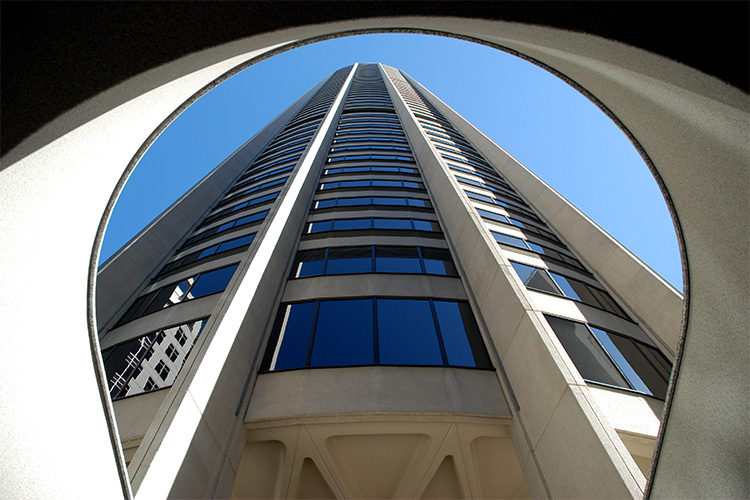
The Australia Square building, designed by Harry Seidler, completed in 1967, photographed in 2007.
Photo source: Elekhh at English Wikipedia, CC BY-SA 3.0, via Wikimedia Commons

Seidler was known for his brilliance in solving design problems. When he was commissioned to design Australia’s embassy in Paris there were tricky problems that Seidler and his team had to solve regarding the shape of the site and height restrictions in that central part of Paris. The embassy is on a piece of land shaped like a triangle. It's made up of two buildings, each nine storeys tall, that are shaped like a quarter of a circle, or a quadrant. These two buildings are very curved, similar to a sharp bend, and are placed so they don't actually touch each other. Imagine the curves of two semi-circles making an "S" shape. This design was chosen to make sure people in the embassy would have the best possible views of the river and particularly of the Eiffel Tower, which is close by.[2]
When it was finished in 1977, the MLC Centre in Sydney was one of the tallest buildings in the world made of reinforced concrete (67 storeys). Notable features include its columns that are shaped like sculptures and get narrower towards the top of the building, and the huge public plaza at its base.
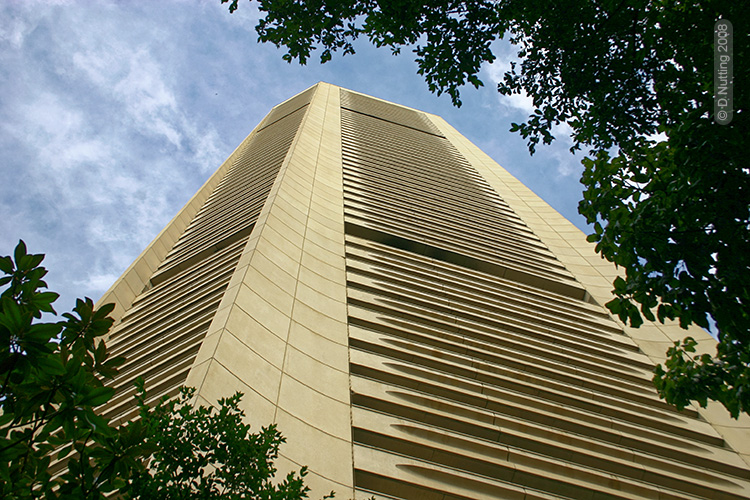
The MLC building, designed by Harry Seidler, completed in 1977.
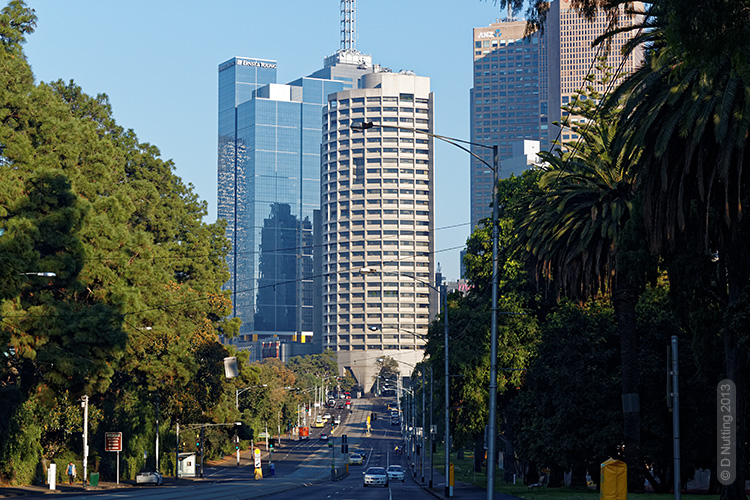
#1 Spring Street (formerly Shell House), Melbourne, designed by Harry Seidler, completed in 1989.
The design and construction of the Riverside Centre in Brisbane involved many innovations, and the building excited interest among many other architects.[3] The office tower of the Riverside Centre is a triangular-shaped building, where two of the three sides have views of the Brisbane River, and at ground level between the tower and the river is an open plaza, whose restaurants and attractively landscaped terraces became a popular gathering space for the people of Brisbane. The building has a strong visual and physical connection with the Brisbane River, and its completion coincided with renewed public interest in the Town Reach section of the river, and the city increasingly oriented itself towards its river.[4]
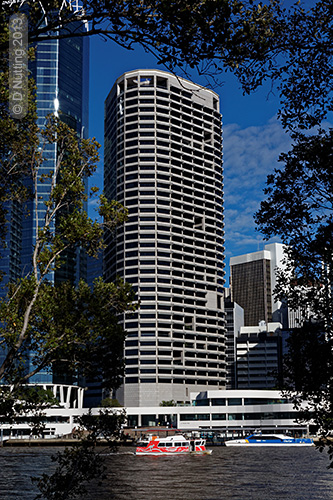
The Riverside Centre in Brisbane, designed by Harry Seidler, completed in 1986.
A contract that particularly pleased him was in his former hometown of Vienna. The project 'Wohnpark Neue Donau' was a large housing community with space for about 3,000 residents and involved tricky engineering and design problems which Seidler and his team solved. Another aspect of the work that appealed to Seidler was the fact that this housing complex alongside the Danube River provided apartments for both public housing rental tenants and some private owners.[5]
Seidler was quite a celebrity in Sydney society and was also known for always wearing a bow tie in public, and for his passion for architecture and design. According to his wife Penelope he was not interested in politics and did not follow newspapers at all – the focus of his world was architecture.[6] At times he was also known for being argumentative and confrontational, particularly with local councils (when they objected to his plans) and with the media[7]. Seidler received several awards from overseas governments, including membership of the Académie d'architecture, Paris, and the Royal Gold Medal of the Royal Institute of British Architects.
In 1989 Harry Seidler wrote an essay in The Bulletin magazine entitled “In Search of an Australian Style”. He wrote: “Australia has presented me wth all these challenges and stimuli. Noone in Vienna or anywhere in Europe has such opportunities.”[8]
♦ Notes:
1. O'Neill (2016), p.195
2. Australian Embassy Building in Paris. (2011, March 4). e-architect. Online at <www.e-architect.com/paris/australian-embassy-paris>
3. O'Neill (2016), pp.286, 288
4. Queensland Heritage Register. Riverside Centre (entry #602401). Queensland Heritage Council. Online here. / O'Neill (2016), p.291.
5. O'Neill (2016), p.307
6. O'Neill (2016), p.155
7. O'Neill (2016), pp.276-277
8. The Bulletin. 24th October 1989 – cited in O'Neill (2016), p.351
♦ Reference:
O'Neill, Helen. (2016). A Singular Vision: Harry Seidler / Helen O'Neill. Sydney : HarperCollins
Tampke, Jürgen and Colin Doxford. (1990). Australia, Willkommen. Kensington (NSW): New South Wales University Press. pp.258-259